PEM Water Electrolysis &
Hydrogen Storage
Demonstration System
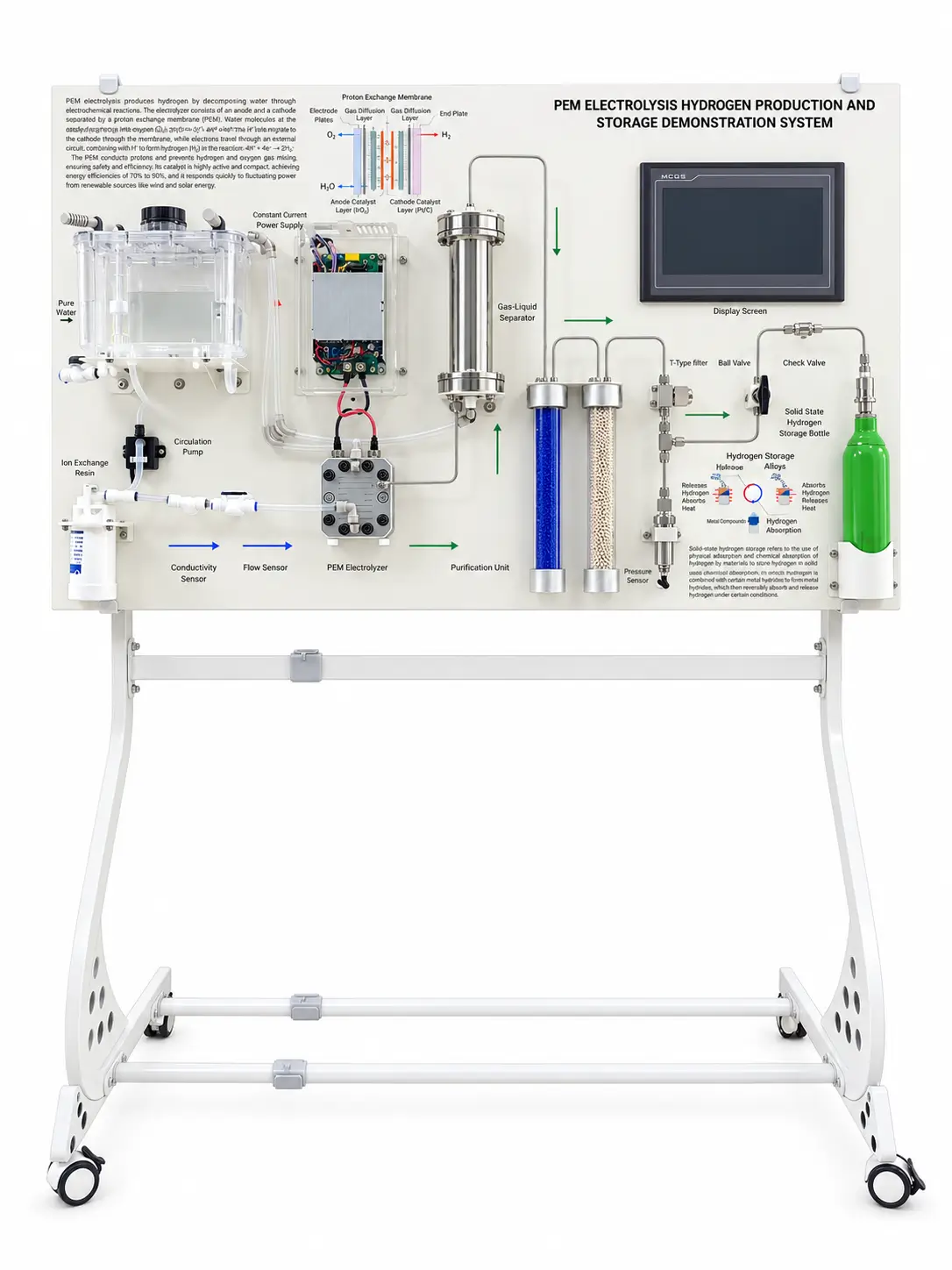
An integrated teaching platform for demonstrating pure-water PEM electrolysis, hydrogen production, gas-liquid separation, hydrogen purification, solid-state hydrogen storage, smart control, and real-time monitoring.
Designed for schools, universities, vocational institutions, and research laboratories to visually demonstrate the complete green hydrogen workflow. Uses pure water, avoiding caustic alkaline solutions, with a touchscreen monitoring interface to help students understand each step of the process.
HYDROGEN EDUCATION PLATFORM
Integrated Platform for PEM Hydrogen Production, Purification and Storage Education
The PEM Water Electrolysis & Hydrogen Storage Demonstration System is an integrated teaching device designed to help students understand how hydrogen is produced from pure water, separated, purified, monitored, and stored through solid-state hydrogen storage technology.
Complete Hydrogen Workflow
Shows the process from pure water circulation and PEM electrolysis to hydrogen purification and solid-state storage.
Visual Teaching Layout
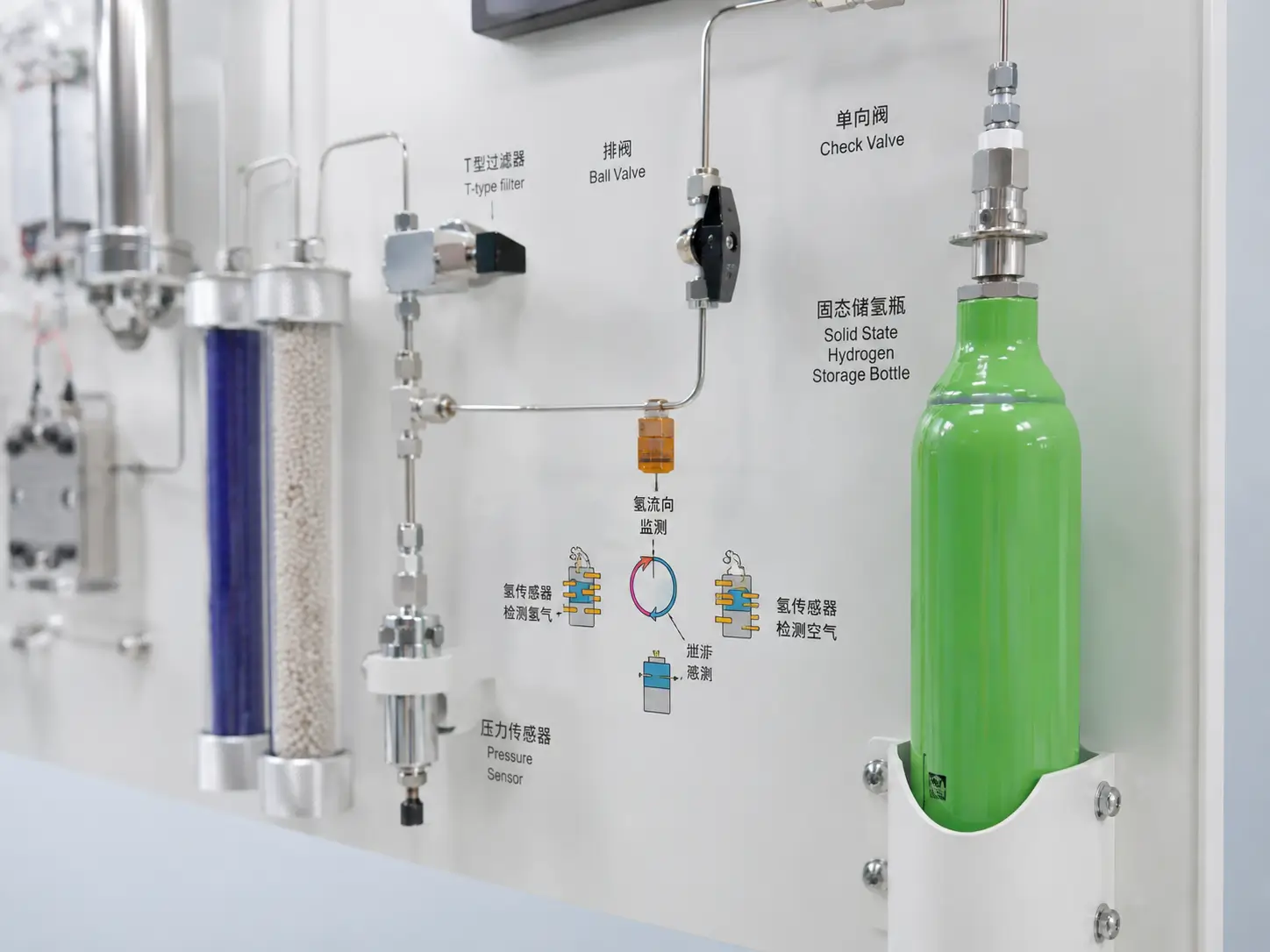
Open panel design, transparent components, labeled modules, and process arrows make the chain easier to observe.
Real-Time Monitoring
Conductivity, water flow, voltage, current, pressure, and liquid level displayed through the touchscreen interface.
Built for Teaching
Supports classroom demonstrations, segmented experiments, hydrogen production analysis, and student lab reports.
How the Demonstration System Works
Designed to visually demonstrate the complete hydrogen production and storage process from pure water supply to solid-state hydrogen storage.
Pure Water Prep
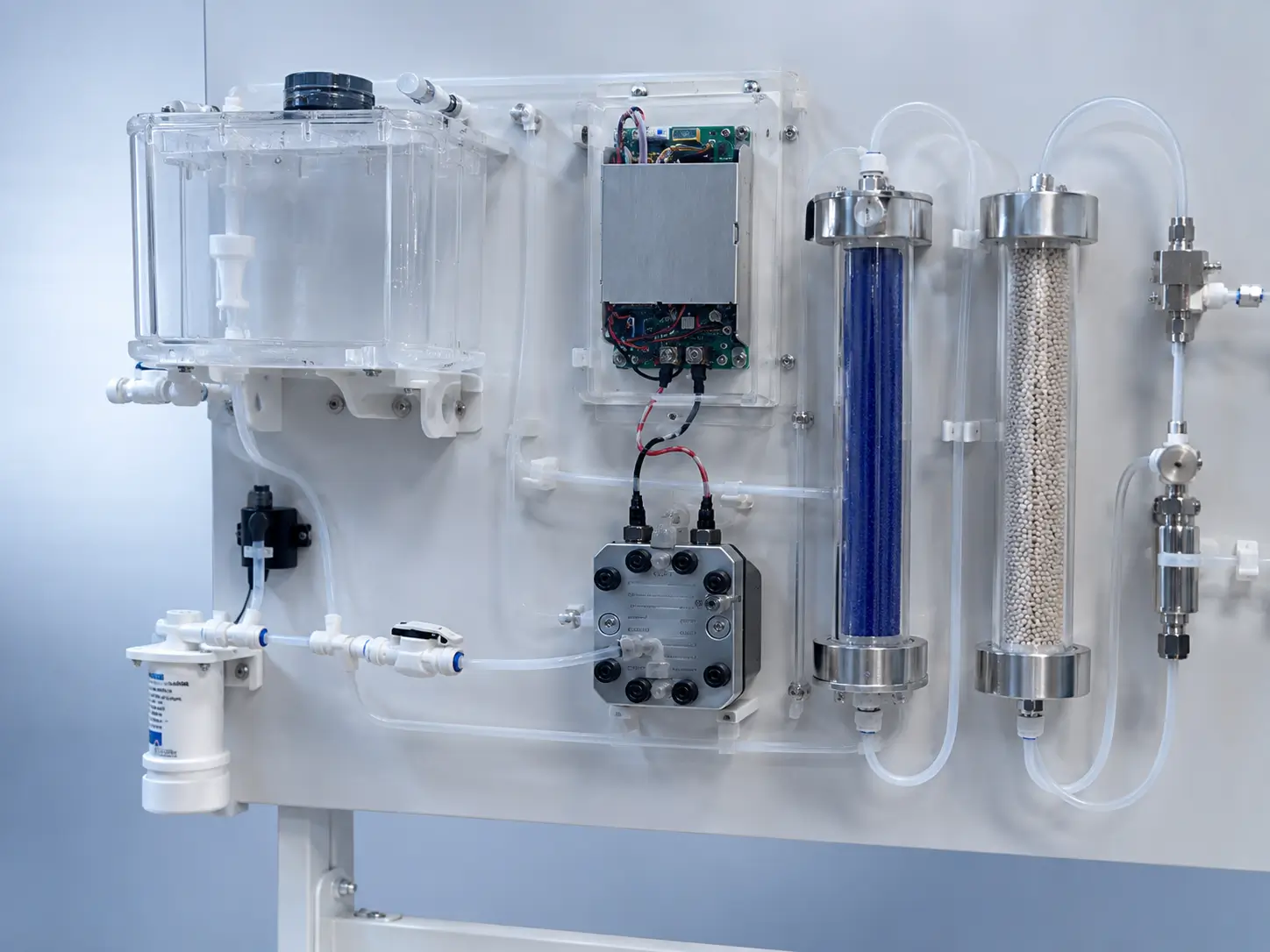
Deionized water tank stores high-purity water. Resin filter removes impurities.
Circulation
Pump supplies feed water. Conductivity and flow sensors monitor quality.
PEM Electrolysis
Generates H₂ and O₂ without alkaline mist. H₂ output > 500 mL/min.
Separation
Gas-water separator separates H₂ from water. Water recirculates.
Purification
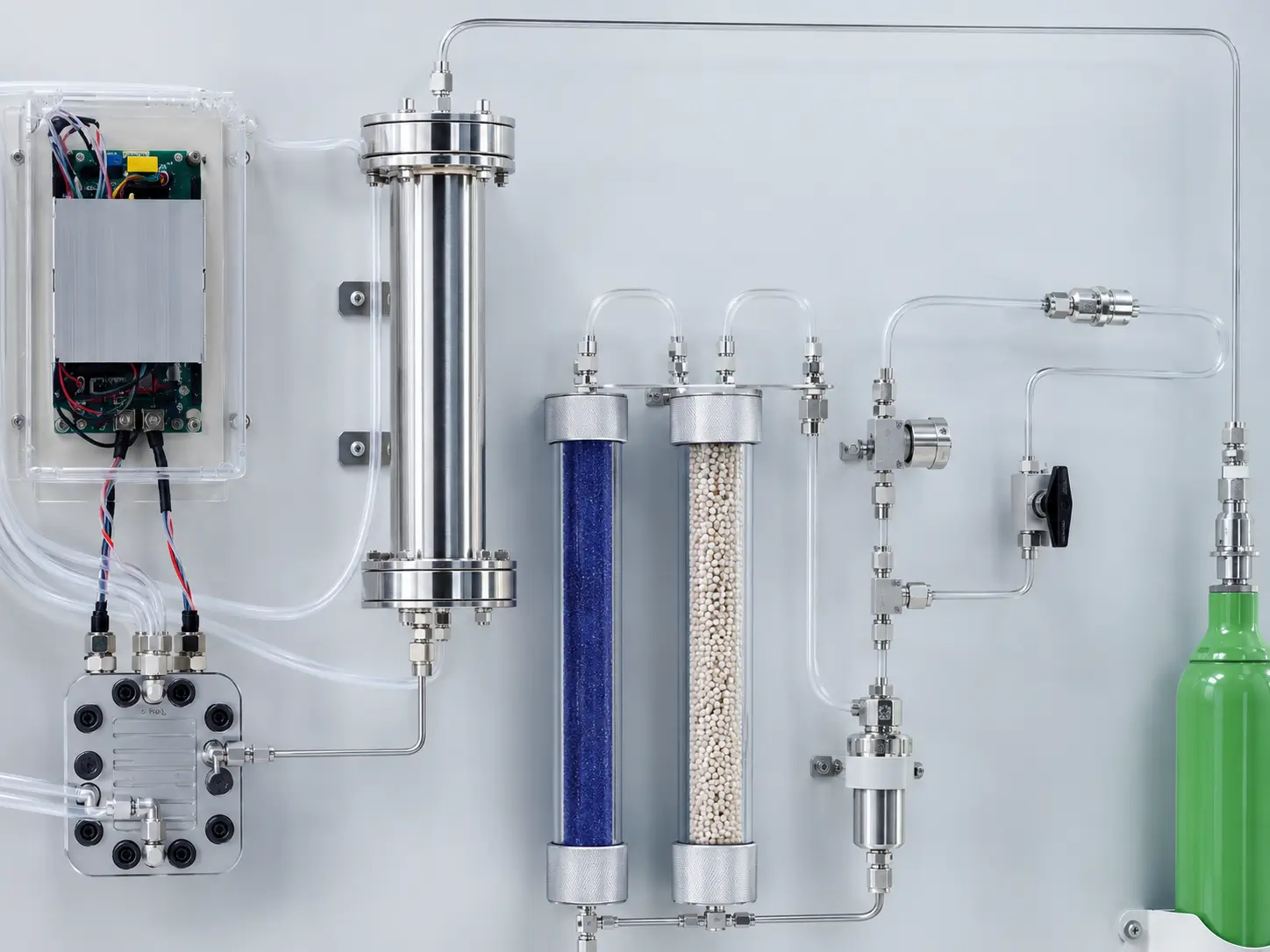
Silica gel and molecular sieve remove moisture and trace impurities.
Solid Storage
Purified H₂ enters hydride-based cylinder with low-pressure storage.
Smart Control
Siemens PLC and MCGS touchscreen support automatic control and data display.
Core Modules & Features
The demonstration system integrates water circulation, PEM hydrogen production, gas-liquid separation, hydrogen purification, solid-state storage, intelligent control, and real-time monitoring into one educational platform.
Pure Water Circulation Unit
- Deionized water tank stores high-purity water for PEM electrolysis.
- Water pump supplies feed water to the electrolyzer and helps remove reaction heat.
- Resin filter absorbs metal ions and impurities from the water.
- Conductivity sensor monitors water purity in real time.
- Flow sensor monitors circulation flow and sends data to the touchscreen.
PEM Electrolyzer & Power Supply
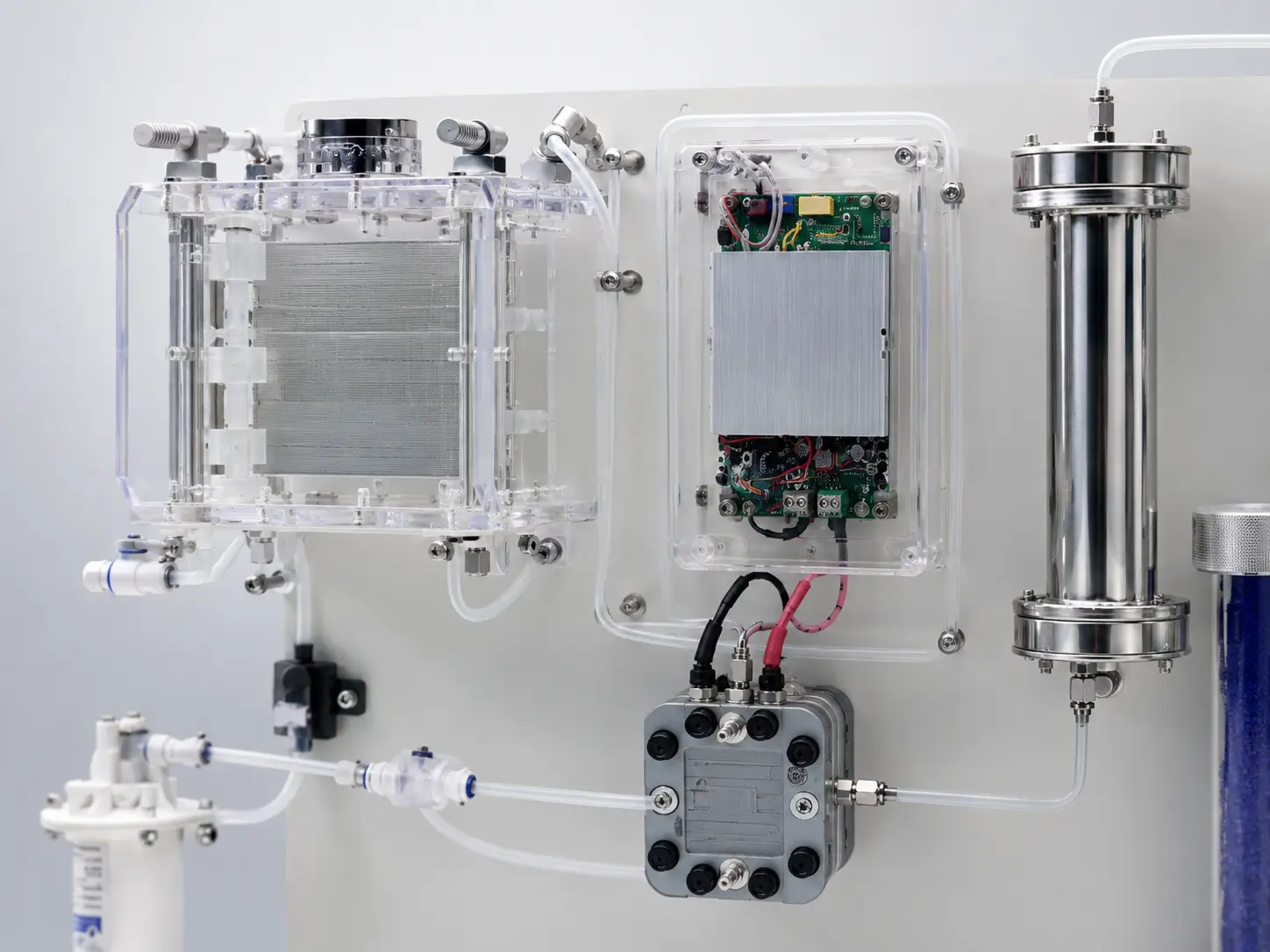
- PEM electrolyzer uses pure water to directly separate hydrogen and oxygen.
- No caustic alkaline solution is required in normal operation.
- Hydrogen output exceeds 500 mL/min, Oxygen approx 250 mL/min.
- Constant current power supply supports AC 110V / 220V input and DC 12V, 25A output.
Gas-Liquid Separation & Purification Unit
- Gas-water separator separates hydrogen gas from liquid water.
- Color-change silica gel column adsorbs moisture and provides visible saturation indication.
- Molecular sieve column provides deeper purification to remove residual moisture.
- T-type filter captures particles and dust; Pressure sensor monitors real-time pressure.
Solid-State Hydrogen Storage & Safety
- Hydride-based hydrogen cylinder stores hydrogen in solid-state material.
- Storage pressure is below 1.6 MPa, enhancing classroom safety.
- Hydrogen capacity is more than 22 g, approximately 246 L hydrogen.
- Ball valve and check valve help prevent backflow; supports fuel cell demonstrations.
Intelligent Control & Monitoring Unit
- Siemens S7-200 SMART PLC enables automatic system start / stop and fault alarms.
- MCGS touchscreen displays key data (conductivity, flow rate, pressure, liquid level, etc.).
- Integrated panel design uses process arrows and clear labels to show the full chain.
- Corrosion-resistant panel layout supports repeated teaching demonstrations
Technical Specifications
The following parameters help schools, laboratories, and training centers evaluate whether the demonstration system matches their teaching and experiment requirements.
| Component | Parameter | Unit | Value |
|---|---|---|---|
| PEM Electrolyzer | Hydrogen Output | mL/min | 500 |
| PEM Electrolyzer | Oxygen Output | mL/min | 250 |
| PEM Electrolyzer | Voltage | V | 9 |
| PEM Electrolyzer | Current | A | 25 |
| PEM Electrolyzer | Dimensions without terminals | mm | 94 × 39 × 106 |
| PEM Electrolyzer | Dimensions with terminals | mm | 109 × 58 × 106 |
| Hydrogen Storage Tank | Diameter | mm | 60 |
| Hydrogen Storage Tank | Height | mm | 258 |
| Hydrogen Storage Tank | Weight | kg | 1.5 |
| Hydrogen Storage Tank | Hydrogen Capacity | g | >22 |
| Hydrogen Storage Tank | Approximate Hydrogen Volume | L | ≈246 |
| Hydrogen Storage Tank | Charging Pressure | MPa | 1.0 |
| Hydrogen Storage Tank | Discharge Pressure | MPa | 0.6 |
| Hydrogen Storage Tank | Maximum Storage Pressure | MPa | <1.6 |
| Hydrogen Storage Tank | Discharge Rate | L/min | >4 |
| Power Supply | Input | AC | 110V / 220V |
| Power Supply | Output | DC | 12V, 25A |
| Control System | PLC | - | Siemens S7-200 SMART PLC |
| Display Interface | Touchscreen | - | MCGS touchscreen |
| Monitoring Data | Display Items | - | Conductivity, flow rate, liquid level, voltage, current, hydrogen pressure, alarm inquiry |
Real-Time Display and Monitoring Interface
The MCGS touchscreen interface allows teachers and students to monitor key operating data during PEM electrolysis, gas purification, hydrogen storage, and laboratory demonstration. It supports classroom demonstrations, experiment recording, alarm review, and performance analysis.
Why This System Works Well for Teaching
Designed not only to show PEM water electrolysis, but also to help students observe, measure, calculate, and understand each key step in the green hydrogen production and storage process.
Visualized Full Process
Each step is labeled and explained on the panel. Transparent components allow students to observe water circulation, gas-liquid separation, purification, and storage processes directly.
Connect theoretical electrochemistry with visible system operation.
Modular Experiment Support
Components can be operated and observed as functional modules. Supports segmented experiments such as purification efficiency, storage capacity, and hydrogen production rate analysis.
Build structured laboratory activities around hydrogen generation.
Quantified Data for Lab Reports
Real-time data such as current, voltage, water quality, flow rate, and hydrogen pressure help students calculate and analyze energy conversion efficiency and performance.
Record measurable data and complete practical engineering reports.
Research Capability for Laboratory Projects
In addition to classroom demonstration, the system can support basic research and student innovation projects related to PEM electrolysis, hydrogen storage, renewable energy integration, and system performance testing.
Voltage & Current Influence
Support experiments showing how voltage and current affect hydrogen production rate, energy conversion, and operating response.
Hydrogen Storage Material Testing
Helps students understand metal hydride hydrogen storage principles, pressure behavior, and hydrogen release characteristics.
Renewable Hydrogen Integration
Expansion ports can support simulated photovoltaic or wind power input for building a complete green energy experiment platform.
System Performance Testing
Observe conductivity, flow rate, hydrogen pressure, gas purification, and storage behavior as part of system performance analysis.
Recommended Applications
Suitable for teaching, laboratory experiments, and entry-level research related to PEM electrolysis, hydrogen production, hydrogen storage, electrochemistry, automation, and renewable energy systems.
Chemistry Laboratories
Used for explaining electrolysis principles, gas separation, catalyst concepts, conductivity control, and purification.
Classroom demo, electrochemistry
New Energy Education
Used for demonstrating green hydrogen production, hydrogen storage, renewable energy conversion, and utilization.
Hydrogen courses, renewable training
Energy & Automation
Used for teaching PEM electrolysis systems, smart control, sensor monitoring, PLC operation, and system automation.
Engineering training, PLC courses
Research & Innovation
Used for hydrogen process optimization, storage material development, performance testing, and renewable integration.
Lab research, student projects
Safety-Oriented Design for Classroom Use
Hydrogen education requires careful system design and controlled operation. This demonstration system integrates low-pressure solid-state storage, pure water electrolysis, control logic, sensors, and protective components to support safer teaching and laboratory use according to classroom operation requirements.
1. Pure Water Electrolysis
Uses pure water and avoids caustic alkaline solution during normal operation, helping keep the laboratory environment cleaner.
2. Low-Pressure Storage
The hydride-based cylinder stores hydrogen at less than 1.6 MPa, helping reduce risks associated with high-pressure gas storage.
3. Pressure Monitoring
The pressure sensor monitors hydrogen pressure in real time and supports safety observation during experiments.
4. Valve Protection
Ball valve, solenoid valve, check valve, and pressure regulation components help control flow and reduce backflow risk.
5. Purification & Filtration
Silica gel, molecular sieve, and T-type filter help remove moisture, particles, and trace impurities safely.
6. PLC Fault Alarm Support
Siemens SMART PLC supports automatic operation, start / stop control, and fault alarm logic to help reduce risk.
Included Educational Resources & Service Support
The system can be supplied with teaching resources and technical support to help instructors explain PEM electrolysis principles, system operation, and experiment design.
Experiment Manual
Includes step-by-step experiment instructions, operation guidance, and teaching support for laboratory courses.
Principle Materials
Includes 3D animation video of PEM principles and demonstration guidance for hydrogen production and storage.
After-Sales Support
1-year warranty for key components, lifetime technical consultation, and remote guidance for product operation.
Customization
Custom flow rate review, solar/wind integration, panel language review, and tailored teaching packages.
What to Confirm Before Ordering
To recommend the most suitable configuration, please confirm your teaching environment, laboratory setup, and technical requirements.
PEM Water Electrolysis & Hydrogen Storage Demonstration System FAQ
What is the PEM Water Electrolysis & Hydrogen Storage Demonstration System used for?
Who is this system suitable for?
What is the hydrogen output of the PEM electrolyzer?
What power supply does the system use?
What hydrogen storage method does the system use?
What data can be monitored on the display?
Can the system support laboratory experiments?
Can the system connect with solar or wind simulation?
Request Details for the PEM Water Electrolysis & Hydrogen Storage Demonstration System
Tell us your teaching application, institution type, required quantity, destination country, power supply condition, documentation needs, and optional add-on requirements. Hele Titanium will help provide suitable product details and quotation support.
- Integrated PEM Water Electrolysis Teaching Platform
- Hydrogen Production, Purification and Storage Demonstration
- 500 mL/min Hydrogen Output and Solid-State Storage
- Factory-Direct Product Supply and Documentation Support
sales@heletitanium.com
Room 1206, Building 1, Huaxia Yue World