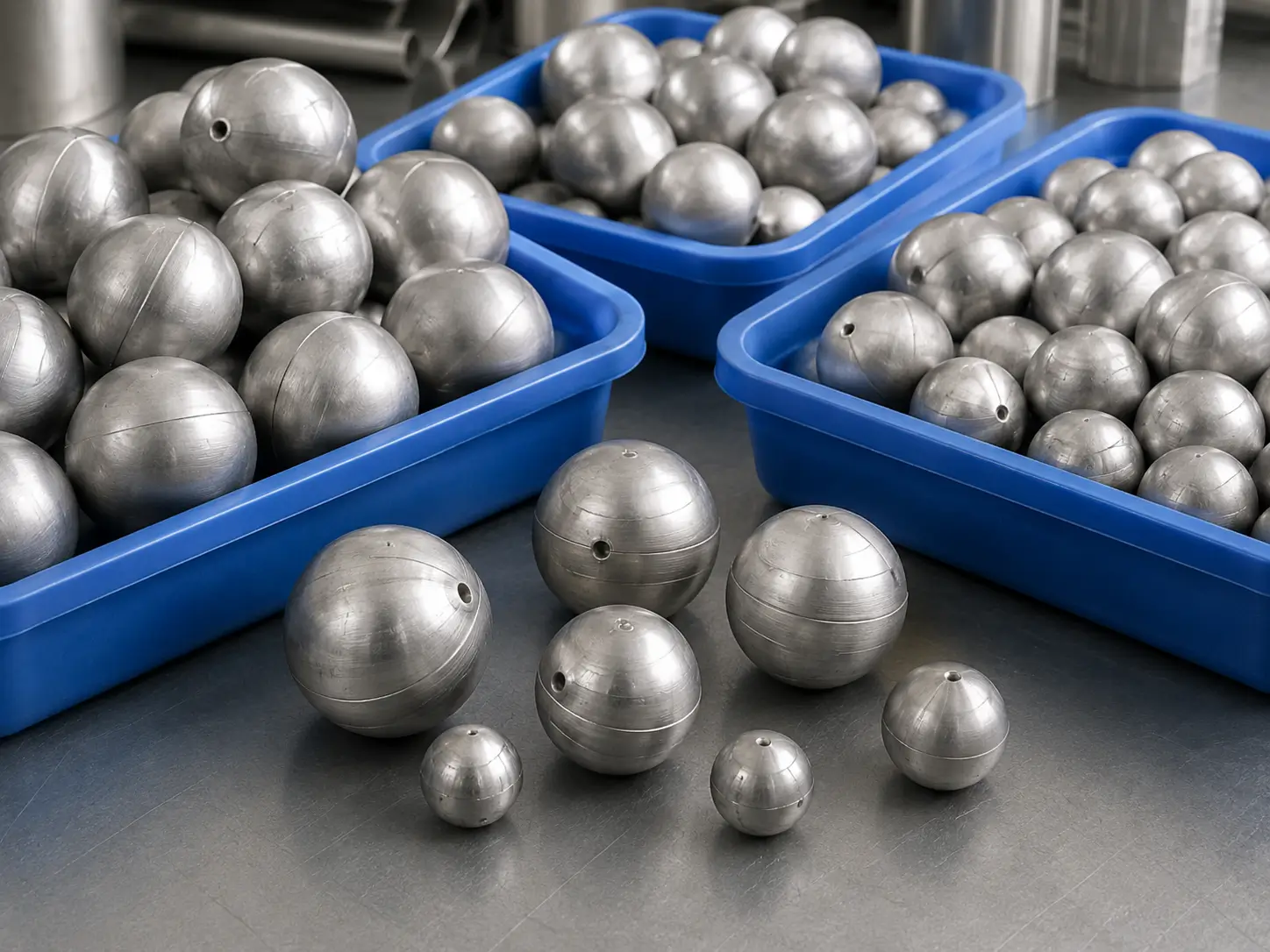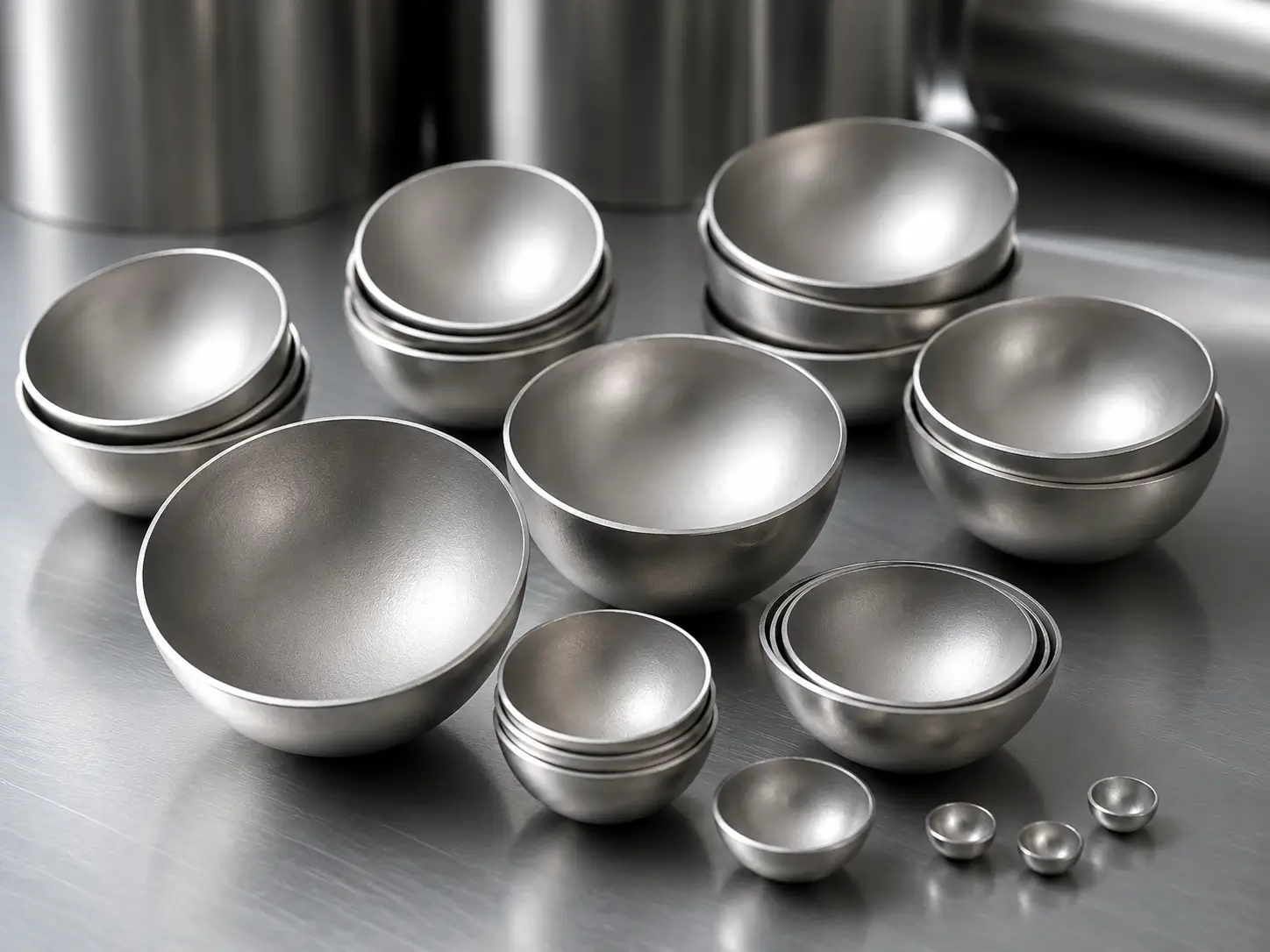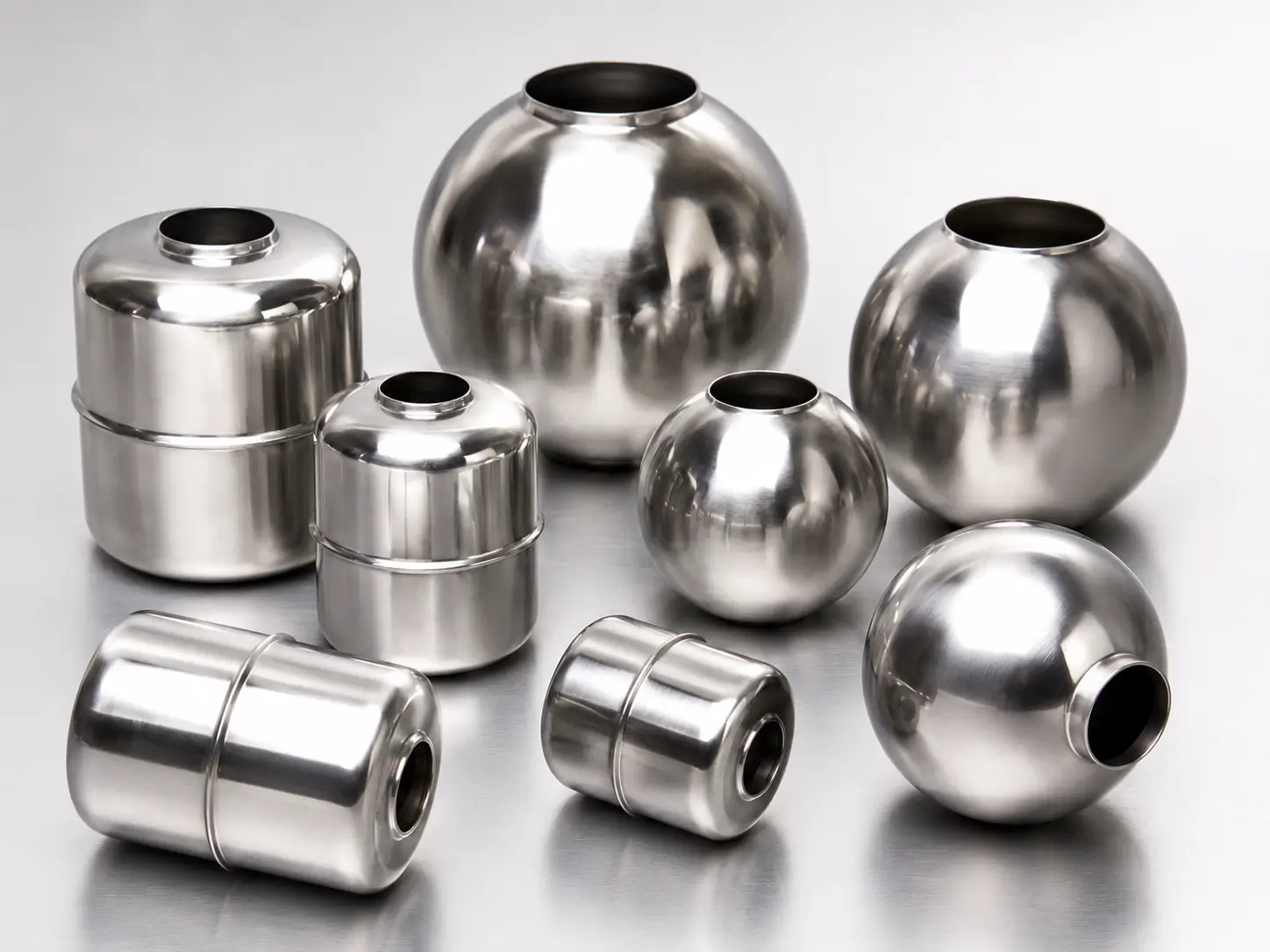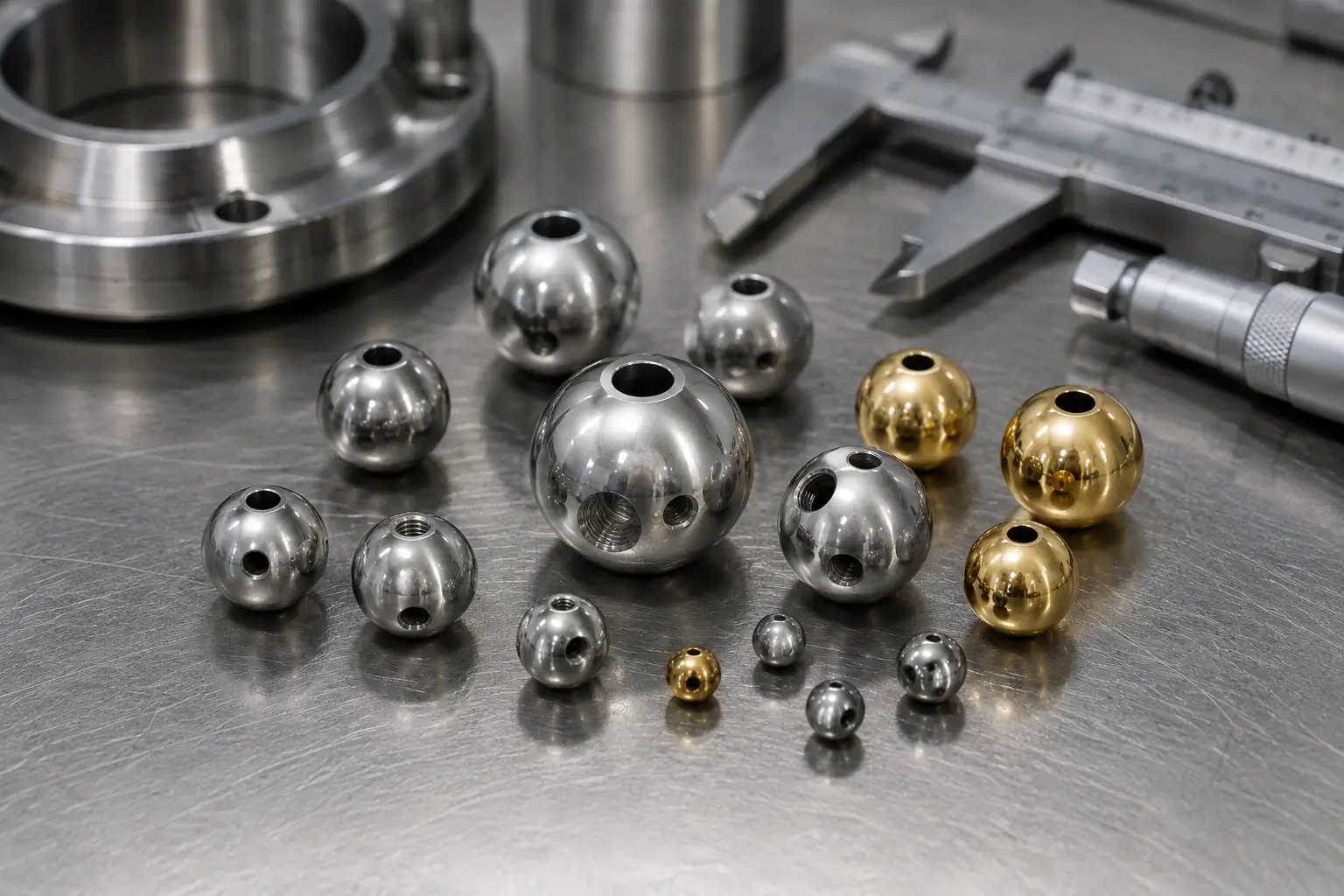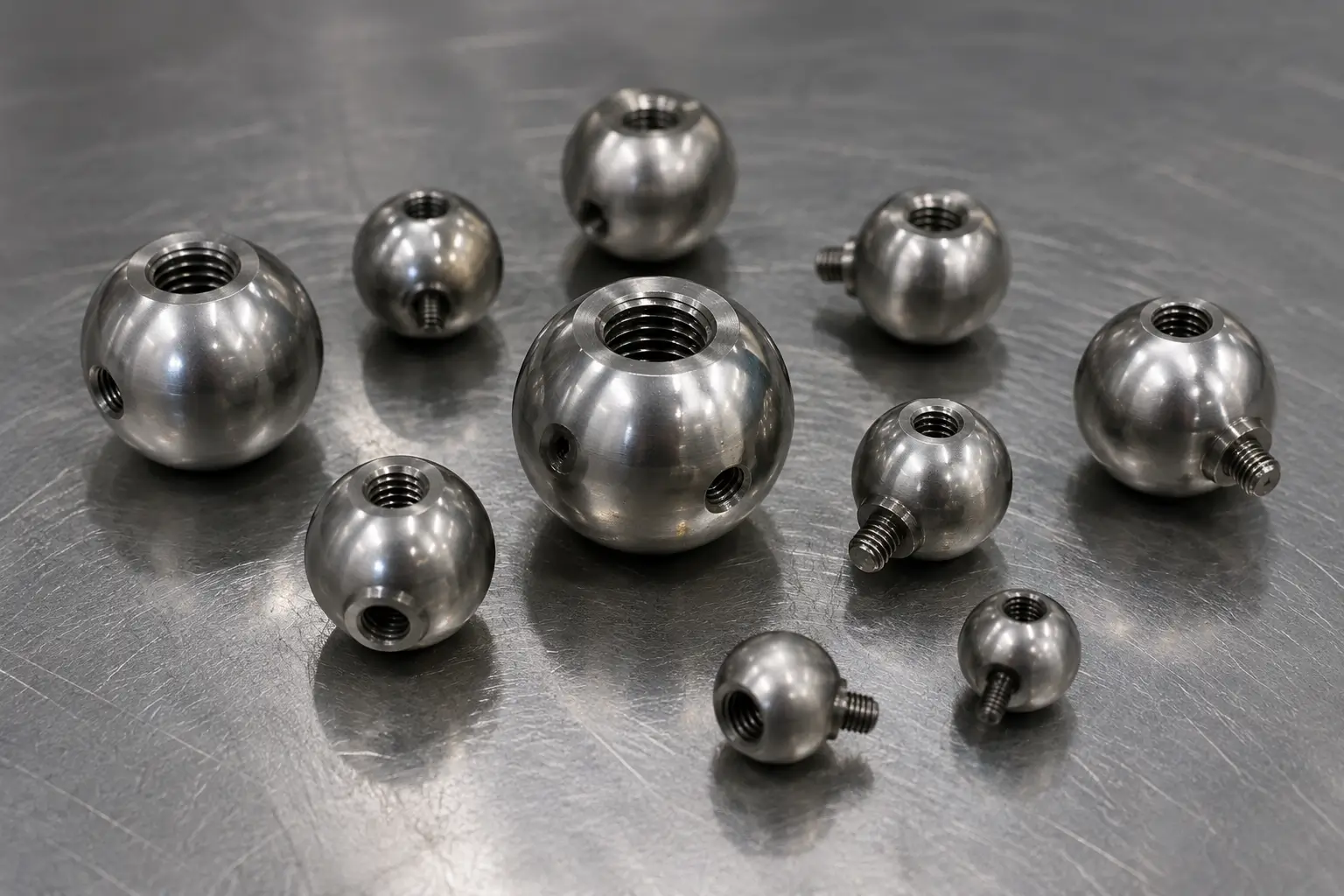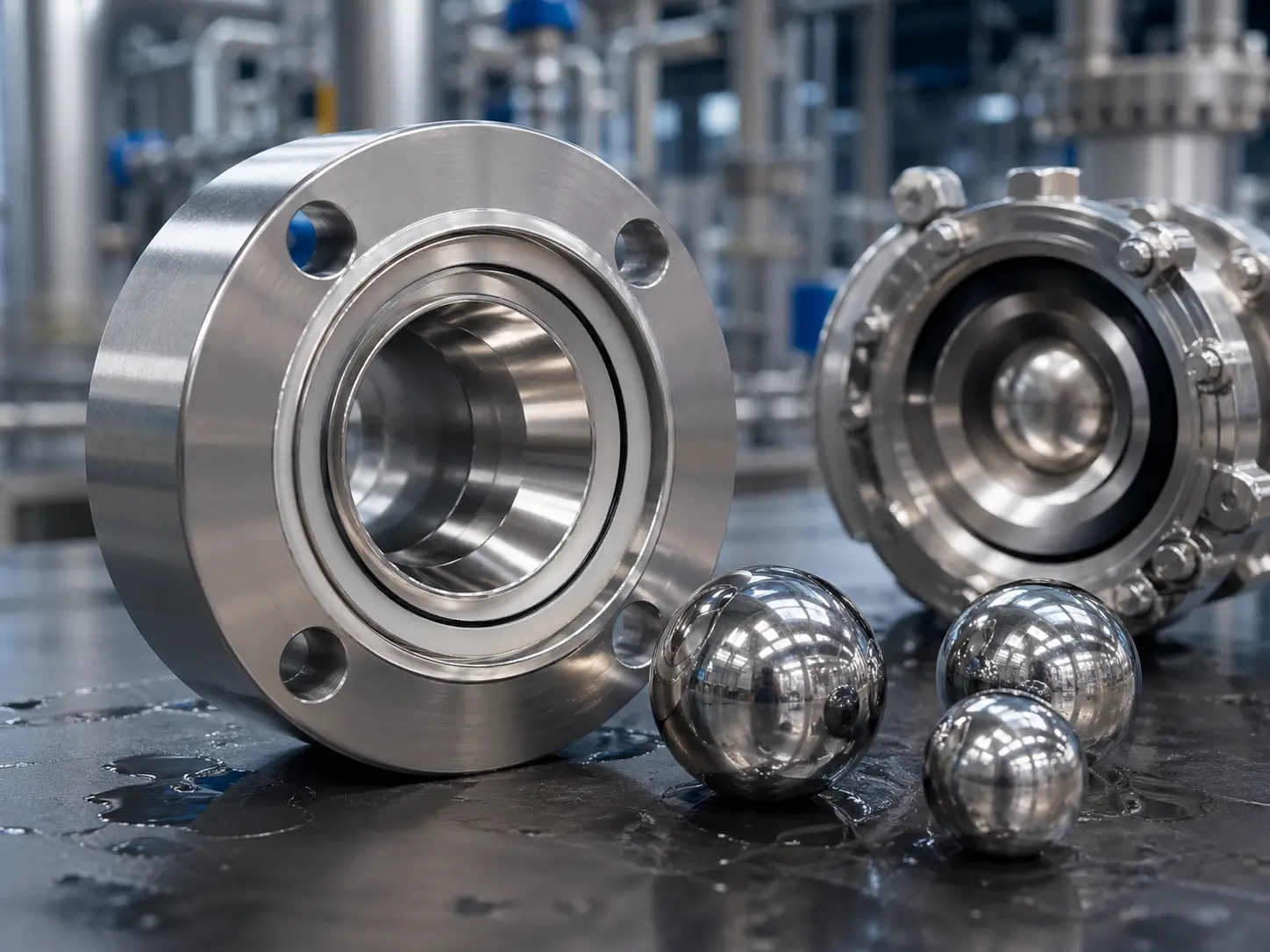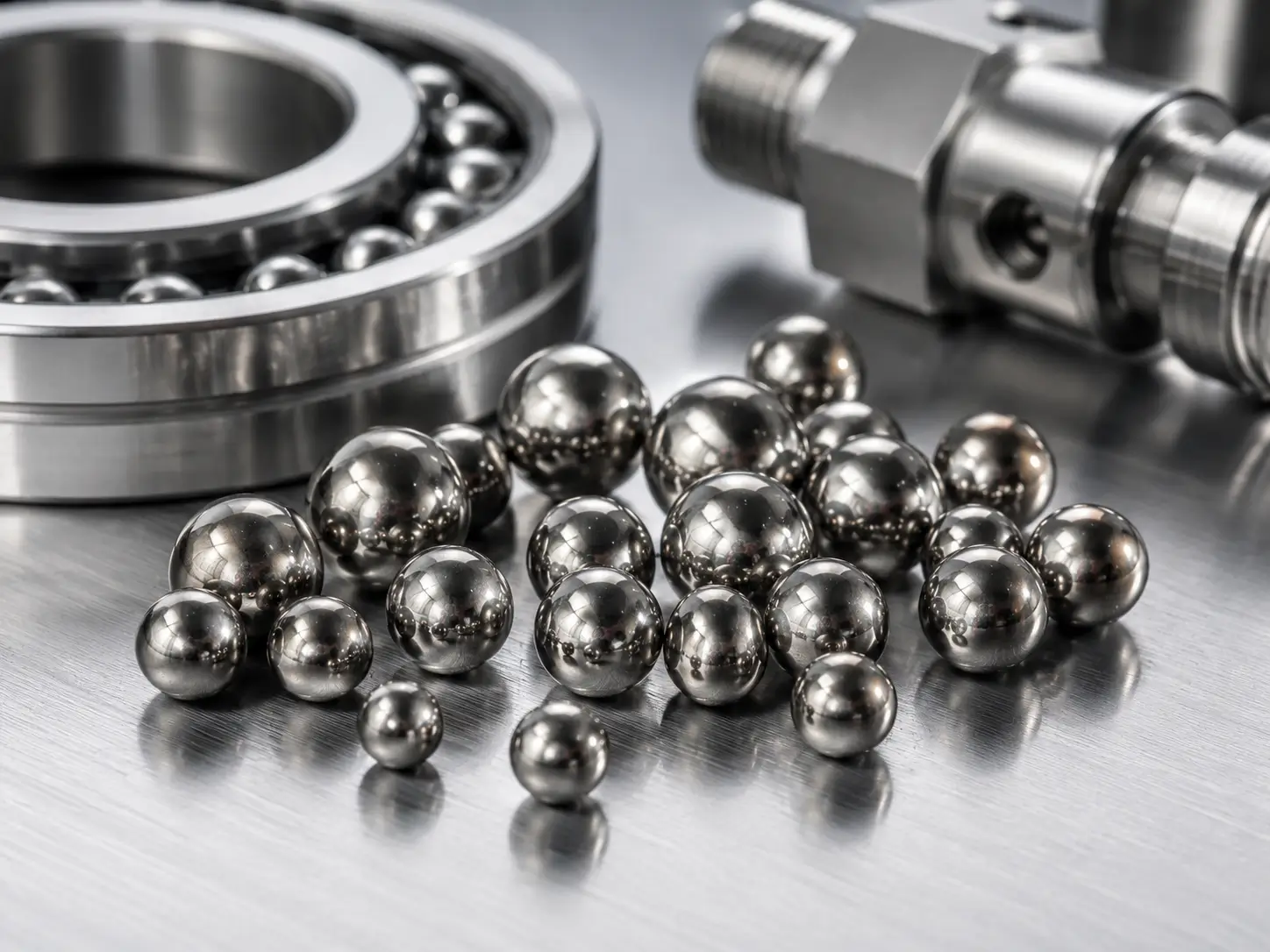
Custom titanium balls and spheres manufactured in solid, hollow, drilled, threaded, polished, and precision-machined forms for industrial, aerospace, medical, marine, chemical, and OEM applications.
Grade 2 & Grade 5 Titanium
Solid & Hollow Options
Custom Diameters
Precision Machining
Inspection Support
Titanium Balls & Spheres
Titanium Balls & Spheres for Precision and Engineering Applications
The right sphere structure supports fit and function. The right material grade improves performance and service reliability.
Titanium ball and sphere selection depends on titanium grade, diameter, tolerance, roundness, sphericity, wall thickness, surface finish, machining features, inspection requirements and documentation.
Hele Titanium supplies solid titanium balls, hollow titanium spheres, titanium hemispheres, drilled titanium balls, threaded titanium spheres, polished titanium balls and custom-machined titanium spherical components with grade selection, drawing review, machining, surface finishing, inspection, traceability and export documentation support according to project requirements.
Review Grade 2, Grade 5, Grade 7, Grade 9, Grade 12 and other titanium grades according to corrosion resistance, strength, weight, machining and application needs.
Custom Machining Support
Support drilling, threading, polishing, forming, machining, diameter control and drawing-based titanium sphere fabrication when applicable.
Inspection & Documentation
MTC, heat number traceability, diameter checks, roundness inspection, surface inspection and export documents can be supported when required.
Titanium ball and sphere selection depends on titanium grade, diameter, solid or hollow structure, wall thickness, tolerance, roundness, surface finish, machining features, inspection requirements and delivery conditions.
1
Confirm Ball or Sphere Type
Identify the required form such as solid titanium ball, hollow titanium sphere, titanium hemisphere, drilled ball, threaded sphere, polished ball or custom-machined spherical component.
2
Define Diameter & Structure
Confirm outer diameter, wall thickness for hollow spheres, solid or hollow structure, hemisphere requirement, hole size, thread size and drawing-based dimensions.
3
Match Grade to Application
Review titanium grade options such as Grade 2, Grade 5, Grade 7, Grade 9 or Grade 12 according to corrosion resistance, strength, weight, machining performance and application needs.
4
Confirm Tolerance & Roundness
Define diameter tolerance, roundness, sphericity, concentricity, surface finish and machining allowance according to assembly, sealing, fitting or functional requirements.
5
Specify Processing & Inspection Requirements
Confirm drilling, threading, polishing, forming, machining, dimensional inspection, surface inspection, roundness inspection and documentation requirements when needed.
6
Prepare Packing & Delivery Needs
Define quantity, product labels, protective packing, packing list, export documentation, delivery destination and any project-specific shipment requirements with your titanium balls and spheres supplier.
Need help selecting the right titanium ball or sphere for your project?
Custom Titanium Ball Manufacturing
Custom Titanium Balls & Spheres for Drawings, Samples and Project Requirements
Beyond standard titanium balls and spheres, Hele Titanium supports custom titanium ball manufacturing for solid balls, hollow spheres, hemispheres, drilled balls, threaded spheres, polished balls and drawing-based spherical components according to application, tolerance, surface finish and inspection requirements.
Manufacturing Note
Final manufacturing capability should be reviewed according to titanium grade, diameter, wall thickness, tolerance, roundness, sphericity, hole or thread requirement, surface finish, inspection scope, quantity and delivery schedule.
Drawing & Requirement Review
Diameter, tolerance, roundness, sphericity, wall thickness, hole size, thread features, surface finish, quantity and application conditions can be reviewed before titanium ball or sphere production.
Material Grade Confirmation
Grade 2, Grade 5, Grade 7, Grade 9, Grade 12 or project-specific titanium alloys can be reviewed according to strength, corrosion resistance, weight, machining and documentation needs.
Manufacturing Route Planning
Solid titanium balls, hollow titanium spheres, hemispheres, drilled balls, threaded spheres, welded spheres, polished balls and custom-machined spherical components can be reviewed based on drawings or samples.
Machining & Feature Support
Drilling, threading, turning, polishing, trimming, forming, welding and custom feature machining can be supported when applicable according to design and tolerance requirements.
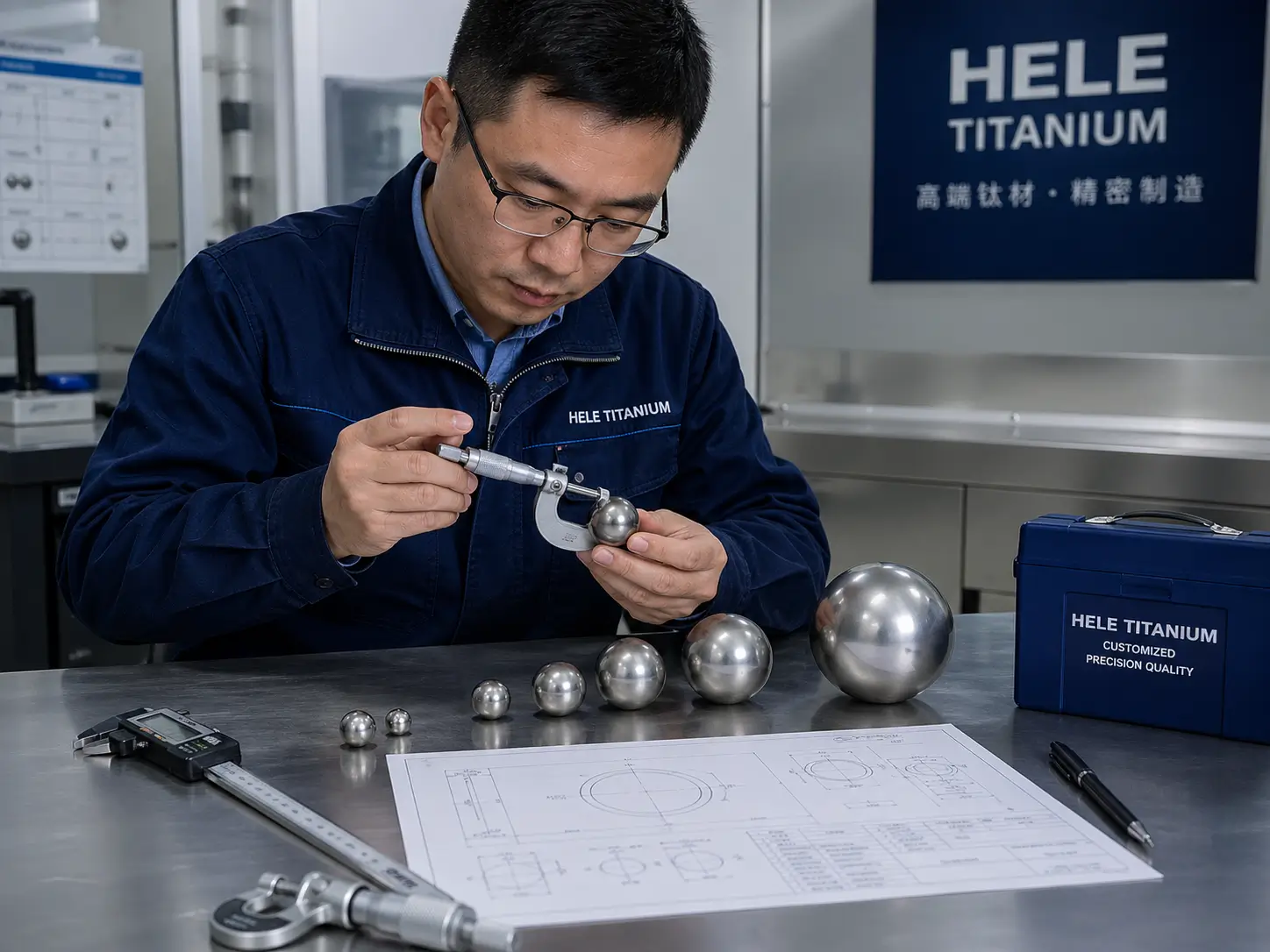
Inspection & Dimensional Control
Diameter inspection, roundness inspection, sphericity review, wall thickness check, hole or thread inspection and surface condition review can be arranged according to the agreed inspection scope.
Packing & Documentation
Material certificates, heat number traceability, inspection records, product labels, protective packing, packing list and export documentation can be prepared according to order requirements.
Designed for OEM manufacturing, precision components, valve and pump parts, lightweight assemblies, chemical equipment, marine hardware, aerospace-style components, electrochemical equipment and custom industrial titanium sphere projects.
QUALITY CONTROL
Quality Control for Precision Titanium Balls & Spheres
Inspection-Driven Quality for Precision Applications
Titanium ball quality depends on material grade, diameter accuracy, roundness, sphericity, surface roughness, hole or thread accuracy, visual surface condition, and final documentation. Hele Titanium can review inspection scope according to drawing, application, tolerance requirement, surface finish, and order documentation needs.
Material Grade Verification
Titanium grade, heat number, material certificate, and alloy compliance can be reviewed according to order and project requirements.
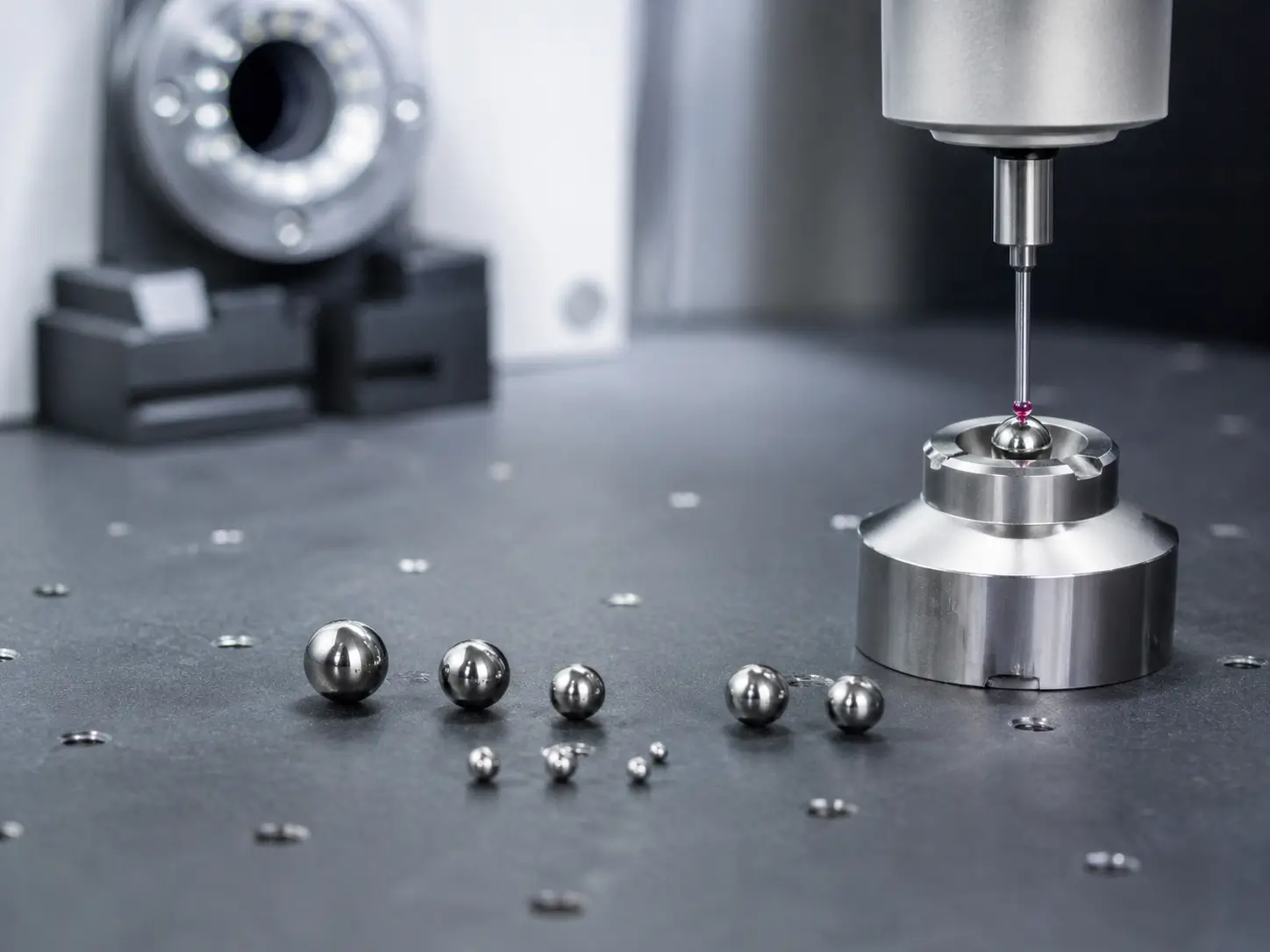
Diameter Inspection
Ball diameter and dimensional tolerance can be measured against drawings, samples, tolerance class, or project-specific specifications.
Roundness & Sphericity Inspection
Roundness, sphericity, and geometric consistency can be reviewed for precision machinery, valve, aerospace, medical, and OEM applications.
Surface Roughness & Finish Review
Surface roughness, polishing quality, machined finish, brushed finish, matte finish, or application-specific finish can be checked when required.
Hole & Thread Inspection
Drilled holes, blind holes, through holes, threaded features, countersinks, alignment, depth, and thread quality can be inspected according to drawings.
Visual Surface Inspection
Surface scratches, pits, dents, discoloration, machining marks, polishing defects, and visible surface flaws can be reviewed before packing.
Documentation & Shipment Support
Available Shipment Documents & Packing Support
Documentation and packing requirements for titanium balls and spheres may vary by titanium grade, diameter, wall thickness, hollow or solid structure, tolerance, surface condition, inspection level, order scope and destination. The following records and shipment support can be prepared according to project requirements.
Material Certificate / MTC
Material certificate support can be provided when applicable based on titanium grade, product form, diameter, forming method and order requirements.
Heat Number & Batch Traceability
Heat number, batch traceability information, product labels and material references can support tracking from raw material preparation to finished titanium ball or sphere shipment.
Dimensional Inspection Records
Diameter, wall thickness, roundness, edge condition, forming tolerance and drawing-based dimensions can be inspected and recorded according to agreed specifications or order requirements.
Surface Condition Records
Surface condition, dents, scratches, cracks, cleanliness and visible defects can be reviewed according to application, finishing requirement and inspection scope.
Export-Grade Protective Packing
Titanium balls, hollow spheres, hemispheres and formed components can be packed with separation materials, protective wrapping, cartons, pallets, wooden cases or custom export packing to reduce surface damage during shipment.
Document Note:
Final document scope should be confirmed according to titanium grade, diameter, wall thickness, product structure, drawing tolerance, surface condition, order standard, inspection level, destination country and customer requirements.
Hele Titanium can support titanium balls and spheres shipment documents, traceability records, product labels and export packing according to order requirements.
Application-Based Titanium Ball Selection Guide
Different applications require different titanium grades, ball structures, tolerances, surface finishes, and inspection requirements. Use this guide to match titanium balls and spheres with your operating environment and engineering needs.
Valve & Flow Control Systems
Titanium balls can support corrosion-resistant flow control in chemical, marine, and industrial fluid systems.
Weight reduction, strength, tolerance, inspection documentation, and drawing-based machining.
Level Measurement & Instrumentation
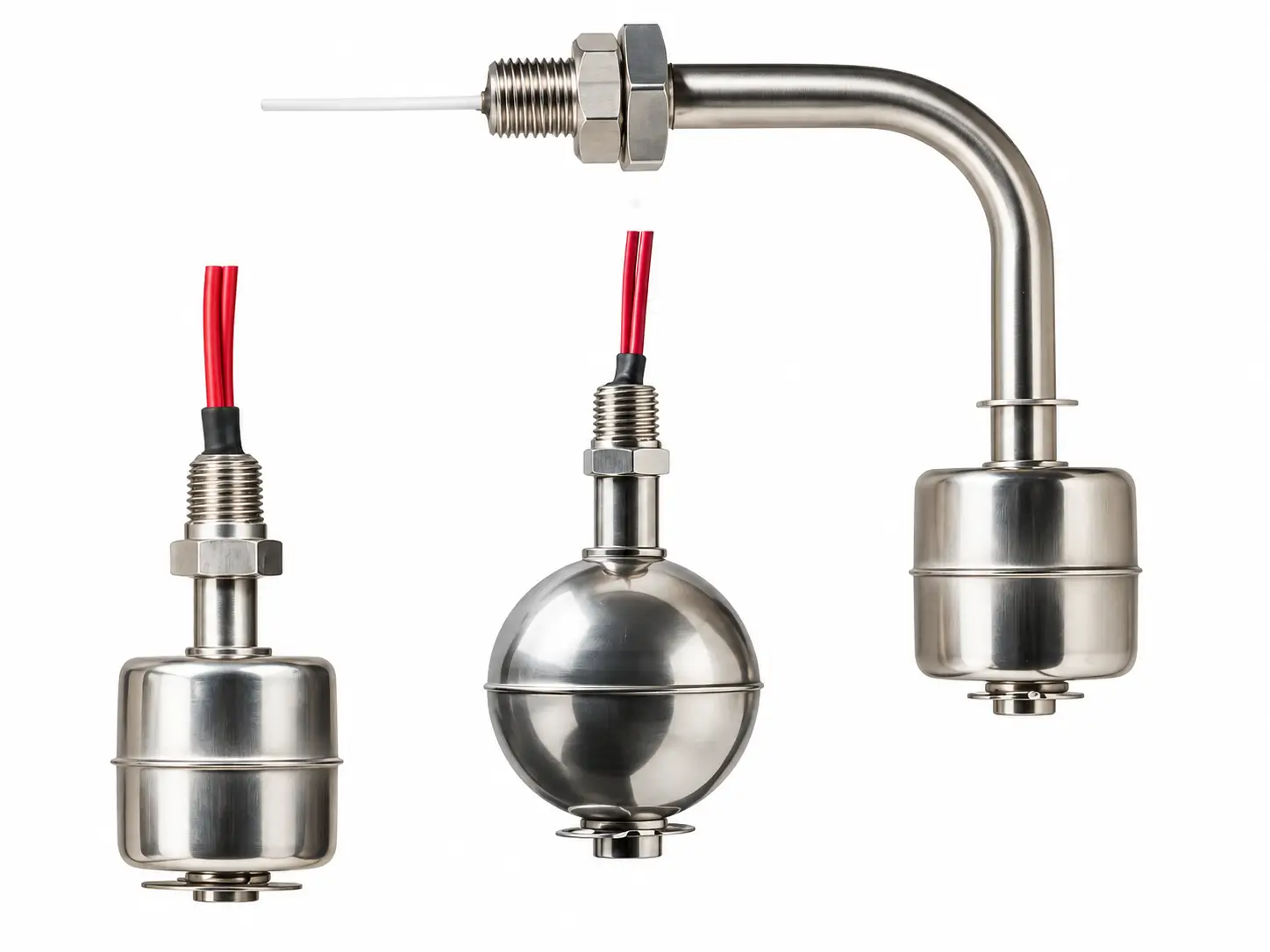
Sealed titanium hollow float balls and magnetic float assemblies can be reviewed for magnetic level gauges, float level transmitters, float level switches, and other corrosion-resistant liquid level measurement applications..
Not sure which titanium grade, structure, or finish is suitable? Share your application and our team can help review the right titanium ball configuration.
MATERIAL SELECTION GUIDE
Common Titanium Grades We Support
Hele Titanium offers a wide range of commercially pure titanium and titanium alloy grades. The table below shows commonly selected grades and their typical applications for industrial, OEM, machining, marine, chemical, energy, medical and aerospace projects.
Grade
Type
Key Characteristics
Typical Use / Commonly Selected For
Grade 1 / Grade 2
CP Titanium
Commercially Pure Titanium
Excellent corrosion resistance, high ductility, and good weldability.
Chemical processing equipment and piping
Marine equipment and seawater systems
MMO anodes and electrochemical applications
General corrosion-resistant components
Grade 5 / Ti-6Al-4V
Titanium Alloy
Titanium Alloy (α+β)
High strength, good toughness, and excellent fatigue resistance.
Aerospace structures and components
High-strength machining parts
Oil & gas, pumps, valves and fittings
Performance and lightweight components
Grade 7
Pd-enhanced CP Titanium
Commercially Pure Titanium
Enhanced corrosion resistance in reducing and complex chemical media.
Strong corrosion resistance in chemical environments
Heat exchangers, reactors and process equipment
Chlorine, hydrochloric acid and mixed acid systems
Demanding corrosion-resistant components
Grade 9
Ti-3Al-2.5V Alloy
Titanium Alloy (α+β)
Low density, good formability, and moderate strength.
Tubing, heat exchangers and condensers
Lightweight structures
General engineering applications
Applications requiring formability and weight reduction
Grade 12
Ti-Mo-Ni Alloy
Titanium Alloy (β)
Good corrosion resistance and strong suitability for heat exchanger service.
Chemical processing equipment
Heat exchangers and condensers
Seawater and brine applications
Corrosion-resistant industrial systems
Grade 23 / ELI
Medical / High-Purity Alloy
High-Purity Alloy (ELI)
High purity, excellent biocompatibility, and good corrosion resistance.
Medical implants and surgical instruments
High-purity equipment and components
Precision and demanding applications
Projects requiring ELI-grade titanium review
Grade Selection Support
We can review the right grade based on your application, medium and operating conditions.
Material Certificates
MTC and traceability documents can be provided according to project requirements.
Custom Supply
Custom sizes, processing, surface finish and packaging can be reviewed upon request.
Global Delivery
Reliable packing and export documentation support for global shipments.
Note:
The information above is for reference only. Final grade selection should always be reviewed according to project standards, medium, operating conditions, drawings, and documentation requirements.
Why Choose Hele Titanium
Why Partner with Hele Titanium for Titanium Balls & Spheres?
Sourcing precision spheres demands confidence in metrology, process control, and scalable customization. We combine precision engineering with dependable global supply support.
01
Factory-Direct Titanium Manufacturing
Titanium material sourcing, machining, polishing, inspection, and packing are supported through one manufacturing system.
02
Custom Ball & Sphere Capability
Solid balls, hollow spheres, valve balls, drilled balls, threaded balls, hemispheres, and custom spherical components can be produced.
03
Titanium Grade Selection Support
Grade 2, Grade 5, Grade 7, Grade 12, Grade 23, and project-specific materials can be reviewed according to application.
04
Drawing-Based Machining
Custom holes, bores, threads, slots, flats, edges, and assembly features can be machined according to drawings.
05
Inspection & Documentation Support
MTC, dimensional inspection, visual inspection, packing documents, and project-specific QC records can be prepared when required.
06
Global Export Support
Export packing, labeling, shipping documents, and international delivery coordination are available for global buyers.
10+ Years
Titanium industry experience.
Factory Direct Supply
Stable capacity and competitive price.
1000+
Products and specifications.
Full Documentation
MTC, reports and certificates.
Global Delivery
100+ countries and regions.
Professional Support
Quick response and technical review.
Built for Performance. Verified for Safety.
Hele Titanium is committed to providing high-quality titanium products, professional support and reliable delivery for global industrial buyers.
1. Why specify titanium spheres over stainless steel alternatives?
Titanium offers a superior strength-to-weight ratio (roughly 45% lighter than steel), exceptional corrosion resistance in aggressive media (like seawater and chlorides), and excellent biocompatibility. It reduces system inertia in dynamic applications and outlasts stainless steel in harsh chemical environments.
2. Which titanium grades are recommended for different applications?
Grade 5 (Ti-6Al-4V) is optimal for high-load bearings and aerospace. Grade 2 (CP) is standard for chemical valves and general industrial use. Grade 23 (Ti-6Al-4V ELI) is strictly required for medical implants. Grade 7 offers maximum corrosion resistance for highly aggressive fluid control.
3. How are dimensional tolerances defined for your precision spheres?
We adhere to standard AFBMA and ISO 3290 specifications. We can supply precision grades from G10 to G1000, controlling diameter variation, sphericity (roundness), and surface roughness (Ra) depending on your exact sealing or bearing requirements.
4. Are titanium balls suitable for high-corrosion and sensitive environments?
Yes. Titanium naturally forms a stable, protective oxide layer that resists pitting, crevice corrosion, and stress corrosion cracking in seawater, body fluids, and many industrial chemicals, making it ideal for marine, medical, and chemical processing.
5. What are your size and custom-configuration capabilities?
We manufacture diameters ranging from Ø0.5mm to over Ø300mm. Beyond solid spheres, we specialize in hollow floats, CNC drilled through-holes, blind threads, and custom mounting flats designed directly from your OEM drawings.
6. What information is required for an accurate RFQ?
To expedite quoting, please provide: target application, material grade, required diameter, G-grade or acceptable tolerances, surface finish requirements, quantity, and technical drawings if custom modifications (drilling/threading) are needed.
7. How does Hele Titanium ensure cost-efficiency without compromising OEM quality?
As a direct manufacturer, we control the entire process from raw material verification to final precision lapping. By selecting the optimal manufacturing route (heading vs. CNC machining) based on your volume and precision needs, we eliminate middleman markups while enforcing strict in-house metrology.
Inside Our Titanium Ball Manufacturing & Quality System
See how we prepare titanium materials, machine spherical parts, inspect dimensions and surface finish, and pack titanium balls and spheres for global industrial buyers.
See how titanium ball and sphere projects move from material preparation through machining, polishing, inspection, packing, and delivery.
Titanium Material Preparation
CNC Machining & Forming
Polishing & Surface Finishing
Final Packing & Release
A look inside the production areas where titanium balls, hollow spheres, drilled balls, threaded balls, and custom spherical parts are processed.
Titanium Ball Machining Area
Drilling & Threading Process
Polishing Workshop
Custom Sphere Assembly Area
Our inspection process can review material grade, diameter, roundness, surface finish, machining features, and project-specific documentation according to order requirements.
Diameter Inspection
Roundness / Geometry Review
Surface Finish Inspection
Final Visual Inspection
Documentation and traceability are important for titanium balls used in aerospace, marine, chemical, medical research, and OEM industrial applications.
Material Test Certificate Example
Dimensional Inspection Report
Surface Inspection Record
Export & Traceability Documentation
Need production photos, inspection records, MTC, or packing documentation? Contact our team for direct factory support.
Engineering Guide for Custom Titanium Balls & Spheres
Read Time: 15 Minutes
Author: Hele Titanium Engineering Team
Last Updated: 2026
Custom titanium balls and spheres should be specified according to material grade, structure, diameter, tolerance, roundness, sphericity, surface finish, machining features, inspection scope, and documentation needs. This guide helps buyers match titanium spherical components with aerospace, marine, chemical, medical, precision machinery, and OEM application requirements.
Before You Specify Titanium Spheres, Confirm These 3 Critical Parameters
Define the Target Application & Environment:
Is the sphere intended for a high-load bearing, a zero-leak check valve, a biocompatible medical implant, a subsea buoyancy module, or a complex mechanical assembly? Understanding the primary stress factors (corrosion, pressure, wear) is the first step.
Determine Precision & Surface Requirements:
What specific G-grade (precision level), exact diameter, and surface roughness (Ra) are required to meet your performance metrics? Tighter tolerances directly impact both functionality and unit cost.
Specify the Optimal Geometry:
Do your structural requirements call for a solid sphere for maximum strength, a hollow sphere for critical weight reduction, or customized drilled/threaded configurations for immediate integration into your actuator or sensor housing?
1. Comparative Material Analysis: Titanium vs. Alternative Alloys
When engineering critical components, selecting the right base material is paramount. While traditional alloys offer specific benefits, titanium stands out in environments demanding an exceptional strength-to-weight ratio combined with absolute corrosion resistance. Below is a comparative analysis to help you benchmark Titanium Grade 5 against other common industrial sphere materials.
Material
Density (g/cm³)
Corrosion Resistance
Relative Hardness
Magnetic Property
Optimal Use Case
Titanium Grade 5
4.43
Excellent
Medium (~36 HRC)
Non-Magnetic
Aerospace bearings, medical implants
52100 Chrome Steel
7.81
Poor
High (~60 HRC)
Magnetic
Standard heavy-load bearings
Ceramic (Si3N4)
3.20
Exceptional
Very High
Non-Magnetic
Ultra-high speed, extreme wear
Tungsten Carbide
14.95
Good
Extreme
Slightly Magnetic
High impact, abrasive environments
2. Structural Configurations & Geometries
Engineered for versatility and precision, our titanium spheres are available in specialized configurations to solve complex industrial challenges. Choose the optimal geometry below based on your specific requirements for load-bearing capacity, buoyancy control, or seamless assembly integration.
Solid Spheres
Engineering Advantage: Delivers maximum load-bearing capacity, exceptional fatigue resistance, and uncompromised structural integrity under extreme hydrostatic or mechanical pressure.
Primary OEM Use Cases: Precision ball bearings, high-pressure check valves, critical medical joint implants, and heavy-duty fluid control systems.
Hollow Spheres
Engineering Advantage: Provides extreme weight reduction and precisely controlled buoyancy without sacrificing external pressure resistance. Ideal for weight-sensitive applications.
Primary OEM Use Cases: Subsea ROV floatation modules, liquid level switches, aerospace structural nodes, and specialized marine equipment.
Drilled / Threaded
Engineering Advantage: Arrives ready for immediate mechanical assembly without the need for secondary machining by the end-user, drastically reducing production time and complexity.
Primary OEM Use Cases: Actuator linkages, specialized sensor housings, custom valve stems, and complex multi-part mechanical assemblies.
3. Titanium Grade Selection Matrix
Selecting the appropriate titanium grade is essential for optimizing performance, durability, and cost-efficiency in demanding environments. This matrix outlines the core characteristics of our commercially pure and high-performance alloy offerings to guide your engineering and procurement decisions.
Commercially Pure (CP) Grades
Grade 1
Features the highest ductility and excellent cold formability. It is the optimal choice for deep-drawn hollow spheres and applications where extreme corrosion resistance is prioritized over high tensile strength.
Grade 2
The standard industry workhorse. It offers a perfect balance of moderate strength and outstanding corrosion resistance, making it the go-to material for chemical processing valves and general industrial use.
Grade 4
Boasts the highest strength among the unalloyed CP grades. It is frequently specified for moderate load applications where the pure corrosion resistance of CP titanium is required but higher mechanical stress is expected.
High-Performance Titanium Alloys
Grade 5 (Ti-6Al-4V)
The most widely utilized titanium alloy globally, offering exceptionally high strength and fatigue resistance. It is the standard specification for aerospace bearings, high-performance actuators, and motorsport components.
Grade 23 (ELI)
The Extra Low Interstitial variant of Grade 5. The meticulously controlled oxygen and iron content provides superior damage tolerance and ultimate biocompatibility, strictly required for critical medical implants.
Grade 7 (Ti-Pd)
Contains a small, precise addition of Palladium, which dramatically enhances its resistance to crevice corrosion and reducing acids. Ideal for the most aggressive chemical and petrochemical environments.
4. Manufacturing Processes & Scalability
Selecting the appropriate manufacturing route is essential for balancing unit cost, precision, and production volume. Our facilities utilize state-of-the-art methodologies tailored to your specific project requirements.
Advanced CNC Machining:Ideal for rapid prototyping, large diameter spheres (>50mm), and highly customized components requiring precision flats, internal threads, or complex cross-drilling. It offers ultimate flexibility and tight tolerances for low-to-medium volume production runs.
Cold Heading & Forming:A high-volume, highly cost-effective forming process used to rapidly produce standard solid spheres. The headed titanium blanks are subsequently subjected to rigorous precision grinding and lapping cycles to achieve the final, specified G-grade tolerances.
Precision Casting:Typically utilized for the near-net-shape manufacturing of very large industrial balls, such as those used in massive pipeline ball valves. The cast spheres undergo extensive secondary surface lapping and polishing to meet strict sealing requirements.
Deep Draw & Welding:A specialized process dedicated to manufacturing hollow spheres. Two precise hemispheres are deep-drawn from titanium sheet metal and seamlessly joined using Electron Beam Welding (EBW) or Tungsten Inert Gas (TIG) welding to ensure a flawless, pressure-resistant seal.
5. Dimensional Tolerances & Metrology Standards
Precision in spherical components is universally defined by the "G-grade" (e.g., G10, G25, G100) in accordance with ISO 3290 and AFBMA standards. A lower G-grade number indicates a significantly higher level of precision, tighter manufacturing controls, and superior performance in dynamic applications.
Comprehensive G-Grade Capability:
At Hele Titanium, our advanced lapping machinery routinely manufactures and supplies ultra-precision spheres from G10 to G100 for demanding aerospace and medical applications, as well as highly robust G500 to G1000 grades for standard industrial valve applications.
Absolute Sphericity (Roundness):
Flawless sphericity is critical for applications like zero-leak check valves where fluid bypass is unacceptable. Specifying a G10 grade ensures a maximum sphericity deviation of just 0.25µm, guaranteeing a perfect, reliable seal every time.
Surface Finish (Ra) Optimization:
The microscopic texture of the sphere directly impacts wear rates and friction coefficients. Mirror-like finishes (Ra < 0.05µm) are our standard for high-grade bearing applications and medical implants, preventing galling and ensuring exceptionally smooth operation.
6. Industry Compliance & Regulatory Standards
Meeting global regulatory and quality standards is non-negotiable for enterprise procurement. Our titanium spheres are meticulously manufactured, rigorously inspected, and fully certified to comply with the most stringent international frameworks, ensuring your end-products confidently pass all compliance audits.
ASTM B348 / B348M
ISO 3290-1
ASTM F136 / F67
ISO 13485 (Medical)
AS9100 (Aerospace)
7. Cross-Industry Application Mapping
Titanium's unique metallurgical properties—combining low density with high strength and immunity to most corrosive media—make it the material of choice across a diverse range of high-stakes industries. Below is a strategic mapping of typical sectors, their primary engineering requirements, and the most commonly specified titanium grades.
Industrial Sector
Primary Engineering Requirement
Typically Specified Grade
Aerospace & Defense
Exceptional strength-to-weight ratio, high fatigue resistance under cyclic loading
Developing a cost-effective procurement strategy requires a deep understanding of the key manufacturing variables. Pricing for precision titanium spheres is primarily influenced by three critical factors:
Precision Demands & Lapping Time:
Tighter tolerances (e.g., specifying G10 instead of G100) require exponentially more machine lapping time, specialized polishing compounds, and rigorous metrology validation. This directly increases the unit cost. Evaluate if your application truly requires G10, or if G100 will suffice.
Manufacturing Route & Economies of Scale:
High-volume production of standard sizes utilizing automated cold heading is vastly more cost-effective per unit than low-volume, custom CNC machined sizes. Leveraging standard diameters whenever possible can significantly reduce procurement costs.
Material Grade Selection:
Specialized alloys, such as Grade 7 with its expensive Palladium content or highly refined Grade 23 ELI, carry a significant raw material premium over standard Commercially Pure Grade 2. Avoid over-specifying the material grade if the operational environment does not demand it.
TITANIUM SPHERE INQUIRY
Get Your Precision Titanium Ball Solution
Tell us your titanium grade, diameter, tolerance, quantity, structure, machining features, surface finish, drawing, and documentation requirements. Hele Titanium will help review the suitable titanium ball or sphere production route.
Solid, Hollow, Drilled, Threaded & Custom Forms
Grade 2, Grade 5 & Project-Specific Titanium
Precision Machining, Polishing & Inspection Support
Factory-Direct Export Documentation
Request a Quote
Request an Engineering Quote
Share your drawings, application, material grade, coating requirement, quantity, and delivery target. Our team will review your request within 1 business day.