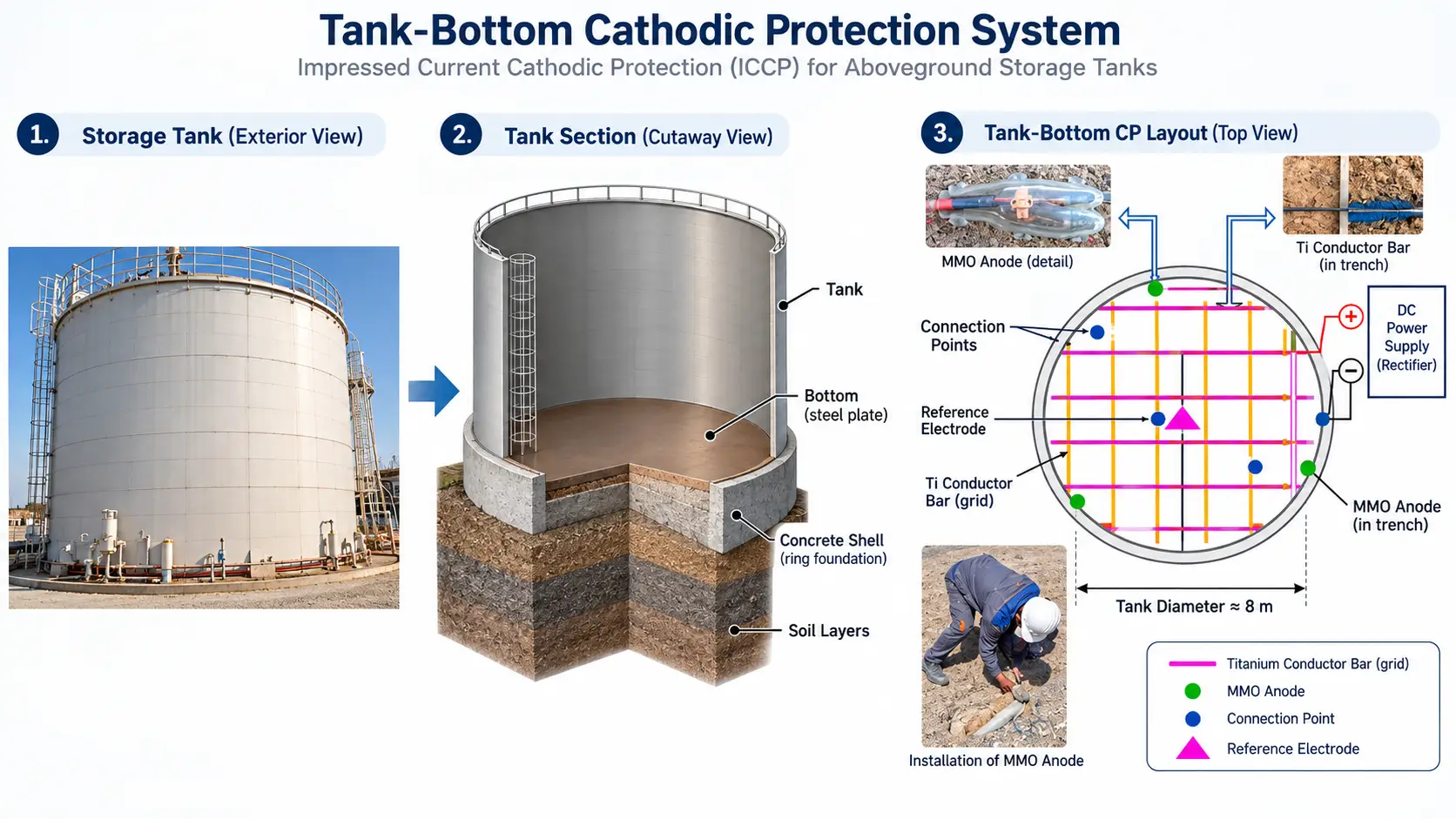
Tank Bottom ICCP Setup
Tank Bottom CP • Under-Tank Layout • MMO Ribbon Anodes • Mesh Ribbon Anodes • Wire Anodes • Current Distribution Review

ICCP Anodes for Tank Bottom Protection

Custom MMO ribbon, mesh ribbon, wire, and linear anode solutions for storage tank bottom cathodic protection, under-tank ICCP layouts, tank farms, above-ground storage tanks, and distributed current output systems.

Tank Bottom ICCP Engineering

Tank Bottom Protection Requires Distributed Current Output

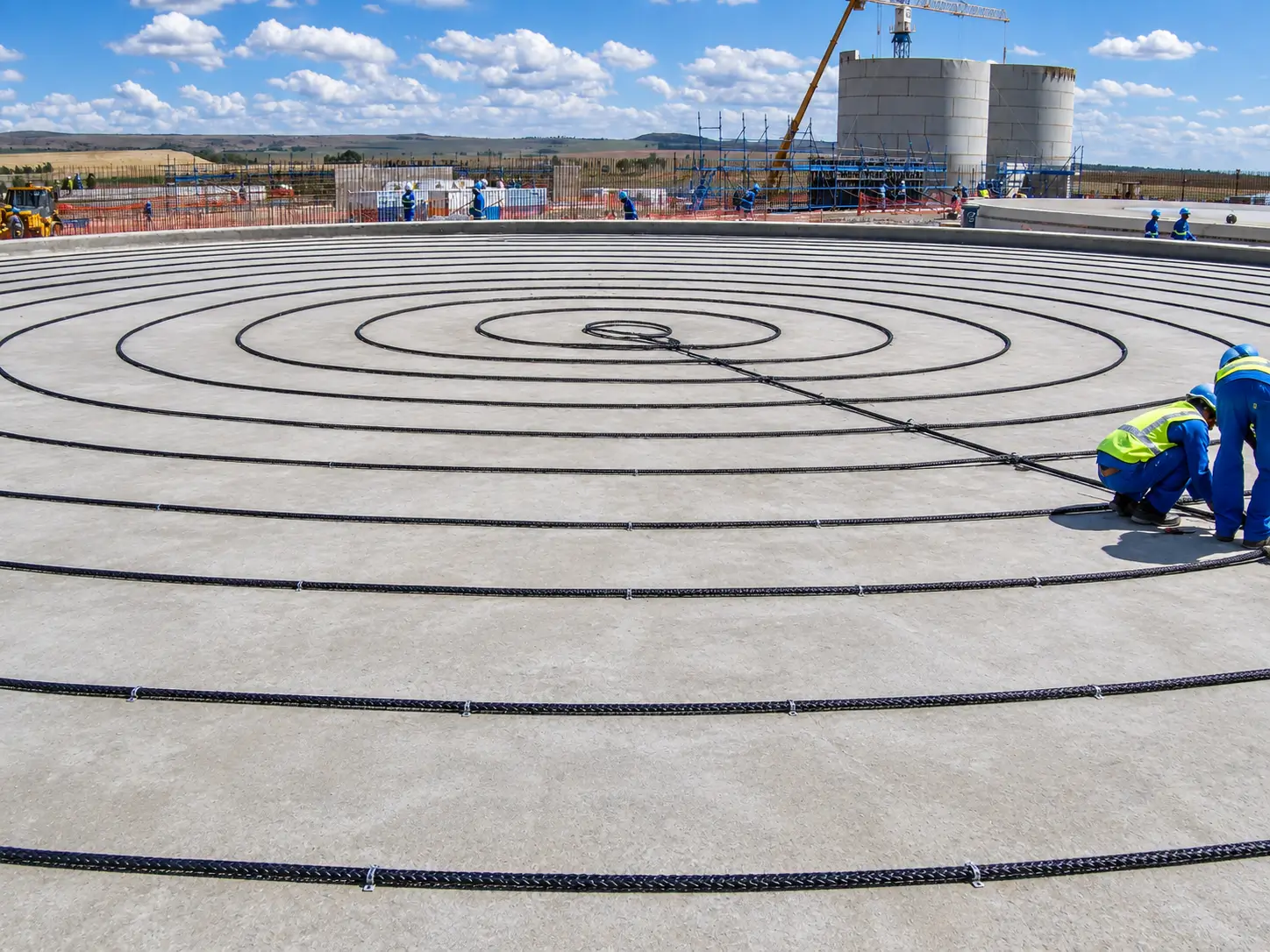
Tank bottom ICCP systems are used to help protect above-ground storage tank floors from soil-side corrosion. Because the tank bottom is a large, flat structure, the anode layout should be designed to distribute protective current across the protected area as evenly as practical.

Unlike point-type groundbed systems, under-tank ICCP layouts usually require distributed anode forms placed beneath or around the tank bottom. The final anode form, spacing, cable routing, reference electrode location, and current output should be reviewed according to tank diameter, foundation type, soil or sand resistivity, coating condition, current demand, and design life target.

Hele Titanium supports MMO ribbon anodes, MMO mesh ribbon anodes, MMO wire anodes, and MMO linear anodes for tank bottom ICCP systems, with coating review, current output review, cable connection, labels, packing, and documentation support according to project requirements.

Engineer Reviewing Layout

Under-Tank Distributed Layout

Anode forms can be reviewed for distributed current output beneath or around storage tank bottoms.

MMO Linear Anode Form Matching

Ribbon, mesh ribbon, wire, and linear anodes can be matched to the tank layout and current distribution needs.

Tank Diameter & Current Review

Tank size, current demand, anode spacing, and design life target should be reviewed together.

Cable, Monitoring & Documentation

Cable routing, connection, labels, reference electrode coordination, packing, MTC, and coating records can be supported.

Product Basics

What Is Tank Bottom ICCP Protection?

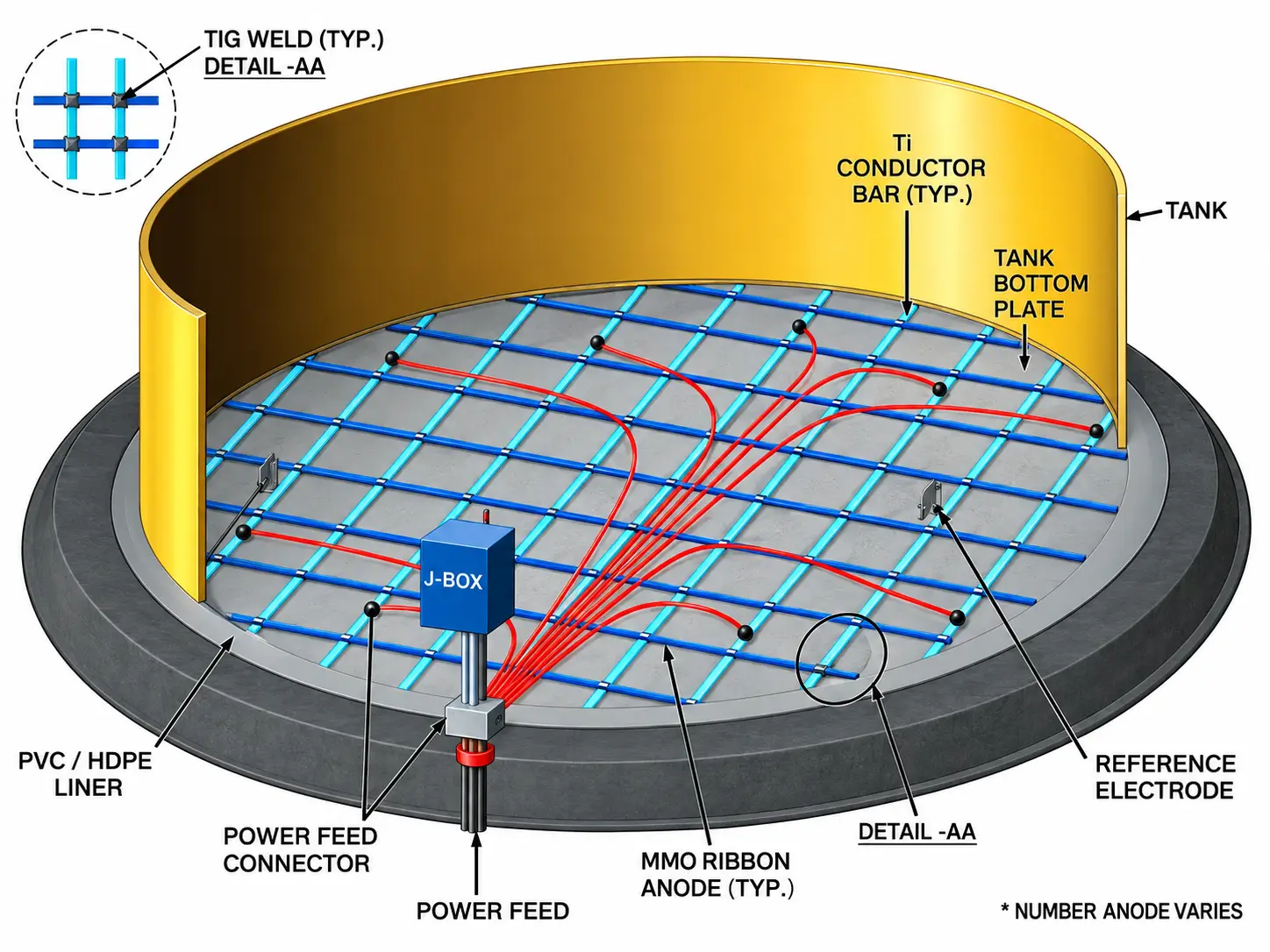
Tank bottom ICCP protection is an impressed current cathodic protection method used to help protect the underside of above-ground storage tank floors from corrosion. In many tank farm projects, anodes are installed beneath the tank bottom, within the foundation system, or around the tank area to deliver protective current to the steel floor.

Answer

Because storage tank bottoms are large and flat, distributed anode layouts are often reviewed. MMO ribbon, mesh ribbon, wire, or linear anodes can be used depending on tank diameter, foundation design, resistivity, installation access, current demand, and project specification.

1. Tank Bottom Steel Floor

What It Does: The protected structure that needs soil-side corrosion control.

Why It Matters: Tank diameter, floor condition, and coating condition affect current demand.

2. Under-Tank Anode Layout

What It Does: Places anodes beneath or around the tank bottom for distributed current output.

Why It Matters: Layout affects current distribution and protection coverage.

3. MMO Linear Anode Forms

What It Does: Ribbon, mesh ribbon, wire, or linear anodes provide distributed current output.

Why It Matters: Different anode forms fit different foundation and installation methods.

4. Cable Routing

What It Does: Connects anodes to the power source and test / junction points.

Why It Matters: Cable route and protection affect long-term system reliability.

5. Reference Electrodes & Monitoring Points

What It Does: Support potential measurement and system commissioning.

Why It Matters: Monitoring layout helps verify and adjust system operation.

Tank bottom ICCP provides distributed current output to protect the underside of above-ground storage tanks.

Recommended MMO Anode Forms for Tank Bottom ICCP Systems

Tank bottom ICCP systems can use different MMO linear anode forms depending on tank diameter, foundation design, current demand, anode spacing, cable route, and installation method. The final recommendation should be based on CP design data and site conditions.

MMO Ribbon Anode

MMO Ribbon Anodes

Flat MMO coated titanium ribbon anodes for under-tank distributed current output and long-area CP layouts.

Best For:

Storage tank bottom protection, under-tank anode grids, tank farms, and flat distributed current layouts.

Key Review Factors:

Ribbon width, coated length, current output, anode spacing, soil or sand resistivity, cable connection, and foundation type.

MMO Mesh Ribbon Anode

MMO Mesh Ribbon Anodes

Open mesh MMO coated titanium ribbon anodes for larger contact area and distributed current output.

Best For:

Tank bottom CP layouts requiring open mesh contact, embedded placement, or large-area current distribution.

Key Review Factors:

Mesh opening, ribbon width, coated length, backfill or sand contact, current output, and installation method.

MMO Wire Anode

MMO Wire Anodes

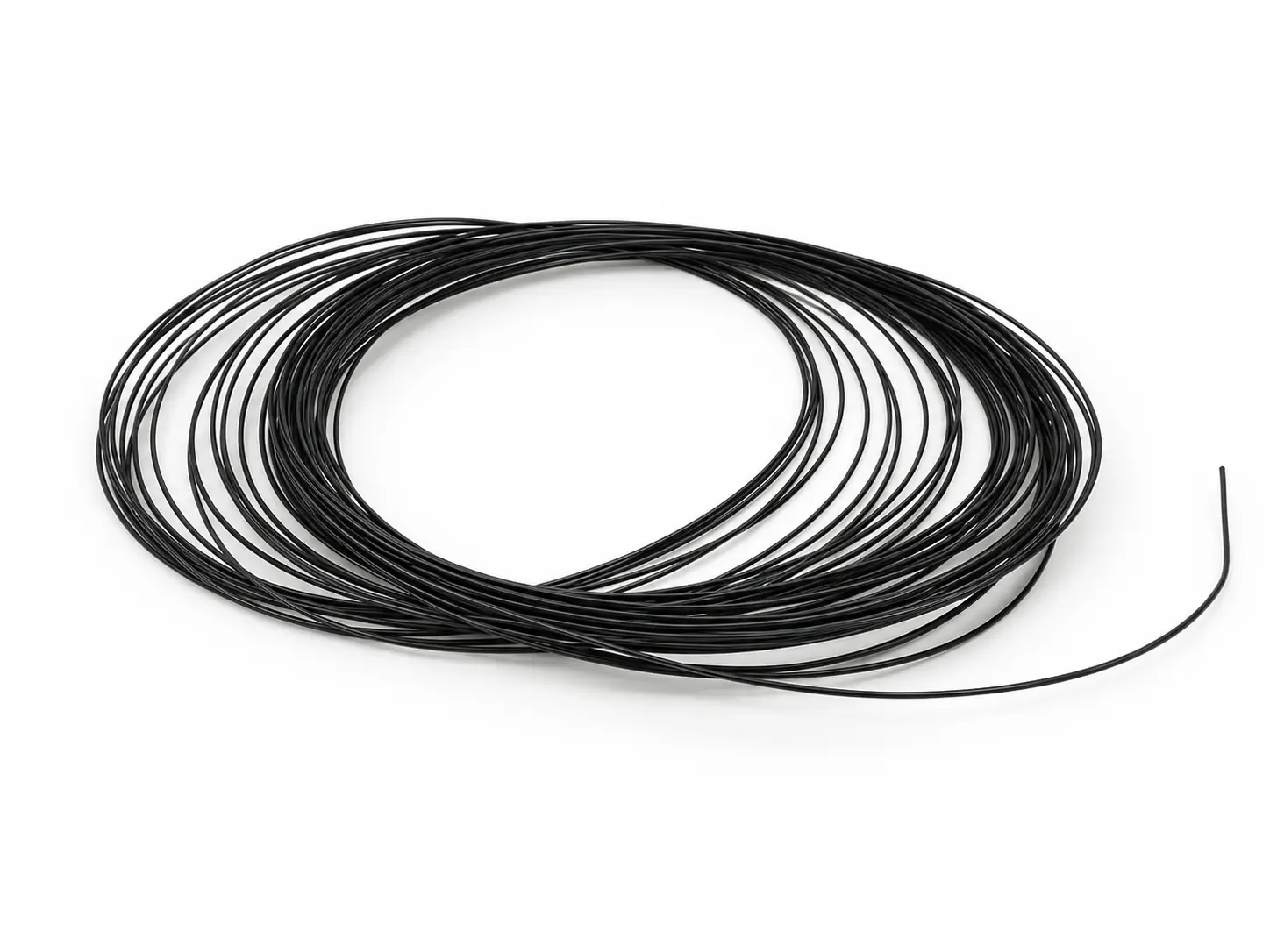
Flexible MMO coated titanium wire anodes for routed, embedded, or compact distributed tank bottom layouts.

Best For:

Projects requiring flexible routing, narrow installation paths, or defined anode spacing.

Key Review Factors:

Wire diameter, coated length, route design, spacing, current output, and cable connection.

MMO Linear Anode Systems

MMO Linear Anode Systems

Continuous or semi-continuous MMO linear anode layouts designed for distributed current output across tank bottom protection zones.

Best For:

Large tank bottoms, distributed CP grids, long-area protection, and custom under-tank layouts.

Key Review Factors:

Tank diameter, total current demand, output per meter, spacing, cable route, and design life.

Where Tank Bottom ICCP Anodes Are Commonly Used

Tank bottom ICCP anode systems are commonly reviewed for above-ground storage tanks, tank farms, and industrial facilities where the underside of steel tank floors requires corrosion protection. The final anode layout should be reviewed according to tank geometry, foundation conditions, current demand, monitoring requirements, and installation access.

Application Why Tank Bottom ICCP May Fit Key Review Factors
Above-Ground Storage Tanks
Distributed anode layouts can help deliver protective current to the underside of tank floors. Tank diameter, floor condition, coating condition, foundation type, resistivity, and current demand.
Oil Storage Tank Farms
Multiple tanks may require coordinated anode layouts, cable routing, and monitoring points. Tank spacing, electrical interference, CP zones, cable routes, junction boxes, and documentation.
Chemical Storage Tanks
Tank bottom protection may be reviewed where soil-side corrosion risk affects long-term tank integrity. Chemical facility layout, foundation material, current demand, monitoring plan, and safety requirements.
New Tank Construction
Under-tank anode systems can be designed before the tank floor or foundation is completed. Foundation drawing, tank diameter, sand or concrete base, anode grid layout, and cable exit points.
Tank Bottom Retrofit Projects
Retrofit protection may be reviewed when existing tank conditions and installation access allow CP upgrade. Existing foundation, access limitations, current demand, reference electrode placement, and installation constraints.
Large Industrial Tank Terminals
Distributed ICCP layouts can support tank bottom protection across large storage facilities. Tank group layout, power supply location, cable routing, monitoring points, current distribution, and project standard.
Where Tank Bottom ICCP Anodes Are Commonly Used

Not sure whether tank bottom ICCP is suitable for your project?

Share your tank geometry, foundation conditions, required current output, available layout and cable route for engineering review.

Key Design Parameters for Tank Bottom Anode Selection

A reliable tank bottom ICCP anode recommendation requires project data. The anode form, spacing, cable route, current output, monitoring plan, and documentation should be reviewed based on the full tank bottom CP design.

01

Tank Diameter & Floor Area

Tank Diameter & Floor Area for tank bottom anode selection
  • Tank size and floor area dimensions
  • Affects current demand and anode layout
  • Determines spacing and total anode quantity
02

Foundation Type

Foundation Type for tank bottom anode selection
  • Sand pad, concrete ring wall, or liner system
  • Double bottom or special foundation design
  • Directly affects the installation method
03

Soil / Sand Resistivity

Soil / Sand Resistivity for tank bottom anode selection
  • Resistivity below or around the tank
  • Affects current distribution and flow
  • Critical for proper anode selection
04

Current Demand

Current Demand for tank bottom anode selection
  • Total current and current density
  • Output per meter and operating profile
  • Affects coating loading and anode spacing
05

Anode Layout & Spacing

Anode Layout & Spacing for tank bottom anode selection
  • Ribbon, mesh ribbon, wire, or linear anode
  • Spacing should match protection area
  • Ensures complete tank bottom coverage
06

Cable Route & Exit Points

Cable Route & Exit Points for tank bottom anode selection
  • Cable routing and physical protection
  • Junction points and exit locations
  • Must be planned before installation
07

Reference Electrode / Monitoring Plan

Reference Electrode / Monitoring Plan for tank bottom anode selection
  • Reference electrode location and test points
  • Monitoring access and system integration
  • Reviewed during layout design phase
08

Documentation Requirements

Documentation Requirements for tank bottom anode selection
  • MTC, coating records, and dimensional inspection
  • Cable records, labels, and packing list
  • Project documents prepared when required

Share Your Project Data for Engineering Review

Provide tank dimensions, foundation type, sand resistivity, required current output, and monitoring requirements for accurate tank bottom anode design.

Accurate Design
Optimal Performance
Cost Efficiency
Long-Term Reliability

Complete Under-Tank ICCP Anode System Components to Review

An under-tank ICCP system is more than the anode itself. Review the complete under-tank layout, MMO anode system, cable routing, foundation contact, reference electrodes, power supply, monitoring points and documentation together to support reliable tank bottom cathodic protection, commissioning and long-term operation.

Component Function in the System What to Confirm
MMO Linear Anode Element
Provides distributed current output beneath the tank bottom through durable coated titanium anode. Ribbon, mesh ribbon, wire or linear anode form, coated length, output per meter, spacing and expected life.
Primary Cable System
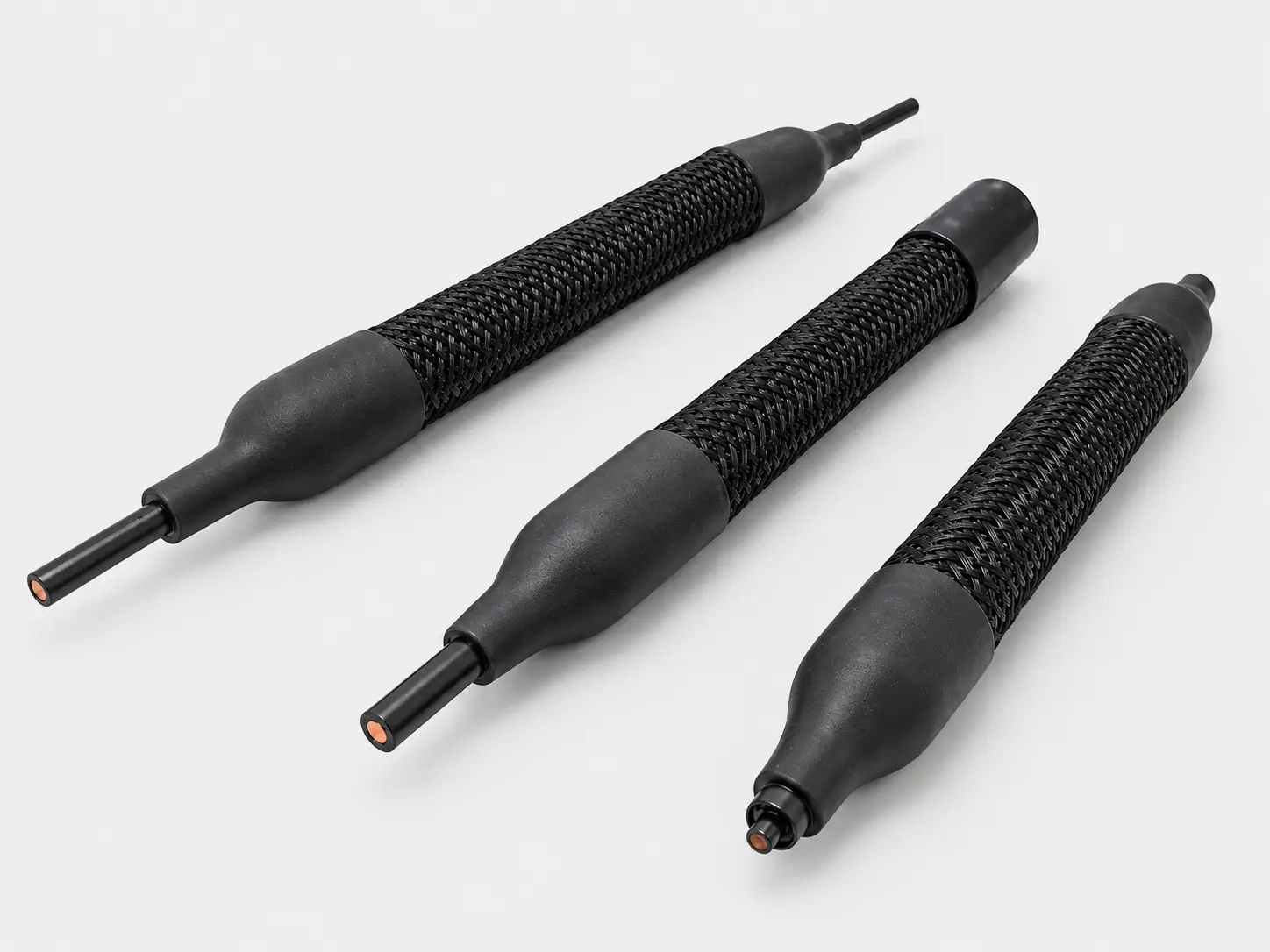
Transports current from the rectifier or junction point to the under-tank anode layout. Cable size, insulation rating, length, exit points, routing protection, sealing and labeling.
Foundation / Contact Layer
Provides the contact environment between the anode system and the tank bottom protection zone. Sand, soil, backfill, concrete, liner condition, moisture level and current transfer path.
Reference Electrodes
Support commissioning, monitoring and future potential measurement of the tank bottom CP system. Electrode type, quantity, location, cable route, accessibility and monitoring plan.
Power Supply / Rectifier
Delivers controlled DC output to the under-tank impressed current cathodic protection system. Output voltage, current capacity, control mode, total current demand and system resistance.
Junction Boxes / Test Points
Provide connection, identification and testing access for anode cables, reference electrodes and monitoring circuits. Box rating, cable termination, identification, test access, protection and maintenance access.
Cable Sealing / Exit Points
Protects cable penetrations and connection areas from moisture ingress and mechanical damage. Sealing method, cable exit location, protection sleeve, strain relief and installation sequence.
Documentation Package
Provides records for installation, commissioning, monitoring and future maintenance. Layout drawings, data sheets, cable records, reference electrode records, test results and O&M documents.
Under-Tank ICCP Anode System

Buyer Note: Under-tank ICCP system review should consider both the physical components and the tank foundation environment. Share your tank drawing, foundation details, soil or sand condition, current demand, anode layout, cable routing, reference electrode plan and documentation requirements for engineering review.

Blueprint Background

Current Distribution, Anode Spacing and Foundation Conditions Must Be Reviewed Together

For tank bottom ICCP systems, anode selection cannot be based only on ribbon width or wire diameter. Tank size, foundation conditions, resistivity, anode spacing, cable routing, reference electrode position, current output, and design life all affect the final recommendation.

1 Tank Diameter & Protection Area

Larger tank floors may require more distributed anode layouts and careful spacing review.

2 Foundation Contact

Sand, soil, concrete, liner, or backfill conditions affect current transfer beneath the tank.

3 Output per Meter

Current output per meter should be reviewed according to CP design, coating loading, spacing, and design life.

4 Cable & Monitoring Layout

Cable routes, junction points, reference electrode positions, and access points should be planned early.

* All recommendations are reviewed according to project requirements and based on operating conditions.

Tank Bottom ICCP Installation Risk Factors to Review

Many tank bottom CP issues are related not only to anode material, but also to foundation conditions, poor cable routing, incomplete current demand data, incorrect spacing, or limited monitoring access. Reviewing these issues before production helps improve anode selection and project planning.

Missing Tank Foundation Data

Without foundation details, anode placement and current transfer assumptions may be less reliable.

Incorrect Anode Spacing

Poor spacing can lead to uneven current distribution beneath the tank floor.

Poor Cable Route Planning

Cable exit points, protection, and junction locations should be confirmed before installation.

Limited Reference Electrode Access

Reference electrode placement affects commissioning, monitoring, and long-term CP system review.

Foundation or Liner Constraints

Double bottoms, liners, sand pads, or concrete base designs may affect installation options.

Incomplete Current Demand Review

Current requirement should be reviewed based on tank size, coating condition, environment, and design life.

Buyer Note:

If your project already has a tank drawing, foundation drawing, CP design calculation, current demand estimate, or resistivity report, share it with Hele Titanium for anode form and documentation review.

Quality & Documentation Support for Tank Bottom ICCP Anode Projects

Tank bottom ICCP anode project quality depends on MMO coating control, coated length accuracy, current output design, cable connection, label identification, packing protection, and final documentation.

Available Documents May Include:

  • MTC
  • Coating record
  • Coated length record when required
  • Dimensional inspection record
  • Cable / connection inspection notes when required
  • Visual inspection notes
  • Packing list & Product labels
  • Project-specific QC documents
  • Third-party inspection support when required

1. MMO Anode Form Review

MMO ribbon, mesh ribbon, wire, or linear anode forms are reviewed according to substrate, size, coating, and output requirements.

2. Coating Control

Coating formulation, application cycles, drying, thermal treatment, and coating loading are controlled according to project requirements.

3. Coated Length & Dimension Check

Ribbon width, mesh opening, wire diameter, coated length, total length, and connection details are reviewed according to agreed scope.

4. Cable & Connection Review

Cable length, insulation, connection method, sealing, labels, and termination details can be reviewed when required.

5. Packing & Labeling

Anodes are packed according to product form, cable protection, coating sensitivity, destination, and shipment requirement.

6. Project Documentation

Documentation and inspection notes can be prepared based on agreed inspection scope.

Tank Bottom ICCP Anode FAQ

What is tank bottom ICCP protection?
It is an impressed current cathodic protection method designed to help protect the external (soil-side) bottom plates of above-ground storage tanks from corrosion, usually using distributed under-tank anode layouts.
What anode forms are used for tank bottom protection?
Common forms include MMO ribbon anodes, MMO mesh ribbon anodes, MMO wire anodes, and custom MMO linear anode systems, depending on the foundation design and required current distribution.
Why are ribbon and mesh ribbon anodes commonly reviewed for under-tank layouts?
They are flat, long, and can be laid out in grid patterns beneath the tank floor. This helps provide a distributed current output across the large, flat surface area of the tank bottom.
What is the difference between MMO ribbon, mesh ribbon, and wire anodes for tank bottom CP?
Ribbon is a solid flat strip, mesh ribbon has an open structure for different contact properties, and wire is a flexible round conductor. Selection depends on foundation material, installation method, and desired current output per meter.
What information is needed for a tank bottom anode quote?
Please provide tank diameter, foundation type, soil/sand resistivity, total current demand, design life target, preferred anode form, cable routing requirements, and documentation needs.
Why is tank diameter important for tank bottom CP design?
Tank diameter determines the total surface area to be protected, which directly affects the total current demand, anode grid spacing, and the total quantity of anode material required.
Why is soil or sand resistivity important?
Resistivity affects how easily current flows from the anode through the foundation material to the tank bottom. It impacts the required driving voltage and can influence anode spacing.
How does anode spacing affect current distribution?
Proper spacing helps ensure that the protective current reaches all areas of the tank bottom evenly. Spacing that is too wide may leave areas under-protected, while spacing that is too narrow may increase costs unnecessarily.
Can cable length and connection be customized?
Yes, cable length, insulation type, and connection methods can be reviewed and supported according to your specific project requirements and layout plan.
Can reference electrode layout be considered with the anode system?
Yes, reference electrode positions and cable routing should be planned alongside the anode layout to ensure proper monitoring access once the tank is constructed.
What documents can be provided?
We can provide MTC, coating records, dimensional inspection, packing lists, and other project-specific QC documents based on the agreed inspection scope.
Can Hele Titanium support new tank and retrofit tank bottom CP projects?
Yes, anode forms and layouts can be reviewed for both new construction and retrofit applications, depending on installation access and existing foundation conditions.
Industrial Metal Background

Get Your Tank Bottom ICCP Anode Recommendation

Tell us your tank diameter, foundation design, soil or sand resistivity, current demand, design life target, preferred anode layout, cable routing, reference electrode requirements, and documentation needs. Hele Titanium will help review suitable MMO anode forms and tank bottom ICCP configurations for your project.

  • MMO Ribbon, Mesh Ribbon, Wire and Linear Anode Support

    Matched to your foundation and current needs.

  • Under-Tank Current Distribution and Spacing Review

    Based on tank diameter and CP design data.

  • Cable Connection, Labels and Documentation Support

    MTC and inspection records prepared when required.

  • Factory-Direct MMO Anode Manufacturing and Export Packing

    Controlled quality from substrate to shipment.

Supported formats: PDF, JPG, PNG, STEP, IGES, STL, DWG (Max 20MB)

Tank Drawing / Foundation Drawing / CP Design Drawing / Resistivity Report