
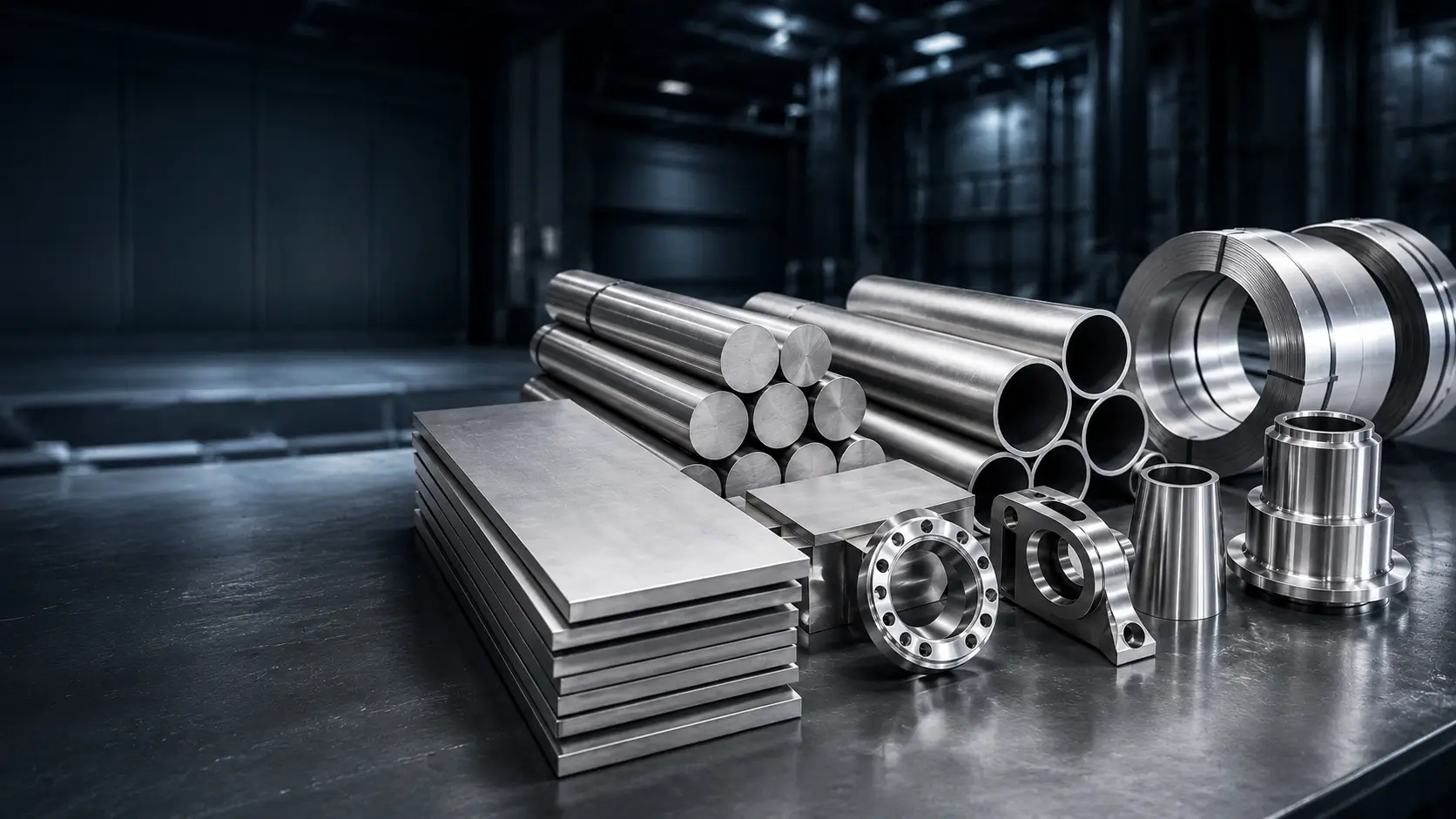
A reliable titanium purchase starts with a controlled order basis—not with a broad claim such as “commercially pure titanium,” “aerospace grade,” or “medical grade.” The buyer and supplier need the same definition of material, form, condition, geometry, processing, inspection, documentation and delivery.
1. Start with the Service Conditions and Supply Scope
First define what the material or component must do. Record the contacting media, concentration, contaminants, temperature, pressure, load, cyclic duty, expected fabrication route, design code and maintenance environment. If those inputs are unknown, identify them as open items rather than selecting a grade from the industry name alone.
Raw or semi-finished material
Specify product form, grade, standard, condition, dimensions, tolerance, surface and quantity.
Processed blank
Add cut geometry, datum, edge condition, machining allowance and inspection method.
Finished component
Add drawing revision, critical characteristics, process requirements and final acceptance records.
Assembly or project package
Define design, joining, bought-out items, tests, interfaces, installation and warranty boundaries.
2. Match the Grade to the Product Form and Standard
Grade describes chemistry and related material requirements, while the product-form standard establishes the applicable requirements for plate, bar, tube, pipe, wire or forging. The purchase order should state the governing standard and revision, condition and any project-specific additions.
| Grade | Material family | Procurement note |
|---|---|---|
| Grade 1 | Commercially pure titanium | High formability; review strength and product-form availability |
| Grade 2 | Commercially pure titanium | Common industrial corrosion-resistant material; confirm environment and fabrication route |
| Grade 5 | Ti-6Al-4V | Higher-strength alloy for machined and structural parts; confirm condition and specification |
| Grade 7 | Palladium-alloyed CP titanium | Consider for selected corrosive chemical conditions after media review |
| Grade 9 | Ti-3Al-2.5V | Useful where strength and formability are both required; confirm form-specific standard |
| Grade 12 | Ti-0.3Mo-0.8Ni | Used in selected chemical and heat-transfer duties; verify exact service conditions |
| Grade 23 | Ti-6Al-4V ELI | Controlled-interstitial alloy; material compliance alone is not finished-device approval |
Common product-form standards
| Standard | General product scope | Buyer action |
|---|---|---|
| ASTM B265 | Titanium and titanium-alloy strip, sheet and plate | Confirm the current revision, grade coverage, condition and order-specific additions. |
| ASTM B348/B348M | Titanium and titanium-alloy bars and billets | Confirm the current revision, grade coverage, condition and order-specific additions. |
| ASTM B338 | Seamless and welded titanium-alloy tubes for condensers and heat exchangers | Confirm the current revision, grade coverage, condition and order-specific additions. |
| ASTM B861 | Titanium and titanium-alloy seamless pipe | Confirm the current revision, grade coverage, condition and order-specific additions. |
| ASTM B862 | Titanium and titanium-alloy welded pipe | Confirm the current revision, grade coverage, condition and order-specific additions. |
| ASTM B863 | Titanium and titanium-alloy wire | Confirm the current revision, grade coverage, condition and order-specific additions. |
| ASTM B381 | Titanium and titanium-alloy forgings | Confirm the current revision, grade coverage, condition and order-specific additions. |
Important: citing an ASTM or ASME number does not by itself define every dimension, tolerance, surface, test, document or finished-component requirement. Record the exact revision and supplementary requirements in the RFQ and purchase order.
3. Compare Titanium with Alternatives by the Actual Duty
Titanium can offer a valuable combination of corrosion resistance, strength-to-weight ratio and service reliability, but it is not automatically the best or lowest-cost material for every condition. Compare candidates using the same environment, design life, fabrication route and inspection basis.
| Comparison | Potential titanium advantage | Questions before switching |
|---|---|---|
| Carbon or stainless steel | Lower density and strong resistance in many oxidizing or chloride-bearing environments. | Is the specific media reducing or crevice-prone? What coatings, corrosion allowance or maintenance does the alternative need? |
| Aluminum alloys | Higher strength and temperature capability for many alloy/product combinations. | Is weight the main driver? What joining, galvanic, temperature and cost constraints apply? |
| Nickel alloys | Lower density and possible lifecycle value in suitable corrosion conditions. | Which material has verified compatibility at the exact chemistry, temperature and stress? |
Use qualified corrosion data, design-code requirements and application testing where failure consequences are significant. Avoid universal claims such as “immune to corrosion” or fixed service-life promises.
4. Understand the Manufacturing and Processing Route
The procurement route may involve sponge and melting, mill conversion, heat treatment, finishing, cutting, machining, forming, welding, surface treatment and inspection. The supplier's contractual scope may cover only some of these stages.
- Source material: identify product form, grade, standard, condition and traceability basis.
- Primary conversion: confirm the route relevant to plate, bar, tube, pipe, wire or forging.
- Value-added processing: define cutting, machining, forming, welding, cleaning and finishing requirements.
- Inspection and release: agree measurements, tests, records, marking and authorization to ship.
5. Compare Cost on the Same Technical and Commercial Basis
Quoted cost changes with grade, product form, condition, size, quantity, raw-material yield, tolerance, machining time, surface requirement, inspection, documents, packing, Incoterm and delivery schedule. A meaningful comparison normalizes all of these items.
Material and geometry
Grade, form, section size, length, quantity, standard size versus custom production and expected yield.
Processing
Tolerance, datum strategy, tool access, machining allowance, welding, forming and finishing.
Evidence and quality
Testing, inspection level, third-party involvement, document review and traceability controls.
Commercial and logistics
MOQ, schedule, packing, freight, Incoterm, payment terms, replacements and change control.
Cost-control principle: use the grade, tolerance and evidence level the application actually requires. Over-specification can add cost; under-specification can transfer risk into machining, qualification or service.
6. Titanium Products Purchase Guard
This is the detailed control list behind the short Purchase Guard on the product category page. Use it to align technical scope, supplier evidence and acceptance responsibilities before issuing the purchase order.
6.1 Material identity and traceability
- State the exact grade, product form, governing standard and revision, condition and any supplementary requirements.
- Define whether heat, lot or piece-level identification is required and how identity must remain linked after cutting or processing.
- State the required certificate type and the fields that must match the purchase order.
- Do not treat a generic certificate, sample report or unrelated project document as evidence for the ordered material.
6.2 Dimensions, tolerance and surface condition
- Define thickness, width, length, diameter, OD, ID, wall, straightness, flatness and other applicable characteristics.
- Identify critical dimensions, datum references, machining allowance and measurement method.
- Specify surface condition, cleaning, edge condition, visible-defect criteria and protective handling.
- Resolve conflicts between drawing, specification and purchase order through an agreed precedence rule.
6.3 Processing and responsibility boundary
- Separate raw-material supply, cutting, machining, forming, welding, heat treatment, cleaning, finishing and assembly.
- Record which party owns design calculations, material selection, drawing approval, process qualification and final application validation.
- Require approval before subcontracting, process substitution or material-source changes when the project demands it.
- Establish revision control and written authorization for deviations.
6.4 Inspection, testing and acceptance
- List mandatory chemical, mechanical, dimensional, surface, NDT or functional checks and the acceptance criteria for each.
- Define sampling, inspection stage, witness or hold points, report format and record-retention requirements.
- State whether third-party inspection is required and who appoints and pays the inspector.
- Agree the response process for nonconformity, concession, rework, replacement and claim evidence.
6.5 Documents, marking and packing
- Create an order-specific document list instead of requesting “full certification” without definition.
- Align product marking, tags, heat or lot references and packing-list descriptions.
- Specify surface protection, separation of items, moisture controls, crate or pallet requirements and lifting restrictions.
- Confirm destination, shipping marks, Incoterm, export documents and any customer-specific labeling.
6.6 Supplier evidence before order
- Request evidence relevant to the exact product, process and proposed scope—not general marketing claims.
- Review a sample document package with sensitive data redacted where appropriate.
- Confirm which operations are performed internally and which are controlled through approved external sources.
- Make performance, warranty and delivery commitments specific to the quotation and agreed operating assumptions.
6.7 Stock, MOQ and lead-time verification
- Ask whether quoted material is physically available, allocated, incoming or planned for production; do not treat a catalog listing as proof of stock.
- Confirm whether the MOQ applies to the raw material, melt or mill batch, processing setup, finished part or shipping lot.
- Break the schedule into material availability, processing, inspection, document review, packing and transit instead of relying on one unqualified lead-time number.
- Record the quotation validity period and the events that may reset price or schedule, including drawing changes, delayed approvals and added testing.
6.8 Commercial quotation comparability
- Normalize the quantity and unit basis: piece, kilogram, meter, set or lot.
- Separate material, processing, tooling, testing, documentation, packing, freight and taxes where the comparison requires it.
- Align Incoterm and named place, payment terms, currency, quotation validity, delivery split and responsibility for import or destination charges.
- List every exclusion and technical exception. A quotation that omits required inspection or documents is not commercially equivalent.
6.9 Material substitution and source-chain control
- Prohibit grade, standard, condition, source or manufacturing-route substitution without written review when these factors affect qualification.
- Check that certificate identity, heat or lot references, product markings and packing records form a consistent chain.
- Define how identity will be transferred to cut pieces, remnants or parts after the original mill marking is removed.
- For higher-risk orders, agree the document-authentication, positive material identification or independent verification method before production.
6.10 Fabrication, cleanliness and contamination controls
- State whether welding, forming, heat treatment, machining, pickling, cleaning or passivation is included and which procedure or acceptance basis applies.
- Define segregation, clean-tool and handling requirements where contact with carbon steel, shop debris or unsuitable media could affect the surface.
- For welding, specify procedure qualification, personnel qualification, shielding, heat-tint acceptance and NDT only to the extent required by the design or contract.
- Identify any prohibited lubricants, marking materials, cleaning agents or repair methods relevant to the downstream process.
6.11 Nonconformity, claims and change control
- Require written approval before use-as-is, repair, rework or deviation from the approved order basis.
- Agree the evidence needed for a claim: tag and packing photos, measured results, affected quantity, certificate or heat reference and preservation of disputed material.
- Define notification timing, containment, root-cause response, replacement or credit route and responsibility for consequential work.
- Keep a single approved record of drawing revisions, technical questions, concessions and commercial changes.
6.12 Repeat-order and record continuity
- Do not assume a repeat purchase is identical; compare the new purchase order with the previously approved revision, source and acceptance plan.
- Record which characteristics must remain unchanged and which may be requalified.
- Define retention periods for certificates, inspection records, approved deviations and manufacturing or traceability records where required.
- Capture lessons from incoming inspection, machining, fabrication and service so the next order basis is improved rather than copied blindly.
Evidence matrix for supplier review
| Control question | Evidence to request where applicable | Acceptance decision |
|---|---|---|
| Is the quoted material the ordered grade and form? | Order-linked certificate sample, heat or lot identification method and marking example. | Identity fields and traceability route match the purchase specification. |
| Can the proposed route meet the drawing? | Relevant capability record, process plan, sample inspection format or qualified external-source control. | Critical dimensions, processes and responsibility boundaries are covered. |
| Will required tests and records be available? | Draft inspection and test plan, report templates, witness points and document index. | Every required result has a method, acceptance criterion, owner and release point. |
| Is delivery based on a complete scope? | Schedule breakdown, packing proposal, Incoterm and named place, exclusions and quotation validity. | Technical and commercial assumptions are aligned across quotation and purchase order. |
Red flags that require clarification before order
A certificate is offered, but the material, heat, lot, marking or ordered quantity cannot be connected to it.
“In stock” or “fast delivery” is stated without confirming grade, form, dimensions, quantity and reservation status.
A low price excludes testing, finishing, documents, packing or processing included in the competing quotation.
The quotation, drawing, specification and purchase order do not reference the same approved revision.
Decision gate before purchase order
Do not release the order until the quotation, drawing/specification revision, technical exceptions, inspection plan, document list, packing basis, delivery term and responsibility boundary tell the same story.
7. RFQ and Pre-Order Checklist
Form, grade, standard and revision, condition and quantity.
Dimensions, tolerances, drawing revision, datum and machining allowance.
Media, concentration, contaminants, temperature, pressure and mechanical duty.
Cutting, machining, forming, welding, cleaning, finishing and assembly.
Certificates, tests, inspections, third-party points and document format.
MOQ, schedule, packing, destination, Incoterm and required shipping documents.
8. Titanium Purchasing FAQ
Should buyers specify a grade or describe the service conditions first?
If the grade is already governed by a drawing or code, state it exactly. If it is not fixed, provide the service conditions and design requirements so candidate materials can be reviewed without treating a general industry label as a specification.
What is the difference between a standard, a certificate and an inspection report?
A standard defines applicable requirements; a certificate reports product or batch information against the order basis; an inspection report records agreed checks or results. The purchase order should state which document, revision and acceptance criteria are required.
When should third-party inspection be discussed?
Discuss it before quotation when the project, customer, code or risk level requires witness points, hold points, independent review or specific reporting. Late additions can affect cost and schedule.
How should buyers compare two titanium quotations?
Normalize the grade, product form, standard revision, condition, dimensions, tolerance, quantity basis, processing scope, inspection, documents, packing, Incoterm and exclusions. A lower unit price may not represent the same supply scope.
Can one MTC cover a fabricated or machined assembly?
An MTC normally supports the source material it identifies. The finished component may require additional traceability, process, dimensional, welding, NDT or acceptance records depending on the project.
What should be frozen before production starts?
Freeze the approved drawing or specification revision, material and condition, dimensions and tolerances, process scope, inspection plan, document list, marking, packing, delivery basis and change-control route.