
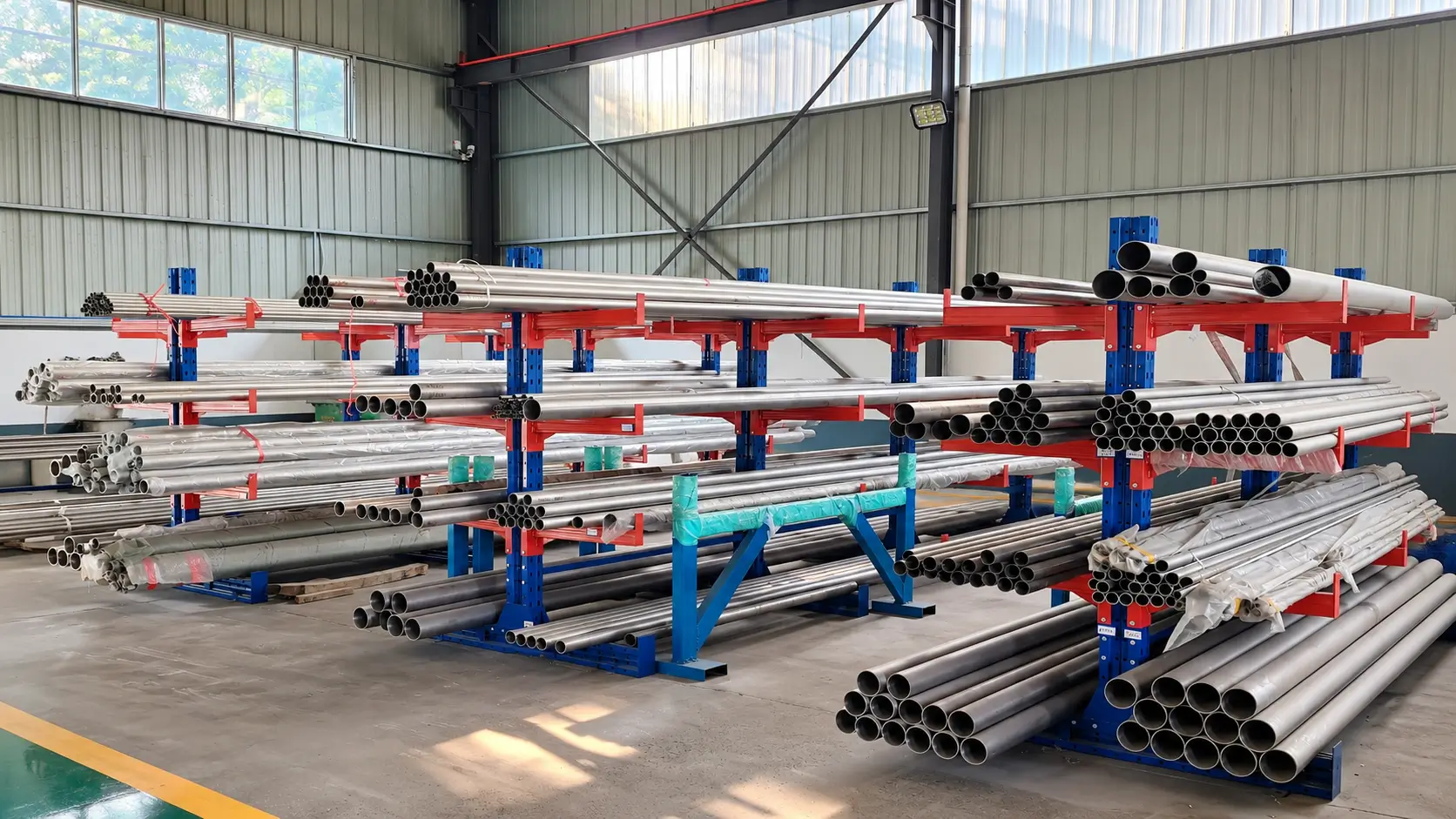
A reliable tubular-product purchase begins with one controlled order basis. “Titanium tubing,” “seamless,” “pressure rated” or “corrosion proof” are incomplete until product form, specification, grade, dimensions, service, design responsibility, fabrication, testing and evidence are defined.
1. Define Tube, Pipe or a Drawing-Based Product
Tube and pipe can be visually similar but are ordered differently and may be governed by different specifications. State the product route, not only the word “tubing.”
| Product | How it is commonly ordered | Purchase risk |
|---|---|---|
| Tube | Outside diameter × wall thickness × length, plus grade, condition, tolerance and ends. | OD/wall dimensions are replaced with a nominal pipe description. |
| Pipe | NPS × schedule × length, or exact OD/wall where the project requires it. | Nominal size is confused with actual OD, ID or wall. |
| Heat-exchanger tube | Grade, B338 revision, OD, wall, length, cleanliness, ends and specified tests. | General-purpose tubing is assumed suitable for condenser duty. |
| Shaped or fabricated tube | Approved drawing, material, section, wall, tolerances, bend or end geometry, inspection and quantity. | A material specification is assumed to cover fabricated geometry and workmanship. |
2. Start with Service Conditions and Design Responsibility
Define the media, concentration, contaminants, temperature, design and operating pressure, vacuum, flow velocity, cyclic duty, external loads, corrosion allowances, joining, cleaning and maintenance environment.
Purchaser / designer defines
Design code, system duty, grade or performance requirement, dimensions, pressure calculation, joint factors, fabrication qualification and final acceptance.
Supplier confirms
Proposed product route, source, condition, dimensions, technical exceptions, testing, records, packing and quotation assumptions.
Responsibility rule: material supply, product testing and system design are separate scopes. Do not infer a system pressure rating or corrosion guarantee from a grade name or generic certificate.
3. Match ASTM B338, B861 or B862 to the Product
| Specification route | Official product scope | Ordering focus |
|---|---|---|
| ASTM B338 | Seamless and welded titanium and titanium-alloy tubes for condensers and heat exchangers. | Grade, seamless/welded, OD, wall, length, condition, ends, tests and supplementary requirements. |
| ASTM B861 | Titanium and titanium-alloy seamless pipe for corrosion-resisting and elevated-temperature service. | Grade, condition, NPS/schedule or exact dimensions, length, ends, tests and project requirements. |
| ASTM B862 | Titanium and titanium-alloy welded pipe for corrosion-resisting and elevated-temperature service. | Grade, welded route, condition, dimensions, weld/NDT requirements, ends and records. |
| Drawing / customer specification | Shaped, capillary, bent, coiled or fabricated products when no listed route fully defines the order. | Precedence, materials, dimensions, process, workmanship, inspection and approval. |
State the required revision. Do not write that one item automatically complies with B338, B861 and B862 at the same time.
4. Review Seamless and Welded Routes Without Assuming One Is Always Better
Seamless route
Review starting form, reduction or drawing route, heat treatment, dimensions, surface, ends and specified inspection. Suitability depends on the ordered specification and service.
Welded route
Review flat-product source, forming, welding, any cold work or heat treatment, weld condition, NDT, dimensions and acceptance evidence required by the order.
Questions to resolve before selection
- Does the governing design or customer specification restrict the product route?
- Are the required grade, dimensions, condition and quantity available in that route?
- Which inspection or NDT methods and acceptance criteria apply?
- Does downstream bending, welding, expansion or machining create additional qualification requirements?
- Which processes are internal, externally controlled or excluded from the quotation?
5. Select Grade and Condition Against the Actual Service
Common enquiries include commercially pure grades and selected titanium alloys, but not every grade is covered or available in every tube or pipe specification, condition and size.
| Grade family | Selection review | Boundary |
|---|---|---|
| Grades 1 and 2 | Review formability, strength, corrosion environment, fabrication and applicable product standard. | Commercial-purity language does not replace the ordered grade and oxygen/strength requirements. |
| Grade 7 and related Pd grades | Consider only after chemistry, temperature, crevices and fabrication are reviewed. | Enhanced corrosion resistance is not universal immunity. |
| Grade 9 / Ti-3Al-2.5V | Review strength, thin-wall forming, condition, joining and the applicable product specification. | Do not infer aerospace approval from the alloy name. |
| Grade 12 / Ti-0.3Mo-0.8Ni | Review specific chemical or heat-transfer duty and product-standard coverage. | Grade 12 is not a beta alloy and should not be described as one. |
| Grade 5 and other alloys | Use only where the applicable product specification, condition, dimensions and project approval are confirmed. | Do not assume every grade is included in ASTM B338. |
6. Control Dimensions, Tolerances, Ends and Fabrication
Tube dimensions
OD, wall, derived or controlled ID, length, OD/wall tolerances, ovality, straightness and end condition.
Pipe dimensions
NPS, schedule, actual OD and wall where required, length, ends and dimensional standard.
Surface and cleanliness
Inside/outside surface, visible-defect criteria, cleaning, drying, capping and contamination controls.
Fabrication
Cutting, bending radius, U-bend geometry, end preparation, welding, heat treatment, fixtures and inspection.
For bends and fabricated items, separate source-material compliance from fabricated-geometry and workmanship acceptance.
7. Define Pressure-Design and Test Boundaries
There is no responsible one-line pressure rating for “titanium tube” or “titanium pipe.” Design pressure depends on the applicable code and complete system inputs.
| Input | Why it matters | Responsible confirmation |
|---|---|---|
| Material and condition | Allowable properties vary with material, condition and design temperature. | Designer specifies; supplier documents the ordered material. |
| Actual dimensions | OD, wall, tolerance and allowances influence the pressure boundary. | Designer calculates; supplier confirms supplied dimensions and records. |
| Seamless or welded route | Joint or quality factors and inspection may affect the code calculation. | Designer selects factors; supplier confirms route and evidence. |
| Service and degradation | Temperature, corrosion/erosion, cyclic duty, vacuum and external loads affect design. | Owner/designer defines the design basis. |
| Product test | Hydrostatic, pneumatic, electromagnetic, ultrasonic or other tests demonstrate specified acceptance, not lifetime system rating. | Purchase order defines; supplier performs or coordinates agreed scope. |
Buyer warning: reject an unqualified “pressure rated” claim that does not identify the design code, dimensions, material/condition, design temperature, allowances, joint basis and responsible engineer.
8. Compare Cost and Quotation Scope
Total cost includes more than material weight. Product route, dimensions, mill quantity, yield, testing, end preparation, fabrication, cleaning, documentation, packing and commercial terms may be decisive.
Material and route
Grade, specification, condition, seamless/welded basis, source form and quantity unit.
Geometry and fabrication
OD/wall or NPS/schedule, length, tolerances, ends, bends, joining and cleaning.
Evidence
Certificates, dimensional records, tests, NDT, third-party points and document review.
Commercial basis
MOQ, currency, validity, packing, Incoterm, named place, payment and schedule assumptions.
9. Complete Titanium Tube & Pipe Purchase Guard
Use these controls before purchase order release. Each requirement should have an owner, evidence source and acceptance decision.
9.1 Product and material identity
- State tube or pipe, seamless or welded, grade, UNS, specification and revision, condition and supplementary requirements.
- Define heat, lot or piece-level traceability and identity transfer after cutting or fabrication.
- List the certificate fields that must match the order, marking and packing list.
- Reject generic or unrelated certificates as proof for the ordered material.
9.2 Dimensions, tolerances and ends
- Define OD and wall or NPS and schedule, actual dimensions where necessary, length and quantity.
- State OD, wall, ID, ovality, straightness and length tolerances as applicable.
- Define plain, beveled, flanged or drawing-based ends, cut quality, caps and protection.
- Identify measurement method, sampling and report format.
9.3 Service and design responsibility
- Record media, concentration, contaminants, temperature, pressure, vacuum, velocity, cyclic duty and external loads.
- Name the governing design code and responsible design authority.
- Separate material selection support from system design and fitness-for-service approval.
- Do not turn a product test result into a corrosion or pressure guarantee.
9.4 Availability, MOQ and schedule
- Ask whether material is physically available, allocated, incoming, mill-order or planned for fabrication.
- Confirm whether MOQ applies to melt/mill quantity, source tube, processing setup, finished pieces or shipping lot.
- Break schedule into source material, processing, inspection, document approval, packing and transit.
- Record quotation validity and events that reset price or delivery.
9.5 Processing and fabrication boundary
- Separate material supply, cutting, bending, U-bending, coiling, welding, heat treatment, cleaning and assembly.
- Identify which activities are internal, externally controlled or excluded.
- State who owns design, material selection, drawing approval, welding/bending qualification and final-system validation.
- Require written approval for substitutions, deviations and source or route changes where necessary.
9.6 Testing, inspection and acceptance
- List chemical, mechanical, dimensional, visual, hydrostatic, pneumatic, ET, UT, PT or other checks only as applicable.
- Define method, sampling, acceptance criteria, witness or hold points, inspector and report format.
- Agree third-party scope, appointment, cost and schedule before order.
- Define nonconformity, concession, rework, replacement and claim procedures.
9.7 Documents, marking and packing
- Create an order-specific document index rather than requesting “full certification.”
- Align tube/pipe marking, tags, heat or lot identity, certificate and packing list.
- Specify bundling, spacers, end caps, moisture protection, crate or pallet and lifting restrictions.
- Confirm shipping marks, destination documents and customer-specific labels.
9.8 Commercial comparability
- Normalize quantity and unit basis: piece, meter, kilogram, bundle or lot.
- Separate material, testing, fabrication, cleaning, documents, packing, freight and taxes as needed.
- Align Incoterm and named place, currency, payment, delivery split and validity.
- List technical exceptions and exclusions beside the quoted scope.
9.9 Source-chain and change control
- Prohibit unapproved changes to grade, specification, revision, condition, seamless/welded route, source or processing location when qualification depends on them.
- Check that certificate, heat or lot, marking and packing records form one consistent chain.
- Define identity transfer to cut lengths or fabricated pieces.
- For higher-risk orders, agree document authentication, PMI or independent verification before production.
9.10 Handling, storage and installation
- Define cleanliness, segregation, end protection, lifting, stacking and storage requirements.
- Identify prohibited contact materials, markers, lubricants, cleaners or repair methods relevant to service.
- Protect thin-wall and long products from ovality, denting and bending during transport.
- Keep installation welding, supports, flushing, commissioning and system testing under the approved project procedures.
Evidence matrix for supplier review
| Control question | Evidence to request when applicable | Acceptance decision |
|---|---|---|
| Is the quoted item the ordered product and material? | Order-linked certificate sample, product-route statement and heat/lot identification method. | Form, grade, standard, condition and traceability match. |
| Can the proposed route meet dimensions and fabrication? | Process plan, relevant capability record, sample dimensional report or controlled external-source route. | Critical geometry, ends, processing and responsibility are covered. |
| Will required tests and records be available? | Inspection and test plan, report templates, witness points and document index. | Each result has a method, criterion, owner and release point. |
| Is delivery based on the complete scope? | Schedule stages, packing proposal, Incoterm, exclusions and quotation validity. | Technical and commercial assumptions are aligned. |
Red flags before purchase order
The quotation lists B338, B861 and B862 without identifying the actual product route.
A pressure rating is stated without design code, dimensions, temperature, allowances and responsible calculation.
Hydro, ET, UT or another test is named without method, sampling, acceptance or report requirement.
Seamless/welded route, standard revision, drawing and purchase order are not aligned.
Decision gate
Do not release the order until product form, material, dimensions, service/design basis, processing, tests, exceptions, documents, packing and delivery terms tell the same story.
10. RFQ and Pre-Order Checklist
Tube/pipe, seamless/welded, grade, UNS, standard and revision, condition.
OD/wall/length or NPS/schedule/length, tolerances, quantity and ends.
Media, temperature, pressure, design code, allowances, joining and approval authority.
Cutting, bending, U-bend, coiling, welding, heat treatment, cleaning and assembly.
MTC, traceability, dimensions, tests/NDT, witness points, reports and marking.
Quantity basis, MOQ, validity, packing, destination, Incoterm and required date.
11. Titanium Tube & Pipe Purchasing FAQ
Should an RFQ specify tube or pipe?
Yes. State tube or pipe, seamless or welded, and the governing specification. Add OD and wall thickness for tube, or NPS and schedule or exact dimensions for pipe.
Can ASTM B338, B861 and B862 be treated as interchangeable?
No. They cover different products and service contexts. B338 is for seamless and welded condenser and heat-exchanger tube, B861 for seamless pipe, and B862 for welded pipe. Use the specification required by the design and purchase order.
Does a supplier's pressure test create a system pressure rating?
No. A specified product test provides evidence against that test requirement. System design pressure and allowable working pressure remain engineering calculations under the applicable design code and service conditions.
Is seamless always better than welded?
No. Suitability depends on specification, dimensions, fabrication route, weld and NDT requirements, service, availability and economics. The purchase decision should be based on the complete order basis.
Which titanium grade should be selected for seawater or chemical service?
Do not choose from the industry name alone. Review media, concentration, contaminants, temperature, velocity, crevices, galvanic conditions, stress, fabrication and the governing design requirements.
How should two titanium tube or pipe quotations be compared?
Normalize product form, grade, specification revision, condition, dimensions, quantity, seamless or welded route, testing, documents, ends, packing, Incoterm, schedule assumptions and exclusions.