
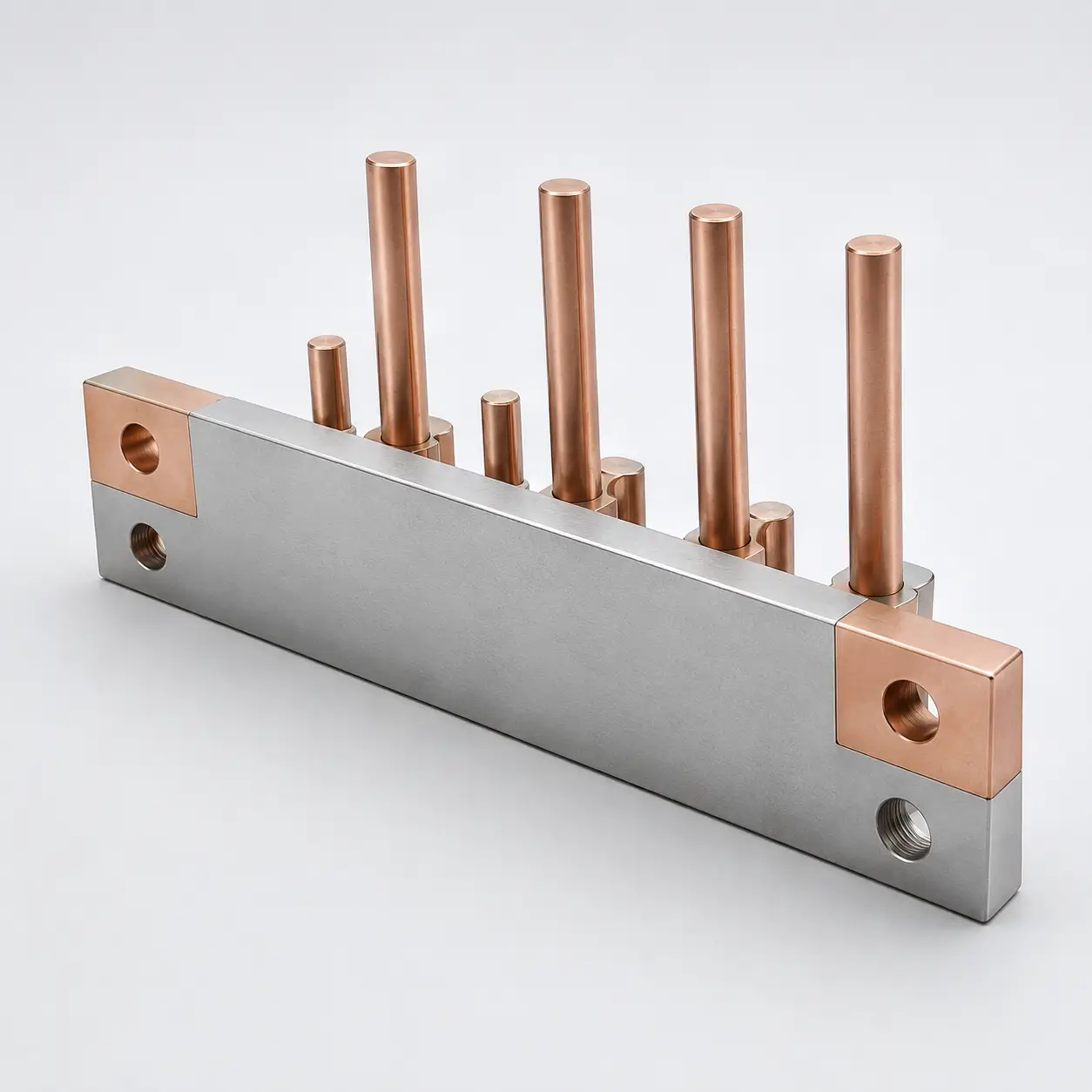
Titanium-clad copper is not a single standardized conductor. The required deliverable changes with product form, bonding route, coverage, current path, environment, connection design and acceptance evidence.
1. Define the Composite and Its Responsibility
State what the component must carry, protect, support and connect. Identify whether it is a busbar, hanger bar, rod, tube, plate, strip, terminal or fabricated assembly, and whether the supplier is responsible for material only, finished machining, seals, contacts, installation hardware or system performance.
Copper provides the principal conductive section; titanium protects only the surfaces and boundaries actually covered and intact in the stated environment. Neither function should be assumed beyond the approved drawing.
2. Separate Product Forms and Manufacturing Routes
A clad plate, cylindrical rod, hollow tube, busbar and machined connector may require different input materials, forming/joining processes, bond definitions and inspection methods. Do not use one generic “metallurgically bonded” statement as the complete specification.
| Form | Key definition | Common procurement risk |
|---|---|---|
| Bar / busbar | Cross-section, length, straightness, holes, contact faces and coverage | Current and contact basis omitted |
| Rod | Core diameter, finished OD, length, ends and immersed zone | Cut ends expose copper |
| Tube | OD, ID, walls, core/clad arrangement, ends and pressure/flow role | Construction not defined |
| Plate / strip | Base/clad thickness, clad side(s), flatness, edges and cutouts | Plate standard applied to other forms |
| Connector / assembly | Datums, joints, seals, contact surfaces and tests | Interface responsibility unclear |
3. Map the Complete Service Environment
List process chemicals and concentrations, contaminants, pH, temperature, pressure, gas/vapor, condensation, solids, cleaning chemicals and electrical potential. Mark continuous immersion, intermittent wetting, splash, vapor, liquid line, dry connection and external atmospheric zones.
- Identify crevices, deposits, stagnant zones and galvanic contacts.
- Show which cut ends, holes, threads, welds and terminals can contact the environment.
- Define startup, shutdown, drain-down, cleaning and upset exposure.
- Do not call the assembly corrosion-proof without an order-specific basis.
4. Write the Electrical and Thermal Duty
State continuous, normal maximum, short-time peak and fault current; voltage; waveform; duty cycle; conductor length; orientation; cooling; ambient/process temperature; installation enclosure; allowable temperature rise and allowable voltage drop. Include the number and arrangement of parallel conductors.
Material conductivity alone does not establish assembly performance. Contact resistance, joint pressure, surface condition, hole pattern, fasteners, conductor transitions, current crowding and operating temperature can dominate local heating and voltage loss.
5. Specify Copper and Titanium Separately
| Element | State in the order | Do not infer |
|---|---|---|
| Copper core | UNS/grade, temper, product form, governing specification, conductivity/resistivity if required, heat/lot | “OFHC” or “high conductivity” without designation and evidence |
| Titanium layer | Grade/UNS, condition, product form, specification, thickness basis, surface and traceability | All titanium grades behave the same in the process medium |
| Composite | Finished dimensions, coverage, bond definition, transitions, acceptance and traceability map | Input-material certificates prove composite performance |
ASTM B265 covers titanium strip, sheet and plate; ASTM B348/B348M covers titanium bars and billets; ASTM B187/B187M covers copper conductor bar, rod and shapes. These standards address their own product scopes, not the complete Ti-Cu composite assembly.
6. Freeze Core Geometry and the Cladding Map
Provide nominal and tolerance requirements for the copper core, titanium layer and finished composite. Show clad and unclad areas, minimum coverage at corners and transitions, cut ends, holes, counterbores, slots, threads, contact faces, weld preparations and machining stock.
- Define whether cladding thickness is nominal, minimum, local or average and how it is measured.
- Control concentricity for rods/tubes and flatness/parallelism for bars and plates.
- State allowable intentional unbonded zones and edge conditions.
- Link every drawing revision to the quotation, inspection plan and released product.
7. Design Connections, Ends and Seals as Part of the Product
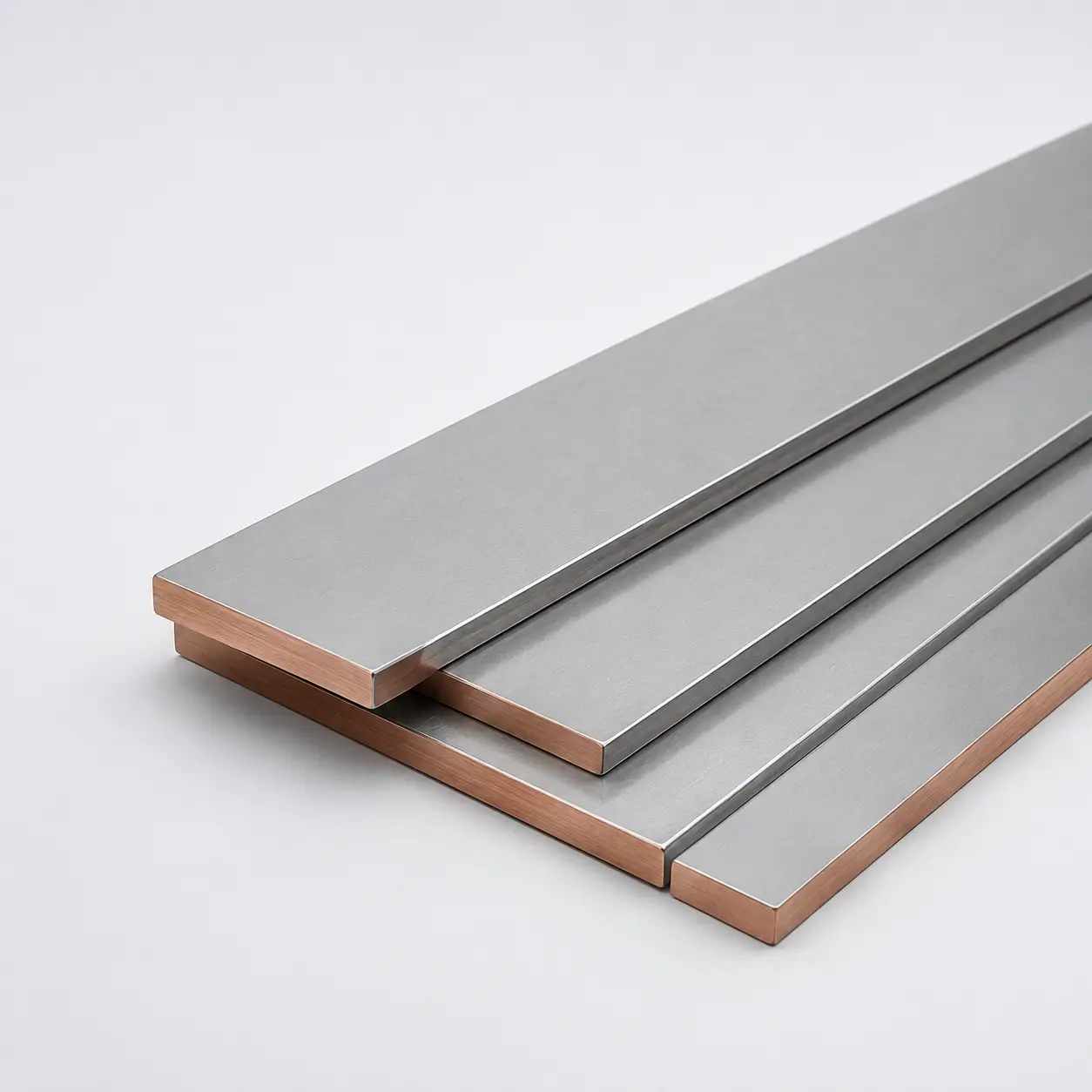
Connections determine both current transfer and corrosion boundary. Define terminal material, contact surface, hole/slot pattern, fasteners, joint preparation, torque responsibility, flexible links, welds, brazed or mechanical transitions, seals, potting, gaskets and maintenance access.
- Mark the liquid line and minimum dry distance to exposed copper where applicable.
- Define whether contact faces remain titanium-covered or intentionally expose copper.
- Protect machined edges and holes according to the approved design.
- State continuity, joint-resistance, load or temperature-rise tests when required.
8. Qualify the Bonding Route and Control Changes
Possible routes may include explosive cladding, roll bonding, extrusion/drawing, diffusion-based processes or other qualified methods depending on form and dimensions. The supplier must confirm the actual route; the page does not claim every route for every product.
- Define input surface preparation, alignment and traceability.
- Identify critical route variables and qualification records.
- Agree change-control triggers for materials, route, processor, dimensions and heat treatment.
- Define bond-area calculation, permissible discontinuities and test-coupon relationship.
9. Control Machining, Forming, Welding and Repair
Machining can remove or smear cladding, expose copper and create burrs or stress concentrations. Forming can thin or separate layers. Welding or joining near the interface can change microstructure and create new corrosion paths. Freeze the sequence and acceptance before production.
- Specify datums, machining allowance, tool access and finished-edge condition.
- Define bend radius/orientation and any post-form inspection.
- Approve weld/joining procedures, filler/transition materials and heat control where applicable.
- State whether repair is permitted and how repaired areas are re-inspected.
10. Match Inspection to the Characteristic
| Requirement | Possible evidence when ordered | Boundary |
|---|---|---|
| Material identity | MTC, heat/lot, grade/UNS and product-form specification | Does not prove bond or assembly performance |
| Geometry / coverage | Dimensional report, thickness map, coverage/edge inspection and photographs | Method and sampling must be defined |
| Bond condition | Qualified UT or other NDT, section, bend/shear or agreed destructive coupon tests | No single method proves every defect or form |
| Electrical path | Continuity/resistance, joint check, load or temperature-rise test | Fixture, temperature and acceptance are order-specific |
| Surface / sealing | Visual inspection, leak/seal test or coating check where applicable | Service chemistry still controls suitability |
| Release | CoC, report index, traceability map, deviations, labels and packing list | Documents must identify shipped items |
11. Use Standards Only Within Their Published Scope
Covers plate with an integrally and continuously bonded reactive/refractory-metal layer and is generally intended for pressure-vessel use. It may be relevant to qualifying clad plate when contractually invoked; it is not a universal bar, rod, tube or busbar specification.
ASTM B432 covers copper or copper-alloy clad steel plate. It does not define a copper core clad with titanium.
ASTM B265, B348/B348M, B187/B187M and B152/B152M can control applicable titanium or copper inputs by form. They do not replace the composite drawing, bonding, connection and acceptance requirements.
12. Add Application-Specific Controls
Tank chemistry, workpiece distribution, hanger contact, liquid level, cleaning, rack changes, current cycle and contact maintenance.
Brine, wet/dry chlorine, hypochlorite, condensate, cell current, gas and heat, sealing, cooling and system-performance owner.
Electrolyte, impurities, temperature, cell layout, contact arrangement, current distribution, cathode/product and maintenance.
Exact conductor function, seawater/soil exposure, current, cable/terminal transition, sealing, installation, monitoring and applicable project standard.
13. Investigate the Failure Mode Before Reordering
Possible contributors include exposed copper, damaged or incomplete cladding, bond discontinuity, crevice attack, unsuitable titanium grade, contact resistance, loose joints, current crowding, inadequate cross-section, poor cooling, overheating, seal failure, machining damage, fatigue or mechanical overload.
- Record chemistry, temperature, current/voltage, joint condition and operating history.
- Photograph the assembly before cleaning or dismantling.
- Map damage relative to liquid line, cut ends, holes, joints and supports.
- Do not assume delamination is the only possible failure.
14. Normalize Commercial and Delivery Scope
Price can be driven by copper and titanium grades, cross-section, cladding coverage, route, length, machining, connections, inspection, destructive samples, reports, quantity, packing and logistics.
- Compare the same finished geometry and material basis.
- Separate conductor, contacts, fasteners, seals, fabrication, tests and documents.
- Record quantity, production assumptions, schedule, validity, Incoterm and exclusions.
- Protect surfaces, ends, contact faces, straightness and identity during packing.
15. Complete Titanium-Clad Copper Purchase Guard
15.1 Function and responsibility
- Define conductor, structural, corrosion-barrier and connection functions.
- State component, subassembly and system-performance ownership.
- Identify installation, commissioning and maintenance responsibility.
15.2 Current and thermal duty
- State continuous, peak and fault current; voltage and duty cycle.
- Define length, parallel paths, contacts, cooling and ambient/process temperature.
- State allowable voltage drop, resistance or temperature rise and test basis.
15.3 Service and corrosion boundary
- List full chemistry, contaminants, temperature and cleaning exposure.
- Map immersion, splash, vapor, condensation and dry zones.
- Identify crevices, deposits and dissimilar-metal contacts.
15.4 Materials and product form
- State copper and titanium grade/UNS, condition and applicable form standard.
- Define core, cladding and finished dimensions/tolerances.
- Require heat/lot and composite traceability.
15.5 Coverage, ends and transitions
- Map clad/unclad surfaces, cut ends, holes, threads and contact faces.
- Define cladding-thickness basis and measurement.
- Specify edge, corner, liquid-line and seal details.
15.6 Bonding and change control
- Identify approved manufacturing route and qualification basis.
- Define bond area, allowed discontinuities, test methods and sampling.
- Require approval for material, route, processor or major dimensional changes.
15.7 Connections and fabrication
- Define terminals, joints, fasteners, contact preparation and seals.
- Freeze machining, forming, welding/joining and repair procedures.
- State re-inspection after fabrication.
15.8 Inspection and documents
- For every characteristic state method, coverage, sampling, limits and report.
- Do not treat UT as proof of all bond, electrical and corrosion performance.
- Agree MTC, dimensional/bond/electrical evidence, CoC, deviations and packing list.
15.9 Commercial and delivery
- Normalize quantity, spares, currency, Incoterm and named place.
- Separate materials, fabrication, tests, documents and freight.
- Record schedule assumptions, validity and exclusions.
Red flags before purchase order
Environment, titanium grade and all exposure boundaries are not defined.
Length, contacts, temperature, cooling and allowable loss are missing.
Procedure, calibration, coverage, detectable limits and acceptance are absent.
The standard applies to copper-clad steel plate, not titanium-clad copper.
Decision gate
Do not release the order until current path, thermal basis, service exposure, materials, geometry, coverage, connections, bond acceptance, fabrication, evidence and commercial terms describe one verifiable deliverable.
16. RFQ and Pre-Order Checklist
Component role, chemistry, temperature, immersion/splash/vapor/dry zones and cleaning.
Current, voltage, length, duty, contacts, cooling, allowable loss and temperature rise.
Copper/titanium grade, form, condition, core/clad/finished dimensions and tolerances.
Clad map, ends, holes, terminals, joints, seals, liquid line and maintenance access.
Bond route, change control, NDT/mechanical/electrical tests, sampling and documents.
Quantity/spares, packing, destination, Incoterm, required date and exclusions.
17. Titanium-Clad Copper Purchasing FAQ
What is the first decision when buying titanium-clad copper?
Define the current path and exposure boundary. The drawing must show where copper carries current, where titanium faces the process environment, and where ends, holes, terminals, welds and seals interrupt the cladding.
Is copper conductivity enough to calculate conductor performance?
No. Use the specified copper grade, temper, dimensions and operating temperature, then include length, interfaces, terminals, current distribution, cooling and contact resistance. A material conductivity value is not the same as assembly voltage drop.
Does ASTM B898 cover titanium-clad copper busbars and rods?
ASTM B898 covers clad plate within its scope and is generally intended for pressure-vessel use. It should not be presented as a universal specification for rods, tubes, busbars or connectors.
Is ASTM B432 a titanium-clad copper standard?
No. ASTM B432 covers copper or copper-alloy clad steel plate. It does not specify a copper core clad with titanium and should not be cited as the governing titanium-clad copper product standard.
Can an ultrasonic test prove electrical performance?
Not by itself. NDT can address defined bond discontinuities under an agreed procedure, but electrical resistance, contact performance, current distribution, thermal behavior and service corrosion require their own evidence.
How should quotations be compared?
Normalize product form, material grades and tempers, core and finished dimensions, cladding thickness and coverage, exposed zones, bond route, connection design, current and thermal duty, inspection scope, documents, quantity, packing, Incoterm and exceptions.
Standards References
- ASTM B898-20(2026) — Reactive and refractory metal clad plate
- ASTM B432-25 — Copper and copper-alloy clad steel plate (not Ti-Cu)
- ASTM B265-25 — Titanium and titanium-alloy strip, sheet and plate
- ASTM B348/B348M-25 — Titanium and titanium-alloy bars and billets
- ASTM B187/B187M-26 — Copper conductor bar, rod and shapes
- ASTM B152/B152M-24 — Copper sheet, strip, plate and rolled bar