
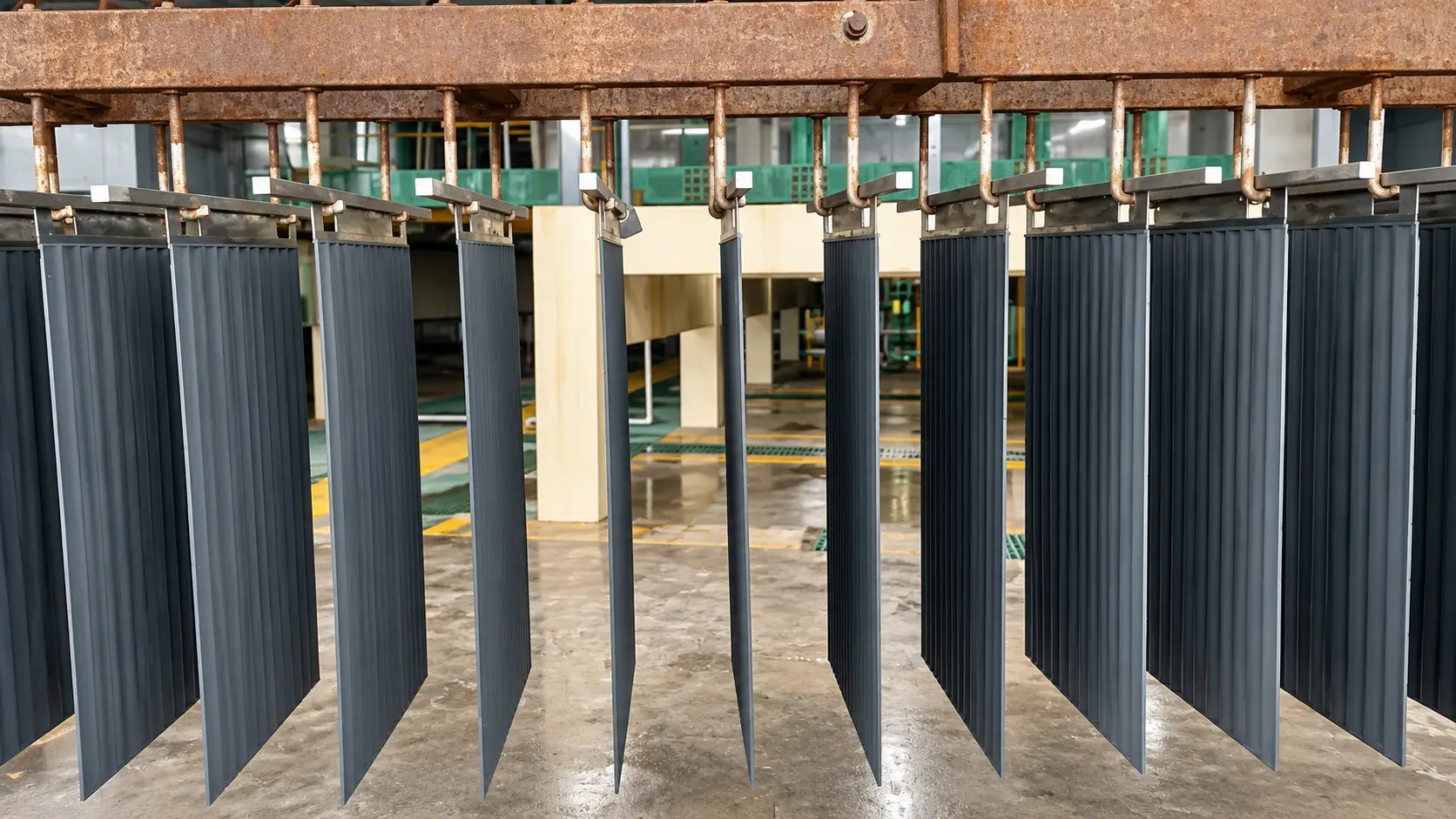
A reliable Ti/PbO₂ purchase starts with a controlled process, matrix and safety basis—not with a broad wastewater label, a copied removal rate or the words “high oxygen-evolution potential.” Buyer and supplier need the same definition of layer architecture, duty, evidence, lead responsibility and acceptance.
1. Confirm the Process Duty and Supply Scope
State the intended anodic reaction, measurable process result, competing reactions, product or effluent requirement and who owns the process/reactor design. Define whether the order covers an electrode, frame/assembly, pilot unit, replacement item, coupons, spares or other components.
- Separate electrode acceptance from full-process performance responsibility.
- State wastewater treatability, electrowinning, synthesis, pilot/R&D or another defined duty.
- List included feeds, frames, seals, fixtures, tests, documents and lead-management scope.
- Record governing drawings/specifications, revisions, precedence and deviations.
2. Define the Complete Matrix and Operating Window
Provide water/electrolyte composition, target and non-target species, COD/TOC or metal ions where relevant, conductivity, chloride, sulfate, acidity/pH, additives, contaminants, temperature, flow, solids, gas release and cleaning chemistry.
- Include normal, minimum, maximum, startup, shutdown, standby and upset conditions.
- Identify seasonal or batch variability, replenishment and carryover.
- State byproduct, product-purity and lead-release constraints.
- Do not use an industry name as chemistry or compatibility evidence.
3. Separate PbO₂, BDD, MMO/IrO₂ and Lead-Alloy Routes
| Direction | Starting duty | Qualification boundary |
|---|---|---|
| Ti/PbO₂ | Validated specialty oxidation/electrowinning route | Layer, matrix, Pb monitoring, reactor and end-of-life |
| BDD | Diamond-electrode oxidation under a defined process basis | Film/substrate, quality, scale, supply and performance evidence |
| MMO/IrO₂ | Defined chlorine- or oxygen-evolution catalytic duty | Reaction, coating family, chemistry, electrical duty and life |
| Lead alloy | Bulk lead-alloy hydrometallurgical duty | Alloy, corrosion, contamination, mechanics and handling |
4. Freeze the Order-Specific Layer Architecture
Identify the titanium substrate, each intermediate/barrier layer, each PbO₂ layer or phase requirement, dopant/modification if any, active-zone map, thickness/loading/performance metric, preparation/deposition control and acceptance.
- Do not assume every product contains both α- and β-PbO₂.
- Distinguish phase, composition, morphology, thickness/loading, adhesion and performance.
- Define qualification coupons and their relationship to production parts.
- Control process/specification changes that could affect structure or performance.
5. Control the Titanium Substrate and Interfaces
State grade/UNS, product form, material standard where applicable, condition, heat/lot identity if ordered, dimensions, tolerances, fabrication, welds, surface condition and preparation basis.
Define what happens at edges, masks, contacts, welds and any place the lead-dioxide system may terminate or the substrate may be exposed.
6. Freeze Geometry, Effective Area and Active Zones
Provide a controlled drawing with overall dimensions, tolerances, active faces, coated and masked zones, inactive edges, holes, frames, welds, supports, seals, mounting and cell interface. For mesh/perforated forms, state geometry, orientation, open area and current-density area convention.
7. Define Electrical and Reactor Duty
State total current, current-density denominator, cell voltage, electrode potential/reference where relevant, waveform, polarity, ramp, duty, electrode gap, flow/mass transfer, gas management, counter-electrode and reactor volume/throughput.
- Separate power-supply voltage, cell voltage, electrode potential and connection drop.
- Use the same effective-area basis in design, quotation, testing and operation.
- Define current-distribution assumptions and shielding.
- Include reversal, interruption, dry exposure and abnormal-control scenarios.
8. Define Treatability, Electrowinning or Synthesis Evidence
For wastewater/treatability, state representative influent, matrix, initial and target analytes, analytical method, sampling, current/area, voltage/energy basis, time or residence time, flow, reactor, temperature, pH, byproducts, Pb monitoring and mass balance where relevant.
For electrowinning, state target metal, electrolyte and impurities, cathode/product quality, current efficiency, voltage/energy basis, metal balance, operating period and monitoring. For synthesis, state conversion, selectivity, yield/purity, analysis and scale-up boundary.
9. Control Manufacturing Route and Changes
Agree substrate verification, fabrication, preparation, intermediate-layer route, PbO₂ deposition, intermediate controls, masking, finishing, cleaning, handling, inspection, identification and protective packing. The public guide does not provide hazardous DIY recipes.
- Define controlled batch/process records and qualification samples.
- Control repair, rework and repeated deposition.
- Require notice/approval for changes to materials, layer route, equipment, site or inspection method when applicable.
- Apply qualified occupational and environmental controls throughout the lead-containing process.
10. Match Each Claim to the Correct Evidence
| Characteristic | Possible evidence | Boundary |
|---|---|---|
| Substrate | MTC, heat/lot, dimensions, surface condition | Does not prove PbO₂ layer performance |
| Crystalline phase | XRD under a stated scan/interpretation method | Not thickness, adhesion or lot-wide performance |
| Morphology/cross-section | SEM on defined samples/locations | Selected-area evidence; preparation may be destructive |
| Thickness/loading | Cross-section, mass-based, calibrated instrumental or validated method | Metric, area, calibration and uncertainty must match |
| Composition | Calibrated XRF or another suitable analytical method | Not automatic proof of thickness, phase or life |
| Adhesion/integrity | Order-defined test and defect criteria | Method, conditioning, coupon/part relationship matter |
| Electrochemical/life | Defined cell test with conditions and end point | Not a direct field-life guarantee without correlation |
11. Define Design Life, End Point and Qualification Boundary
Life is conditional on matrix, layer architecture, effective area, current/potential, temperature, duty, flow, reactor, cleaning, monitoring and process control. Define hours/cycles/throughput, allowable performance drift, layer/lead-release end point, inspection and exclusions.
For accelerated tests, state sample, layer basis, matrix, temperature, current-density denominator, waveform/duty, end point and interpretation limits.
12. Preserve Evidence Before Assigning Failure Cause
Before cleaning or dismantling, preserve matrix analysis, current/voltage/potential history, temperature, flow, polarity events, operating time/throughput, process results, energy data, Pb monitoring, cleaning records, photos, dimensions, layer condition and connection measurements.
- Distinguish fouling/deposits, cracking/spalling, wear/erosion, adhesion loss and substrate exposure.
- Check active-area loss, gap, flow, gas, counter-electrode and current distribution.
- Check contact heating, seal ingress, reversal, short circuit and control errors.
- Compare actual operation with the approved design and safety basis.
13. Define Installation, Commissioning and Maintenance
Specify protective handling, orientation, gap, polarity check, connection setup, ramp-up, baseline electrical/process/Pb readings, operating limits, monitoring, cleaning, shutdown and incident response. Cleaning must be approved for the layer, substrate, deposits, connections and process.
14. Control Lead Exposure, Release and End-of-Life
Assign responsibilities for risk assessment, engineering controls, restricted handling, PPE, hygiene, exposure monitoring, decontamination, spill/incident response, process/effluent/product Pb monitoring, packaging, labeling, transport, storage and waste determination.
Applicable exposure limits, transport classification, effluent limits and waste obligations vary by site and jurisdiction. Qualified EHS/legal personnel must confirm the requirements for the actual project.
15. Normalize Technical and Commercial Quotations
Cost and schedule may be driven by layer architecture, active area, substrate form, fabrication, masking, connection, qualification, destructive testing, monitoring/document scope, quantity, protective packing and logistics.
- Compare one frozen layer/drawing revision and area convention.
- Separate development/pilot qualification, production units, spares, assemblies, tests and freight.
- Record validity, schedule assumptions, Incoterm, destination, transport/waste responsibility and exceptions.
- Compare performance/life claims only when matrix, reactor, method, end point and monitoring assumptions match.
16. Complete Lead Dioxide Anode Purchase Guard
16.1 Process and scope
- Confirm target reaction, measurable outcome and competing reactions.
- Define electrode, assembly, pilot, replacement, spares, tests and documents.
- Assign process/reactor, analytical and performance responsibility.
16.2 Matrix and operating window
- List full composition, variability, chloride, conductivity, pH, contaminants and cleaning.
- State temperature, flow, solids, gas, normal, peak and upset conditions.
- Define byproduct, purity and Pb-release constraints.
16.3 Layer architecture
- Identify substrate, each intermediate layer and each PbO₂ layer/phase requirement.
- Separate phase, composition, morphology, thickness/loading, adhesion and performance.
- Show active, masked, contact and transition zones.
16.4 Geometry and traceability
- State Ti grade/form basis, condition, heat/lot where ordered and fabrication.
- Freeze dimensions, tolerances, mesh-area convention, welds, supports, seals and mounting.
- Control drawing/specification revisions.
16.5 Electrical and reactor basis
- State current, density denominator, voltage/potential/reference, waveform, duty and polarity.
- Define gap, flow/mass transfer, gas, counter-electrode and distribution assumptions.
- Control feeds, contacts, joints, seals and acceptance tests.
16.6 Testing and performance evidence
- Separate XRD, SEM, thickness/loading, composition, adhesion and electrochemical/life evidence.
- For every result state method, sample/location, calibration, units, limits and lot relationship.
- Define process analytical methods, energy/current-efficiency basis, life end point and exclusions.
16.7 Lead management and operation
- Assign EHS controls, handling, PPE/hygiene, monitoring, cleaning and incident response.
- Define Pb monitoring in the relevant process, effluent or product.
- Confirm packaging, transport, storage and end-of-life responsibilities.
16.8 Commercial and change-control scope
- Define qualification/pilot and production scope separately.
- Control material/process/site/method changes and requalification.
- Normalize quantity, tests, documents, packing, Incoterm, schedule and exceptions.
Red flags before purchase order
Cell voltage, current efficiency, mass transfer, reactor and treatment time are missing.
XRD or another appropriate phase method and interpretation are missing.
Matrix, reactor, time, area/current, analytics, byproducts, energy and Pb data are absent.
Exposure, handling, monitoring, transport and end-of-life responsibilities are undefined.
Decision gate
Do not release the order until process, matrix, layer architecture, active area, electrical/reactor duty, evidence, lead controls, life and commercial scope describe one verifiable deliverable.
17. RFQ and Pre-Order Checklist
Reaction/outcome, complete matrix, variability, pH, conductivity, chloride, temperature, flow and cleaning.
Ti basis, intermediate layers, PbO₂ phase/metric, active zones, adhesion and change control.
Current, area denominator, voltage/potential/reference, duty, gap, flow, volume/throughput and gas.
XRD/SEM/thickness/composition/adhesion methods, analytics, energy/current efficiency, life and end point.
Exposure controls, handling, monitoring, commissioning, cleaning, incident, transport and end-of-life.
Qualification/pilot, quantity/spares, documents, packing, destination, Incoterm, date and exceptions.
18. Lead Dioxide Anode Purchasing FAQ
What is the first decision in a Ti/PbO₂ RFQ?
Confirm the target reaction and process outcome, complete electrolyte or water matrix, lead-management boundary and whether the requested product is an electrode, assembly, pilot item or replacement.
How should a layer structure be specified?
Identify the titanium substrate, each order-defined intermediate or barrier layer, each PbO₂ layer or phase requirement, active-zone map, metric, units, preparation/deposition control, qualification samples and acceptance method.
What does XRD prove?
XRD can support crystalline-phase identification under the stated specimen, scan and interpretation method. It does not automatically prove coating thickness, adhesion, lot-wide uniformity, lead release or service life.
What does SEM prove?
SEM may show selected-area morphology or cross-sectional features. Sampling and preparation matter, and the images do not automatically represent an entire production lot or identify crystalline phase without suitable complementary evidence.
How should electrowinning performance be evaluated?
Define target metal, electrolyte and impurities, current/area basis, cell geometry, cathode and product-quality targets, current efficiency, voltage/energy reporting, operating period, monitoring and acceptance.
How should competing quotations be compared?
Normalize layer architecture, coating metric/method, active area, electrical duty, geometry, connection, tests, lead-management scope, documents, quantity, packing, Incoterm, schedule assumptions and exceptions.
Technical and Safety References
- CDC/NIOSH — Lead in the workplace
- CDC/NIOSH — Lead-exposure prevention information for workers
- Chemical Society Reviews — Electrodeposited lead dioxide coatings
- U.S. Bureau of Mines / CDC Stacks — Lead-dioxide-plated titanium anode research
- HELE — BDD electrodes
- HELE — IrO₂ / Ir-Ta oxygen-evolution anodes