
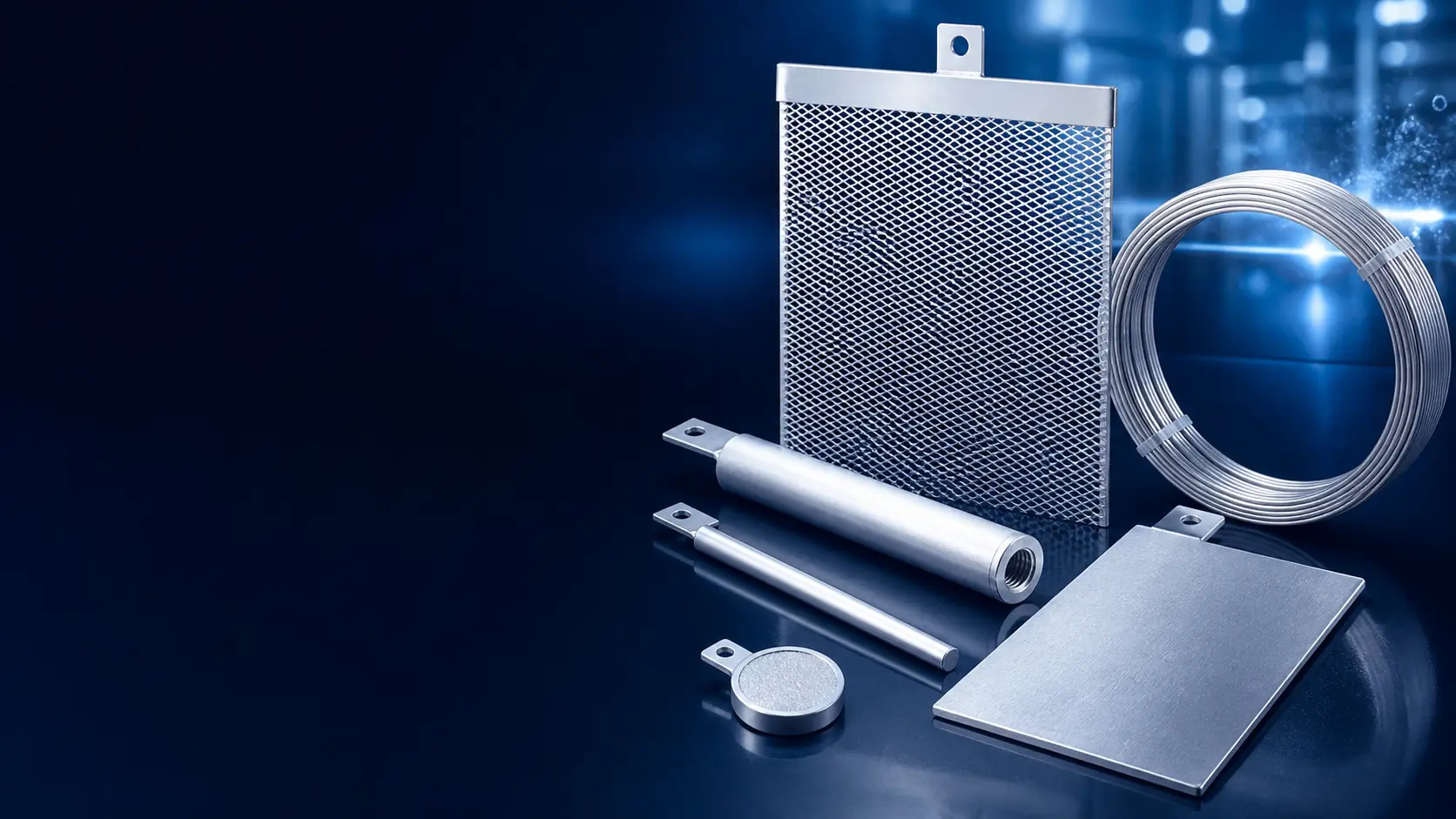
A reliable Pt/Ti purchase begins with a controlled electrochemical and substrate basis—not with an application label, a copied platinum thickness or the phrase “platinum coated.” Buyer and supplier need the same definition of chemistry, substrate, deposit, active area, geometry, electrical duty, evidence and life.
1. Confirm the Electrochemical Duty and Supply Scope
State the intended anodic reaction, process result, competing reactions, product-quality requirement and who owns the cell/process design. Define whether the order covers an electrode, frame/assembly, replacement item, replatinizing service, test coupons, spares or other components.
- Separate electrode acceptance from complete-cell and process-performance responsibility.
- State new design, OEM replacement, retrofit or used-substrate evaluation.
- List included drawings, leads/tabs, frames, seals, fixtures, tests and documents.
- Record governing specifications, revisions, precedence and deviations.
2. Define the Complete Electrolyte and Operating Window
Provide composition and concentration ranges, acidity/pH, chloride, fluoride, oxidizing/reducing species, metal ions, additives, contaminants, conductivity, temperature, flow/agitation, gas release, solids, scale and cleaning chemistry.
- Include startup, shutdown, standby, normal, peak and upset conditions.
- Identify replenishment, drag-in/drag-out and expected process changes.
- State product-purity, deposit-quality or selectivity requirements.
- Do not use a broad application name as compatibility evidence.
3. Separate Pt/Ti, Pt/Nb, MMO and Solid Platinum
| Direction | Construction | Primary review |
|---|---|---|
| Pt/Ti | Platinum surface on titanium | Titanium compatibility, Pt metric, active area, duty |
| Pt/Nb | Platinum surface on niobium | Substrate risk under the complete chemistry/potential |
| MMO/Ti | Mixed-metal-oxide catalyst on titanium | Target CER/OER reaction and coating family |
| Solid Pt | Platinum through the full section | Specialized duty, geometry, mechanical need and Pt inventory |
Platinum-clad construction is not automatically equivalent to deposited/platinized Pt/Ti. Use the manufacturing route stated in the controlled order.
4. Specify the Platinum Requirement Without Mixing Metrics
Define whether the controlled requirement is thickness, loading, mass, composition, coverage, functional performance or another metric. State units, actual coated area, coated sides, method, calibration, locations, sampling, tolerances and acceptance.
- Do not convert μm and g/m² without a validated agreed relationship.
- Map coated, masked, contact and transition zones.
- Distinguish minimum, nominal, average and local requirements.
- Control process or specification changes that affect the platinum surface.
5. Control the Titanium Substrate and Exposure Risk
State grade/UNS, product form, applicable substrate standard, condition, heat/lot, dimensions, tolerances, fabrication, welds and surface condition. Review what happens if the platinum surface contains pores, is damaged or becomes locally worn.
If fluoride, aggressive chemistry, elevated temperature, unusual anodic potential or prior substrate failure is present, re-evaluate Pt/Ti rather than assuming more platinum thickness solves the substrate risk.
6. Freeze Geometry, Effective Area and Active Zones
Provide a controlled drawing with overall dimensions, tolerances, coated surfaces, active length, submerged area, inactive edges, holes, masking, frames, welds, supports, seals and mounting. For mesh, state SWD/LWD, strand dimensions, orientation and the area convention.
Overall outside dimensions are not automatically the effective electrochemical area. Use the same active-area definition for design, quotation, testing and operation.
7. Define Electrical Duty with the Correct Area Denominator
State total current, current density and its denominator, cell voltage, electrode potential/reference where relevant, waveform, polarity, ramp, normal/peak duty and operating schedule.
- Separate power-supply voltage, cell voltage, electrode potential and connection drop.
- Show one-side/two-side or projected/geometric mesh-area basis.
- Define electrode spacing, counter-electrode, shielding, flow and current distribution.
- Include reversal, interruption and abnormal-control scenarios.
8. Treat the Connection and Cell Interfaces as Part of the Design
Define tab, thread, cable, bus/feed, weld or mechanical joint; materials, contact area, seal, strain relief, orientation, torque where relevant, corrosion protection, continuity/resistance test and acceptance.
Assign responsibility for fixtures, cell, cathode/counter-electrode, reference electrode, rectifier/control, hydraulics, temperature and gas management.
9. Control Manufacturing Route and Changes
Agree substrate verification, forming/machining/welding, surface preparation, platinum deposition route, intermediate controls, masking, finishing, cleaning, handling, inspection, identification and packing.
- Define qualification samples or coupons and their relationship to production parts.
- Control repair, rework and repeated deposition.
- Require notice/approval for changes to substrate, precursor/process, equipment, site or inspection method when applicable.
- Keep customer drawings and acceptance revisions traceable.
10. Match Each Claim to the Correct Inspection Evidence
| Characteristic | Possible evidence | Boundary |
|---|---|---|
| Substrate | MTC, heat/lot, dimensions, surface condition | Does not prove platinum performance |
| Pt thickness/loading | Calibrated XRF, cross-section, mass-based or other validated method | Method must fit metric, geometry and accuracy |
| Adhesion | Order-defined test on part/coupon | Thickness does not automatically prove adhesion |
| Coverage/surface | Defined visual or instrumental inspection | Criteria, lighting/magnification and sampling matter |
| Electrical/electrochemical | Continuity/resistance, potential/polarization or project test | Cell, reference, chemistry and conditions must be stated |
| Life/qualification | Conditioned test with method and end point | Not a direct field-life guarantee without correlation |
11. Define Design Life, End Point and Qualification Boundary
Life is conditional on the stated chemistry, substrate, platinum basis, effective area, current/potential, temperature, duty, flow, cell geometry, cleaning, maintenance and process control. Define hours/cycles/throughput, performance end point, allowable drift, monitoring and exclusions.
If accelerated testing is required, state sample, geometry, electrolyte, temperature, current-density denominator, waveform/duty, end point and how the result may—and may not—be used.
12. Preserve Evidence Before Assigning a Failure Cause
Before cleaning or dismantling, preserve bath analysis, current/voltage/potential history, temperature, flow, polarity events, operating hours, product/deposit quality, cleaning records, photos, dimensions, surface/coverage condition and connection measurements.
- Distinguish deposit/fouling, platinum wear/damage, adhesion loss and substrate exposure.
- Check active-area loss, gap, shielding, cathode condition and current distribution.
- Check contact heating, seal ingress, reversal, short circuit and control errors.
- Compare the actual process with the approved design basis.
13. Define Installation, Commissioning and Maintenance
Specify protective handling, orientation, gap, polarity check, torque/contact setup where relevant, ramp-up, baseline readings, bath limits, monitoring, cleaning and shutdown. Cleaning must be approved for the platinum surface, titanium substrate, deposits, connections and process.
State which operating records are required to support warranty, life or failure evaluation.
14. Assess Replatinizing as Conditional Requalification
Inspect remaining thickness, pitting, cracks, deformation, welds, threads, contacts, seals, contamination, dimensional compliance and the updated process duty. Define removal of the old platinum, substrate preparation, new deposition, identification, tests and acceptance.
Replatinizing does not by itself prove a fixed percentage saving or restoration of original efficiency, purity, service life or warranty.
15. Normalize Technical and Commercial Quotations
Cost and schedule may be driven by platinum metric and area, substrate form, fabrication, masking, connection, qualification, destructive testing, precious-metal price basis, documents, quantity, packing and logistics.
- Compare one frozen drawing/specification and area convention.
- Separate development/qualification, production units, spares, assemblies, tests and freight.
- Record Pt-price adjustment basis if applicable, validity, Incoterm, destination and exceptions.
- Compare life claims only when chemistry, duty, end point and maintenance assumptions match.
16. Complete Platinized Titanium Anode Purchase Guard
16.1 Process and scope
- Confirm target reaction, process/product objective and competing reactions.
- Define electrode, assembly, replatinizing, spares, test and document scope.
- Assign cell, bath, rectifier, controls and product-quality responsibility.
16.2 Chemistry and substrate
- List complete bath, additives, chloride, fluoride, contaminants and cleaning.
- State normal, peak, startup, shutdown and upset conditions.
- Confirm titanium compatibility and exposure risk; route Pt/Nb separately when required.
16.3 Platinum and active area
- Define Pt metric, units, method, calibration, locations, sampling and limits.
- Do not mix thickness and loading bases.
- Show coated, masked, contact and transition zones with effective area.
16.4 Geometry and substrate traceability
- State grade/UNS, product-form basis, condition and heat/lot.
- Freeze dimensions, tolerances, mesh-area convention, welds and mounting.
- Control drawing and specification revisions.
16.5 Electrical and interfaces
- State current, density denominator, voltage/potential/reference, waveform and duty.
- Define gap, flow, counter-electrode and distribution assumptions.
- Control contacts, joints, leads/feeds, seals and acceptance tests.
16.6 Inspection, life and evidence
- Separate Pt metric, adhesion, coverage, electrical/electrochemical and life evidence.
- For every result state method, calibration, sample/location, units and limits.
- Define design-life conditions, end point, qualification and exclusions.
16.7 Operation and failure evidence
- Define handling, installation, polarity, ramp, monitoring and approved cleaning.
- Keep process and electrical operating records.
- Preserve evidence before cleaning or dismantling after abnormal performance.
16.8 Replatinizing and commercial scope
- Inspect substrate and connections before approval.
- Define stripping, new deposition, requalification, warranty and identification.
- Normalize quantity, Pt-price basis, tests, documents, packing, Incoterm, schedule and exceptions.
Red flags before purchase order
Bath, reaction, substrate risk and product-quality responsibility are missing.
Units, coated area, calibration, locations and acceptance are unclear.
Coated sides, masks, edges and mesh-area convention are missing.
Chemistry, duty, end point, substrate assessment and exclusions are absent.
Decision gate
Do not release the order until chemistry, substrate, Pt basis, active area, electrical duty, geometry, connection, evidence, life, operation and commercial scope describe one verifiable deliverable.
17. RFQ and Pre-Order Checklist
Target reaction, full electrolyte, pH, additives/contaminants, temperature, flow and cleaning.
Ti material basis, Pt metric/method, coated zones, substrate exposure risk and Pt/Nb decision.
Current, area denominator, voltage/potential/reference, waveform, duty, peaks, polarity and gap.
Drawing, tolerances, mesh convention, active/inactive area, welds, tab/cable/feed, seal and mounting.
MTC, Pt/adhesion/surface methods, commissioning, monitoring, cleaning, life and failure records.
Quantity/spares, Pt-price basis, tests, documents, packing, destination, Incoterm, date and exceptions.
18. Platinized Titanium Anode Purchasing FAQ
What is the first decision in a Pt/Ti RFQ?
Confirm the intended electrochemical duty, complete electrolyte and whether titanium is a suitable substrate before selecting the platinum metric, thickness, area or geometry.
Are micrometres and grams per square metre interchangeable?
No. They are different reporting bases unless a validated relationship, density/model, actual coated area and measurement method are defined. Compare quotations only on the same agreed metric and area basis.
Does more platinum always mean longer life?
No. Life also depends on chemistry, substrate compatibility, local current distribution, active area, porosity/defects, adhesion, temperature, duty, cleaning, polarity and the agreed end point.
Can an application name define the anode?
No. Electroplating, electroforming, electrolysis and laboratory use each cover different baths, reactions, potentials, duty cycles, product-quality responsibilities and acceptance methods.
How should a mesh active area be stated?
State the mesh geometry and whether current density uses projected area, geometric strand area, one-side/two-side area or another agreed convention. Use the same denominator in design, quotation, testing and operation.
How should competing quotations be normalized?
Align chemistry, substrate, platinum metric and method, effective active area, current basis, geometry, connection, tests, documents, quantity, packing, Incoterm, schedule assumptions and exceptions.