
A Ru-Ir anode can be the right starting point for a chloride-electrolysis project, but the coating name does not tell you how it will behave in your brine, seawater loop or replacement cell.
The buyer’s main risk is assuming that all Ru-Ir-coated electrodes for chlorine service are interchangeable. Chloride concentration, impurities, pH, temperature, flow and current density can change the anode’s working conditions. Cell output and product quality also depend on the cathode, residence time and controls—not only the electrode.
The short answer: Send feed-water or brine analysis, intended chlorine/hypochlorite duty, operating current, flow and temperature, active-zone drawing and connection. Ask the supplier to describe its service assumptions, qualification method and complete delivered scope.
1. What reaction and product does the system target?
Ru-Ir mixed-metal-oxide-coated titanium anodes are commonly discussed for chloride-rich chlorine-evolution service. The actual process may be a brine cell, seawater electrochlorination system or an OEM replacement module. These share a reaction family but differ in salinity, impurities, flow and product handling. Describe whether the plant needs chlorine gas, on-site hypochlorite or another specified output; the system design and safety controls belong to that process.
Do not use this guide to select an oxygen-evolution electrode from a vague “MMO” description. An Ir-based OER route should be evaluated on its own chemistry and duty. A mixed electrolyte or process whose dominant reaction can change should be flagged for engineering review, not sorted by a marketing label.
2. Which feed conditions make two chlorine systems different?
Give the chloride range and complete feed analysis, including hardness, organics or other contaminants relevant to the actual plant. State pH, temperature, flow, pressure where it affects the cell, and the method of cleaning deposits. Even a source described as “seawater” changes by location and operating season. A coating test in clean laboratory brine is not automatically representative of dirty field water.
| Operating input | Reason to include it | Supplier/buyer boundary |
|---|---|---|
| Feed composition and variability | Affects competing reactions, deposits and exposure. | Buyer supplies analyses; supplier reviews coating suitability. |
| Current and hours | Drive anode loading and cumulative duty. | Buyer supplies measured/design basis. |
| Flow and gas removal | Affects local concentration and bubble coverage. | System designer owns hydraulics. |
| Reverse polarity or cleaning | May create exposure outside steady chlorine duty. | Controller and maintenance plan must be disclosed. |
For an existing cell, provide records from both normal production and unusual periods: low flow, high current, idle immersion and cleaning. If the old electrode failed, take photos of coated surfaces and connections before disposal. Failure at the connection is a different problem from gradual coating loss.
Feed preparation belongs in the comparison. Filtration, hardness control and the way deposits are removed may differ between a clean brine plant and a once-through seawater system. Ask which feed conditions the electrode supplier assumes and which the plant operator must maintain. If a process excursion can exceed those limits, agree how it will be detected and whether the anode must survive it or merely be protected by an interlock.
3. What is the active electrode geometry?
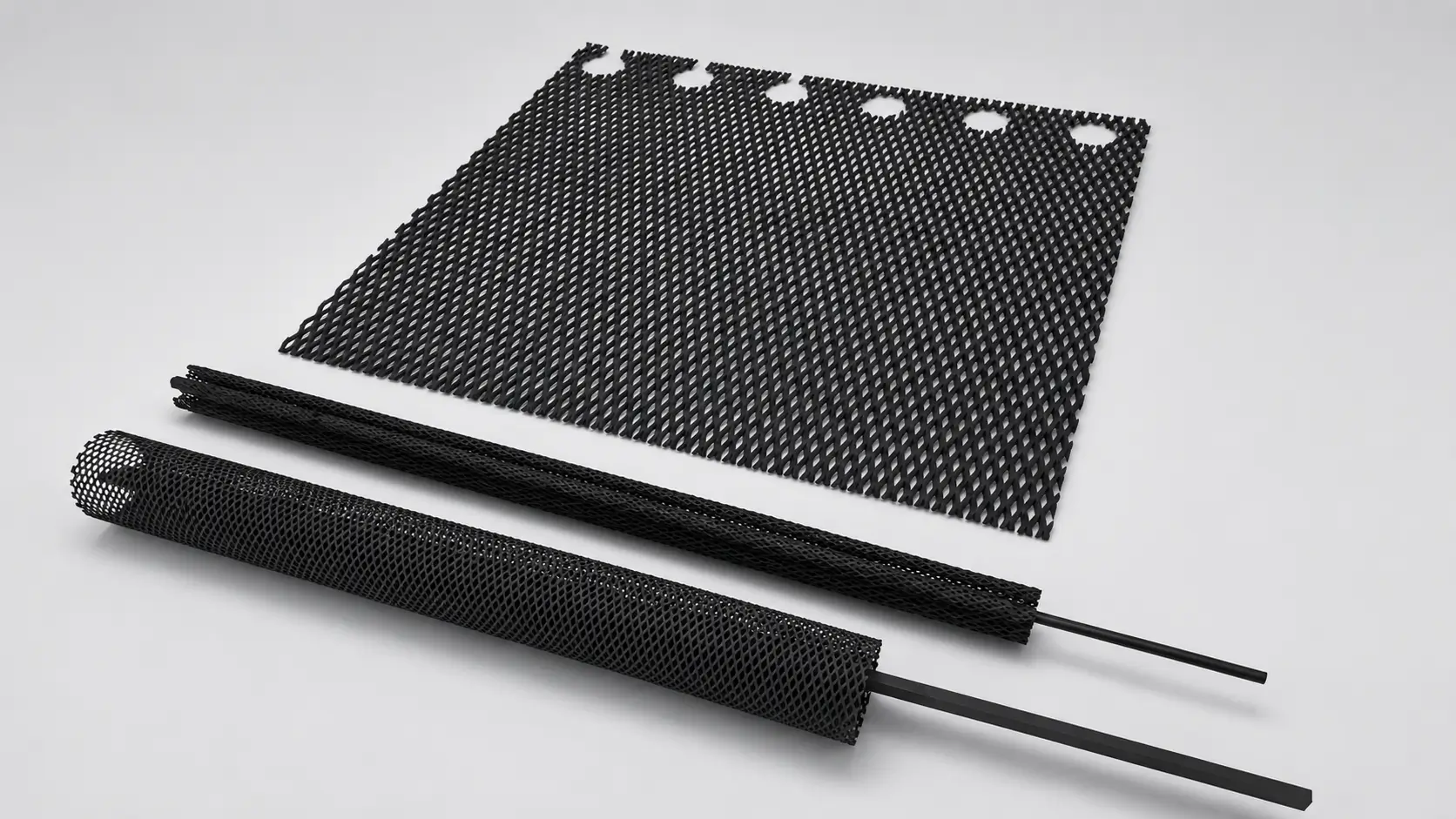
Mesh, plate, rod and tube are not interchangeable at equal outside size. The buyer should show cell spacing, wetted height, coated faces, cutouts and any masked or insulated zones. Ask the supplier how active area is calculated. Current density based on projected mesh area cannot be directly compared with a value based on the real coated strand surface unless the convention is made explicit.
A replacement electrode should also fit the cell hydraulically. Changing a plate to a mesh can alter flow paths and bubble removal; changing thickness can alter clearances. Such changes may be valuable, but they require cell review rather than being presented as an “equivalent part.”
For long electrodes or arrays, consider distribution along the length, not only total projected area. Gas can occupy part of a narrow interelectrode gap, and flow near the inlet need not match flow near the outlet. A supplier can fabricate to a drawing, but system output needs a validated hydraulic and electrical arrangement. This distinction is important when the buyer is deciding whether the purchase is a like-for-like spare or a cell redesign.
4. What could go wrong at the current feed?
Specify design current, normal operating current, controller capacity and any peaks separately. Show the conductor, weld or bolt connection, cable length, insulation and seal. A well-coated mesh with high-resistance contact can heat locally or increase cell voltage. Electrical continuity checks of the delivered assembly help, but the installed connection and controller must also be checked after installation.
For reversible or polarity-cleaning systems, confirm whether the electrode sees cathodic exposure and for how long. The supplier should review that duty as a condition of coating selection. Do not assume a coating qualified under steady anodic operation will tolerate every controller program.
5. What does the qualification evidence actually support?
A useful life claim states electrolyte, temperature, current density, operating schedule, coated geometry and endpoint. Accelerated tests can compare candidate coatings when the method is appropriate, but their conditions and extrapolation must be visible. XRF-based composition or loading checks do not independently prove adhesion or field life.
Separate three records: substrate/assembly identity, coating-process acceptance and operating performance. A material test certificate covers titanium stock, not the catalytic coating. A coating lot report cannot replace a system test for hypochlorite output or faradaic efficiency. Agree who performs a site acceptance test and what process measurements will be taken.
For a replacement program, record the voltage trend and output at the same current and feed conditions before and after the change. That comparison is more informative than a single commissioning number. It also helps distinguish anode deterioration from changes elsewhere in the cell, such as cathode deposits, hydraulic blockage or feed chemistry. Make clear in the acceptance plan which measurements are supplier-controlled and which depend on the plant.
Recoating a returned electrode may be possible after inspection of the titanium, welds, contact and contamination. It should not be sold as guaranteed restoration of the original efficiency or life. If damage is local to a seal or conductor, replacing the coating alone may not resolve it.
6. How should suppliers’ offers be compared?
Ask for the same coated zone, electrical loading, connection and test package. A bare coated plate is not the same supply as a ready-to-install cell element with terminals and seals. Price can change with coating loading, substrate form, preparation, quantity and evidence required. A lower quote can be correct—but only when its exclusions are visible.
The HELE Ru-Ir anode page identifies possible geometries. For each inquiry, HELE still needs the process and installation data before confirming a configuration, delivery schedule or life basis.
7. What should the RFQ contain?
- Process output and chloride feed analysis with operating ranges.
- Current, voltage, hours, flow, temperature, cleaning and reversal program.
- Cell drawing with active zone, substrate form, spacing, connection and seals.
- Old electrode drawing and service records for a replacement.
- Required material, coating and electrical tests plus site acceptance boundary.

Questions buyers often ask
Can an Ir-based oxygen-evolution anode replace a Ru-Ir chlorine anode?
Not by coating name alone. Reaction, chloride chemistry, current and cell design must be reviewed before substitution.
Does a clean-brine accelerated test prove life in seawater?
No. The test conditions and endpoint must be compared with actual feed, contaminants, flow and duty.
What is usually missing from a replacement inquiry?
The electrical and mechanical interface: coated area, terminal, seal, cable and controller history.