
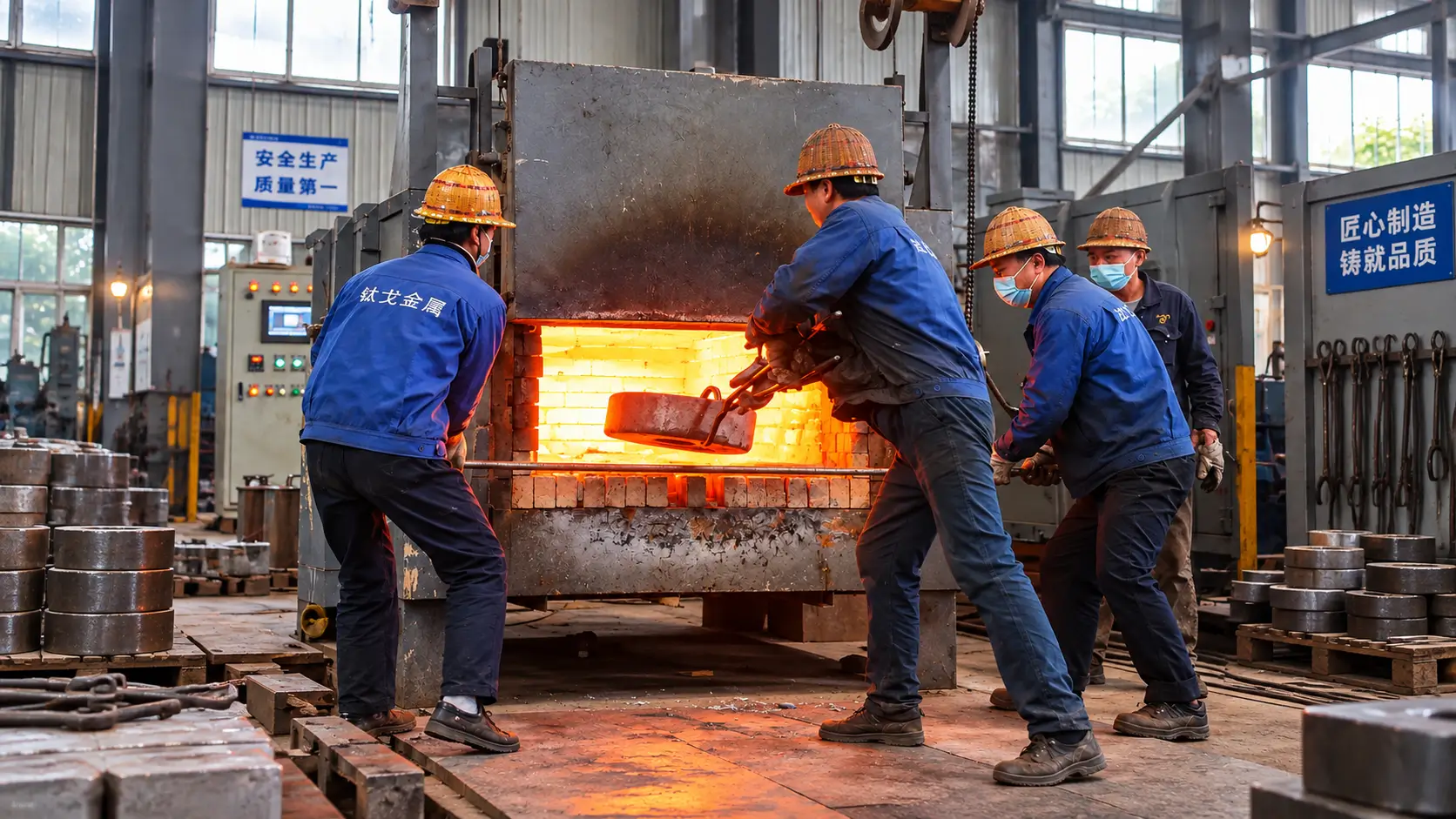
A titanium forging purchase is not complete when it names only a commercial Grade and final-part dimensions. The buyer and supplier need one controlled definition of the forging, its relationship to the final part, and the evidence required at each manufacturing stage.
1. Define the Delivery Boundary
State whether the deliverable is as-forged, heat-treated and descaled, proof-machined for NDE, rough-machined, finish-machined or a complete component with secondary processes. Identify who owns final machining, final dimensional acceptance and functional qualification.
Material, envelope, heat treatment, tests, NDE, rough dimensions, surface and documents.
Add final drawing, GD&T, machining, threads, surface, special processes and final inspection.
2. Connect the Final Part to a Forging-Envelope Drawing
Provide the final-part model/drawing and a controlled forging envelope or permit the supplier to propose one for approval. The envelope should show rough dimensions, datums or orientation references, machining stock, draft, radii, transitions, flash/parting features where applicable, test prolongations and removal areas.
- Identify critical load path and orientation requirements.
- Mark no-cut or minimum-stock locations where needed.
- Define how the forging is located for rough and finish machining.
- Freeze drawing/model precedence and revision control.
3. State Specification, Revision, F-Grade and Customer Additions
ASTM B381 covers annealed titanium and titanium-alloy forgings in listed F-Grades. Use the forging designation required by the contract—for example F-2 or F-5 where applicable—plus UNS or customer alloy designation when needed. State the required revision rather than assuming the newest edition applies.
Customer, aerospace, medical, pressure-equipment or other project specifications can add approved-source, process, heat-treatment, sampling, microstructure, NDE, traceability and documentation requirements. List them separately and define precedence.
4. Control Starting Stock and Heat/Lot Traceability
Identify whether the starting stock is billet, bar or another approved form and which material specification controls it. ASTM B348/B348M covers annealed titanium and titanium-alloy bars and billets within its scope; it does not itself establish that the delivered product is a forging.
- Link melt/heat, starting-stock lot, cut piece, forging batch, heat-treatment lot and shipped forging.
- Define identity transfer after cutting, heating, forging, descaling and machining.
- State approved source and substitution controls.
- Agree remelt, macro/micro or other upstream evidence only when required.
5. Select and Freeze the Forging Route
The route may use open-die forging, closed-die forging, ring rolling, upsetting, drawing-out, mandrel work or combinations. Selection depends on geometry, quantity, section transitions, equipment, material utilization, property/orientation requirements, tooling and economics.
| Route | Useful when | Order questions |
|---|---|---|
| Open-die | Large/simple envelopes, blocks, shafts, discs or low-volume custom work | Reduction sequence, orientation, flatness/straightness stock, transitions and allowance |
| Closed-die | Repeat geometry and quantity justify dedicated tooling | Parting line, draft, flash, radii, tool ownership, prototype and change control |
| Rolled ring | Ring geometry and material utilization support a ring-rolling route | OD/ID/height, wall, roundness stock, orientation, expansion ratio and NDE coverage |
| Hollow/mandrel route | Cylinders or sleeves where bore stock and section flow matter | Starting form, bore condition, wall stock, ends, straightness and inspection access |
6. Treat Grain Flow and Orientation as Measurable Requirements
Forging changes shape and microstructure, but “continuous grain flow” is not a universal guarantee of a specific strength, fatigue life or superiority over every other route. If orientation matters, show it relative to the final part and define how it will be demonstrated.
- State longitudinal, transverse, tangential, radial or axial test directions where applicable.
- Define required macrostructure, flow-line evidence or process record only when contractually needed.
- Connect coupon orientation to the final component load path.
- Avoid unsupported percentage-strength or fatigue-improvement claims.
7. Define Machining Allowance, Scale Removal and Inspection Stock
Allowance must cover forging variation, scale and surface removal, heat-treatment distortion, straightening, datum creation, NDE surface preparation, test-coupon removal and final machining. Excess stock adds cost; insufficient stock can make the final part impossible.
State allowance by surface or controlled envelope, not one vague global value.
Define as-forged, descaled, proof-machined or rough-machined geometry and surface condition.
Reserve stable stock for establishing rough- and finish-machining datums.
Identify who verifies cleanup, minimum wall and final-part conformity.
8. Control Heat Treatment and Delivery Condition
Specify the required delivery condition, applicable heat-treatment specification, lot definition, furnace controls, cooling route, permitted straightening and required records. The route must match the alloy, section, properties and project requirements.
- State whether heat treatment is after final forging or at another controlled stage.
- Define whether coupons travel with the production lot.
- Record events that require reheat treatment, retest or buyer approval.
- Do not publish one universal temperature or cycle for all Grades and sizes.
9. Define Test Coupons, Location, Orientation and Mechanical Tests
ASTM B381 requires applicable mechanical properties, but the order must still identify any customer additions and how coupons represent the forging. State integral prolongation, attached, sacrificial, separately forged or another approved coupon basis.
- Define coupon location, orientation and removal stage.
- Link coupons to the same heat treatment and forging lot.
- State tensile, hardness, impact, fracture, fatigue or other tests only when applicable.
- Define sampling frequency, specimen standard, reporting, retention and retest rules.
10. Specify NDE Method, Class, Coverage and Stage
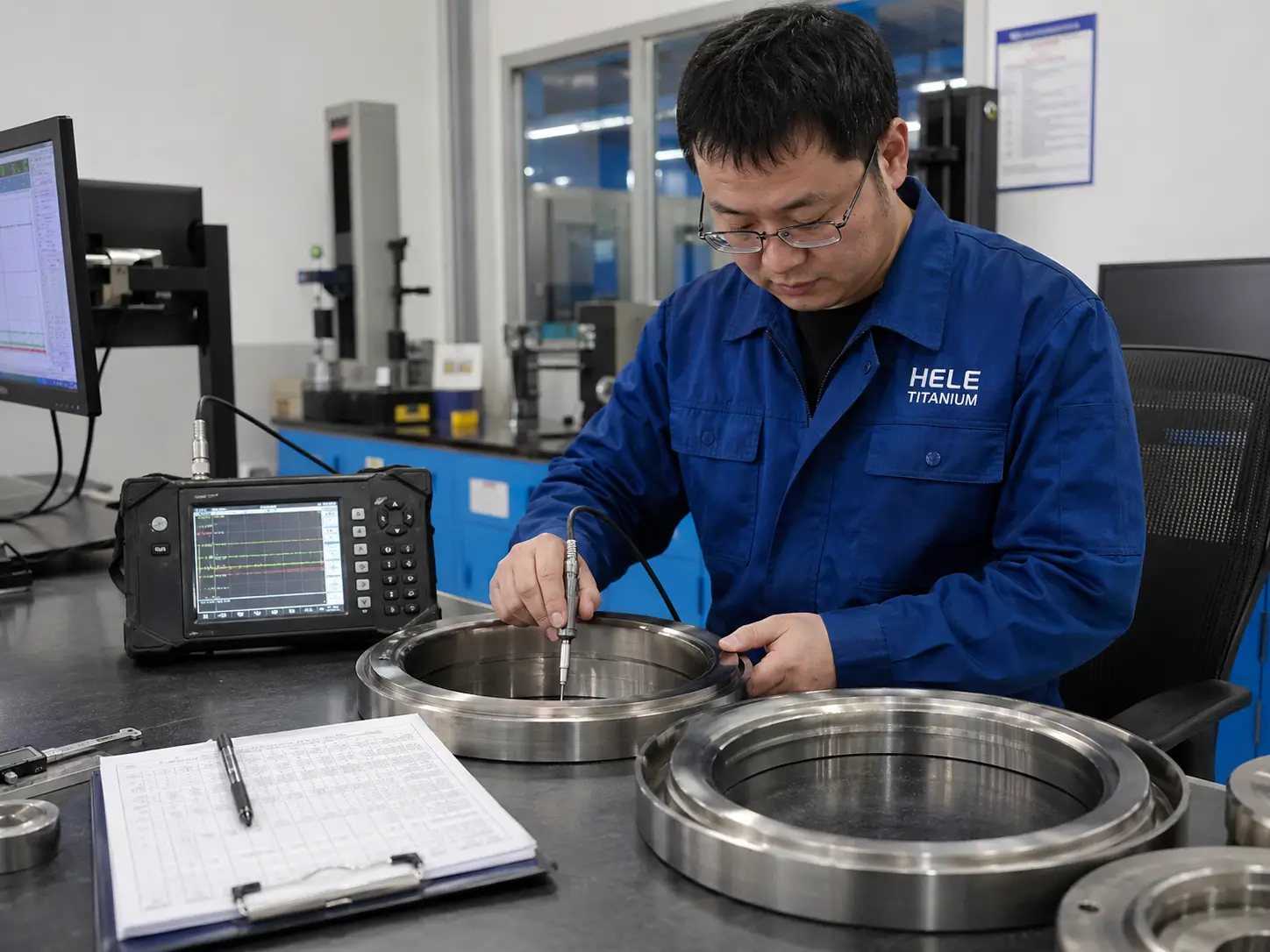
ASTM B381 states that nondestructive requirements such as ultrasonic, X-ray or surface inspection are specified by the purchaser when required. “UT included” or “100% NDE” is incomplete without the procedure and acceptance basis.
| NDE control | What the order should state | Common gap |
|---|---|---|
| Method/procedure | ASTM E2375, customer procedure or another applicable reference and revision | A method name with no controlling document |
| Acceptance | Class/level, reference reflectors, reportable and rejectable limits | “Pass UT” with no class |
| Coverage | Surfaces, directions, zones, exclusions and scan percentage | “100%” with no geometric meaning |
| Stage | As-forged/descaled/proof-machined/rough-machined/final condition | Surface or geometry cannot support the required examination |
| Personnel/report | Qualification, calibration, map/data, part/lot identity and review authority | Generic certificate not linked to the forging |
11. Add Metallurgical Controls Only Where Required
Depending on alloy and project, the order may require macrostructure, microstructure, grain size, alpha case, contamination, hydrogen, hardness, beta-transus information or other controls. State method, sampling location, orientation, acceptance and report; do not assume they are part of every commercial forging order.
A photomicrograph or generic “fine grain” statement is not traceable evidence unless it is linked to the forging lot, sample location, preparation, magnification, method and acceptance criteria.
12. Define Rough Dimensions, Surface and Final-Part Inspection
For the forging, inspect the approved envelope, stock distribution, straightness/flatness, concentricity stock, draft, radii, flash/trim condition, scale removal, laps, folds, cracks and surface condition as applicable. For a finish-machined part, add the full drawing and inspection plan.
- State measuring datums and whether dimensions are before or after heat treatment/straightening.
- Define visual/surface acceptance and permitted blend or repair.
- Confirm cleanup against the final-part model where required.
- Separate forging inspection records from final dimensional reports.
13. Build the Document Index and Change-Control Plan
Create the required release package before quotation: MTC, forging/heat-treatment records, mechanical test report, NDE reports, dimensional report, metallurgical results, deviations, certificate of conformance, packing list and traceability map as applicable.
- Require written approval for material source, forging route, heat treatment, coupon basis, external processor, NDE method or major tooling changes where qualification depends on them.
- Define nonconformance, rework, repair, concession, retest and replacement.
- State document language, electronic format and retention period where needed.
- Do not treat ISO 9001 or AS9100 certification as finished-forging acceptance.
14. Protect the Forging and Its Identity During Delivery
Packaging should prevent impact, corrosion from incompatible contact, thread or datum damage, moisture, loss of identification and mixing of Grades, heats, revisions or inspection status.
- Define lifting/handling points and protection for machined inspection surfaces.
- Preserve stamping, tags or other approved identity.
- Align forging ID, heat/lot, drawing, packing list and document index.
- State export packing, preservation, Incoterm and named place.
15. Normalize Cost and Quotation Scope
Cost can be driven by alloy and starting stock, buy-to-fly ratio, route and reductions, tooling, heating/forging steps, heat treatment, coupons and testing, NDE, proof/rough/finish machining, documentation, quantity, packing and logistics.
- Separate tooling/programming/first-article cost from recurring unit price where useful.
- Compare the same forging envelope, delivery condition and machining scope.
- Record MOQ driver, validity, schedule assumptions and exclusions.
- Make proposed route or test deviations visible beside the requirement.
16. Complete Titanium Forgings Purchase Guard
16.1 Contract and product identity
- List final drawing/model, forging-envelope drawing, specifications and revisions.
- State document precedence and approved deviations.
- Define as-forged, heat-treated, proof-machined, rough-machined or finished delivery.
- Identify final-part and application approval responsibility.
16.2 Grade, starting stock and traceability
- State ASTM B381/project specification, F-Grade, UNS and revision.
- Define starting billet/bar specification and approved source.
- Link heat, starting stock, forging batch, heat treatment and shipment.
- Prohibit substitutions without written approval.
16.3 Forging route and orientation
- State open-die, closed-die, ring-rolled or approved proposed route.
- Define reduction, orientation or flow-direction requirements where critical.
- Control draft, radii, parting/flash and section transitions.
- Require approval for material-route or major process changes.
16.4 Envelope and allowance
- Define rough dimensions and stock by surface.
- Include scale removal, heat-treatment distortion and NDE preparation.
- Reserve machining datums and test-coupon removal areas.
- Assign cleanup and final-wall responsibility.
16.5 Heat treatment and straightening
- State condition, specification, lot definition and records.
- Define coupon linkage and permitted straightening.
- Control reheat treatment and retest.
- Identify approved external processors where required.
16.6 Coupons and mechanical tests
- State location, orientation, status and removal stage.
- Define test methods, specimen direction, frequency and acceptance.
- Link results to forging and heat-treatment lots.
- Set retest, replacement and sample-retention rules.
16.7 NDE and metallurgical evidence
- State method, procedure/revision, class, coverage, stage and report.
- Define personnel qualification and calibration requirements.
- Add macro/micro, grain, alpha-case or chemistry controls only when required.
- Reject generic reports not linked to the delivered forging.
16.8 Dimensional, surface and machining control
- Define forging datums, envelope inspection and surface acceptance.
- State proof-, rough- and finish-machining boundaries.
- Control repair, blending and concession.
- Separate forging and final-part inspection reports.
16.9 Documents and commercial basis
- Agree the document index before quotation.
- Normalize quantity, currency, Incoterm, named place and required date.
- Separate tooling, testing, NDE, machining, documents and freight.
- Record validity, MOQ, schedule assumptions and exceptions.
16.10 Packing and delivery
- Protect datums, inspection surfaces and identity.
- Prevent mixing of Grade, heat, revision or inspection status.
- Align labels, packing list and document package.
- Define preservation, handling, export packing and claim evidence.
Red flags before purchase order
The order does not identify B381 F-Grade, revision or customer additions.
No orientation, process record, macrostructure or test direction supports the claim.
Procedure, coverage, geometry, stage, calibration and limits are missing.
Machining stock, scale removal, coupons and NDE surfaces are not defined.
Decision gate
Do not release the order until product boundary, specification, F-Grade, starting stock, envelope, route, heat treatment, coupons, tests, NDE, machining, traceability, packing and commercial terms describe one verifiable deliverable.
17. RFQ and Pre-Order Checklist
Final drawing/model, forging envelope, delivery stage, revision and precedence.
Specification/revision, F-Grade/UNS, starting stock, heat/lot and source.
Forging route, orientation, rough dimensions, allowance, datums and coupons.
Heat treatment, mechanical tests, specimen direction and metallurgical controls.
Method, class, coverage, stage, reports, dimensions and document index.
Quantity, tooling, machining, MOQ basis, packing, Incoterm and required date.
18. Titanium Forgings Purchasing FAQ
Should the RFQ use Grade 5 or F-5?
When ASTM B381 controls the forging, use its forging-grade designation and required revision, such as F-5 where applicable, together with UNS or customer specification when needed. Do not copy a bar, sheet or generic material label into a forging order without review.
What should a forging-envelope drawing contain?
Include rough dimensions, datum or orientation references, machining allowance, draft, radii, parting line or flow-direction requirements where applicable, test prolongations/coupons, removal areas, surface condition and inspection stage.
When should ultrasonic testing be performed?
The order should define the applicable practice or customer procedure, acceptance class, scan coverage, surface condition, geometry, calibration, timing before or after machining, reporting and disposition of indications.
Does a material test report prove the final machined part is acceptable?
No. It supports the material and forging lot within its scope. Final-part conformity requires the controlled drawing, machining and special-process evidence, dimensional inspection and any required final NDE or functional tests.
How should test coupons be controlled?
State location and orientation, integral or separate status, heat-treatment linkage, specimen direction, test methods, frequency, retention and rules for retest or replacement.
How should two titanium forging quotations be compared?
Normalize specification/revision, F-Grade/UNS, starting stock, forging route and envelope, heat treatment, allowance, test coupons, mechanical tests, NDE, machining scope, documents, quantity, packing, Incoterm, schedule assumptions and exceptions.