
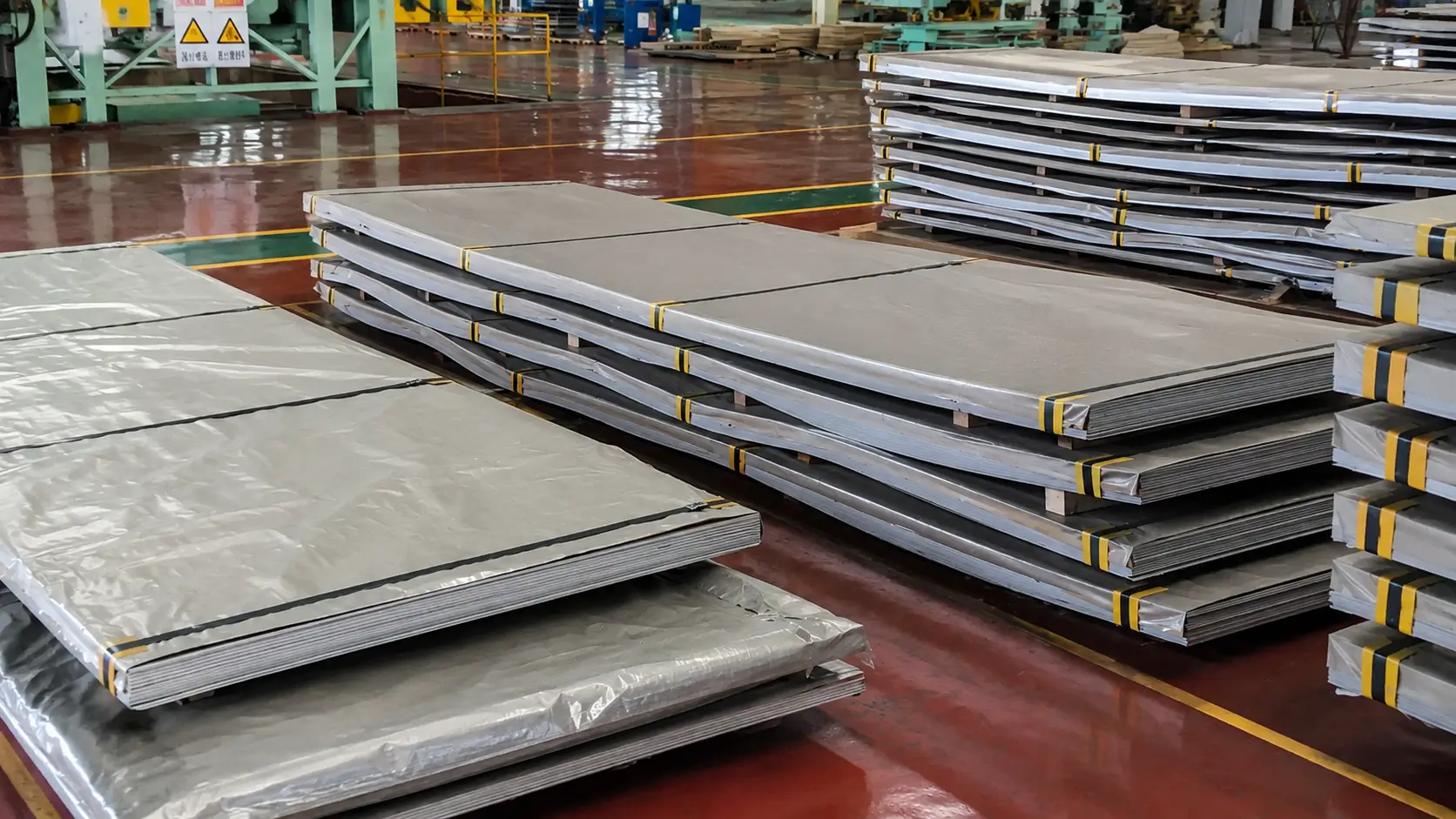
Two offers for “Grade 5 titanium plate” can describe different purchases. One may be a full plate with a mill certificate; another a cut blank with machining allowance, edge condition and dimensional inspection included.
Neither offer is automatically better. What matters is whether the delivered form fits your next operation, the material documents match your drawing, and the supplier has priced the same work.
The short answer: specify the delivered form, the exact grade and governing specification, the required condition and usable dimensions, then the records you will need to release the material.
1. Are you buying sheet, plate or a cut blank?
A sheet or plate purchase is often about stock size and material identity. A cut blank adds a conversion step: the supplier has to account for kerf, edge quality, nest yield and enough allowance for your machining or forming route. If the drawing calls for a finished part, a cut blank is only an intermediate product; it should not inherit finished-part tolerances by implication.
| Delivered form | Best when | Common quotation gap |
|---|---|---|
| Full sheet or plate | You can use or nest the remaining material yourself. | Nominal dimensions are quoted, but flatness, surface or handling condition is left open. |
| Cut-to-size blank | You want less internal cutting and a defined machining envelope. | Cut size is mistaken for final part size; edge cleanup and material allowance are not included. |
| Machined component | You need a part ready for assembly or inspection. | Material supply is priced without the drawing's machining, finish and acceptance scope. |
For an RFQ, say where the material stops: as-rolled/as-supplied sheet or plate, a cut blank, or a finished component. That one sentence can remove a surprising amount of ambiguity from a quote.
Choose the form around your next operation
If your workshop can nest several parts from one plate and use or resell the remainder, a full plate may be the sensible purchase. If the parts are dispersed across several jobs, delivered blanks can reduce handling, storage and cutting work. A cut blank can also simplify the job when the parent plate is difficult to fit into the buyer's equipment. None of these advantages is universal: the right choice depends on quantity, part shape, internal cutting capacity and ownership of offcuts.
Forming and machining lead to different starting-stock questions. A formed component may be sensitive to rolling direction, surface condition and the blank's edge quality. A machined component needs stock for clamping, facing and final dimensions. If both suppliers receive the same finished-part drawing but one assumes a formed blank and the other a machining blank, their material quantities and processes will diverge before either begins work.
2. Which grade and specification belong on the order?
Choose grade for the service and the part design, but order it under the specification and condition the project actually requires. Grade names alone do not tell a supplier which chemistry, mechanical tests, heat treatment, tolerances or certification route must be met. If a customer drawing names a standard revision, repeat it in the purchase order.
| Material route | How to describe it | Important boundary |
|---|---|---|
| Commercially pure titanium, such as Grade 2 | State Grade 2, the required sheet/plate specification, condition and dimensions. | Do not substitute a stronger alloy because the name “titanium” appears on both offers. |
| Ti-6Al-4V, Grade 5 | State Grade 5 and the governing material specification; ASTM B265 is one possible sheet/plate route. | Aerospace material requirements, when specified, require their own review; do not assume B265 and AMS 4911 are automatically equivalent. |
| Grade 7 or Grade 12 for a specified corrosion-service design | Name the exact grade and standard, and provide the actual medium and temperature for material review. | Neither grade is universally corrosion-proof; suitability depends on service conditions. |
| Grade 23 under ASTM B265 | Use Grade 23 / UNS R56407 when that is the drawing's specified sheet/plate route. | Do not equate this designation with the material in ASTM F136 merely because both are called ELI titanium alloy. |
| Implant-material request under ASTM F136 | Use the specified ASTM F136 / UNS R56401 route and have the drawing and regulatory requirements reviewed separately. | A raw-material certificate is not a medical-device approval, and F136 is not a drop-in citation for B265 Grade 23 / R56407. |
HELE's titanium plate product range is a starting point for discussing form and processing. The exact grade, material source, condition and documented compliance should be confirmed on the quotation rather than assumed from a product-family page.
Grade choice is an application decision, not a price ladder
Grade 2 and Grade 5 solve different design problems; one is not a simple “premium” version of the other. The strength requirement, forming route, corrosion environment, temperature and joining method can matter as much as the base-metal price. For corrosion-service grades, describe the real medium and exposure rather than ordering by a generic “marine” label. Where the customer's design already specifies a grade, ask whether alternates are permitted before pricing them. A supplier cannot approve a material substitution on behalf of the design authority.
Keep material standards and end-product approvals separate
A standard tells the mill and supplier which material requirements must be met for the ordered form and condition. It does not automatically qualify the finished component for aerospace or medical use. SAE AMS4911T addresses annealed 6Al-4V sheet, strip and plate; ASTM B265 is a different specification route. A project requiring both needs a heat-specific comparison of requirements and records, not a statement that the titles look alike. Medical material requests also need the intended regulatory and manufacturing context; an ASTM F136 certificate is not approval of a finished implant.
3. Which dimensions are actually usable?
Give nominal thickness, width and length, but also the minimum material envelope your downstream operation needs. A plate that meets nominal size may still be unusable if the flatness, surface condition, cut edge or available machining stock is wrong for your fixture. If a blank will be milled on both faces, state the minimum finished thickness and the stock you expect to remove, instead of asking for a blanket “oversize” without a target.
- Thickness and flatness: identify the controlling standard or agreed measurement method, sampling positions and whether the requirement applies before or after cutting.
- Cut size and edge: distinguish saw, waterjet or another agreed process from a finished machined edge. Record whether burr removal and edge cleanup are included.
- Surface: call out handling marks, scale removal, surface finish or protective packaging where they affect forming, bonding, coating or appearance.
- Orientation: if rolling direction or grain orientation matters to the design, show it on the drawing and in the cutting plan.
Do not carry a finished-part tolerance backward onto mill plate by accident. Separate the mill's material tolerance, the blank-cutting tolerance and any machining tolerance on the final component.
Ask when and where flatness will be checked
Flatness is not a single number without a state and method. A large plate can be checked before cutting; a smaller blank can move after material is removed or stresses are released. If the final process clamps the blank flat, the buyer may care more about recoverable condition and available machining stock than an unconstrained blank reading. For a part that must remain flat without restraint, the acceptance method is different. State the condition, support method, measurement locations and whether any flattening or stress-relief operation is included.
Cutting and edge condition affect the usable envelope
Sawing, waterjet and other cutting methods leave different edge conditions and allowances. Waterjet can avoid a conventional thermal heat-affected zone, but its cut edge may still need taper or surface cleanup for a precision fit. A saw cut can be suitable when the buyer will machine the edges. The quotation should say which method is proposed, whether the dimensions are measured before or after deburring, and whether the part orientation is fixed on the parent plate. A “cut to size” line with no edge definition is not enough for a tight downstream fixture.
If the finished part will be machined, specify the minimum stock that must remain after cutting and any local features that need extra allowance. That is more reliable than applying the same excess size to every side. Surface-sensitive jobs should also state whether scale, scratches, pick-up or packaging contact are acceptable; cosmetic requirements cannot be inferred from a material grade.
4. What evidence should arrive with the material?
The material test certificate (MTC) should connect the delivered item to its heat or lot and the ordered specification. A cut blank also needs an identification method that survives cutting, packaging and receipt. If dimensional or surface inspection is important, define the report and sampling before the order—not after the material arrives.
| Record | Decision it helps you make | What to ask HELE to confirm |
|---|---|---|
| Material test certificate | Does the identified heat meet the ordered material specification? | Certificate type, heat/lot link, named standard and revision. |
| Cutting and identification record | Can each blank be traced back to its parent material? | Marking or labeling method and whether it is included. |
| Dimensional or surface report | Does the delivered form meet agreed acceptance points? | Measurement method, sample quantity, report format and any third-party requirement. |
HELE handles titanium materials and custom fabrication inquiries. For a specific plate order, ask the team to identify the material source and which cutting, finishing and inspection steps are performed within HELE's scope or by another named party. Do not infer a mill-ownership claim from a titanium product listing.
Follow the identity from parent plate to each blank
When a parent plate becomes several blanks, the heat identity has to follow every delivered piece or its packaging. Ask how the lot is recorded before cutting, how pieces are marked or labeled, and how the shipping list ties those pieces to the MTC. That trail matters if a buyer later needs to isolate a nonconforming blank or demonstrate material identity after several operations. A certificate in the shipment is of limited use if no one can connect it to the individual material.
Choose inspection by what could fail downstream
For a mill-form purchase, the material certificate and agreed size checks may be the central records. For blanks entering precision machining, additional checks may include thickness distribution, cut dimensions, flatness or surface condition. Third-party witnessing or a specific report format should be requested when the project needs it. Ask whether the report covers every piece, a sample or only the parent plate; those scopes have different cost and evidential value.
At receipt, the buyer can compare labels, quantity, material certificates and dimensions before the material is mixed with other stock. Any discrepancy is easier to resolve while the original packaging and identification remain intact. This receipt step is particularly important when multiple grades or heats arrive in one order.
5. Why can similar-looking plate quotes differ?
Grade and specification affect the eligible material source. Size and quantity affect yield from the parent plate. Cutting can add setup, kerf loss and edge cleanup; inspection and documentation can add a separate work package. For a high-value alloy, the amount of metal you buy but cannot use may matter as much as the cutting charge.
A practical comparison is to ask each supplier to show the delivered form, parent material basis, quantity, cutting method, usable size, included records, packaging and any exceptions. If one supplier quotes a full plate while another quotes net-shape blanks, their unit prices answer different questions. Request a like-for-like alternative where both routes are feasible.
Useful RFQ choice: quote both a full plate and cut blanks only if your own cutting and scrap recovery make that comparison meaningful. Tell the supplier whether offcuts should be returned, credited or treated as supplier scrap.
Availability, minimum order and lead time are order-specific. Ask HELE to confirm them for the requested grade, standard, condition, dimensions, quantity and processing route; they are not universal properties of “titanium plate.”
Understand the material-utilization part of the quote
A blank's selling price may include metal that becomes kerf, trim or unusable offcut. The key question is not only the net weight of the finished blank but how efficiently the required shapes fit the available parent material. Quantity can improve nesting, but a change in grade, thickness or rolling direction may require a different parent plate and reset that advantage. Ask a supplier to identify whether the quotation is based on supplied weight, net blank weight or the parent material consumed.
Where the buyer can use offcuts, agree who owns them before ordering. Return, credit or supplier retention lead to different economic comparisons. A cheaper per-kilogram full-plate quote can still cost more per usable component if much of the plate cannot enter the buyer's process.
Where lead time really comes from
Lead time can include material sourcing, condition or documentation review, cutting, inspection, export packing and freight. A source that can provide the grade quickly may not have the exact condition or plate size required by the drawing. Ask HELE to state whether the offer is based on identified stock, a mill order or another approved supply route, and from which milestone the quoted lead time starts. That makes schedule comparisons more meaningful than a single unqualified “delivery in X weeks” statement.
6. What should go into the RFQ?
- Application, part drawing or intended next process, and whether you need full sheet/plate, cut blank or finished part.
- Grade, UNS if specified, governing material standard and revision, required condition and any customer-specific clause.
- Thickness, width, length or blank drawing; quantity; flatness, edge, surface and machining allowance where critical.
- Heat/lot traceability, MTC, inspection report and marking/packaging requirements.
- Delivery location and timing, plus whether an alternate material or cut plan may be quoted.
Questions buyers often ask
Can a cut blank be accepted against a finished-part drawing?
Only if the order clearly defines it as an intermediate blank and separately states the blank dimensions, allowances and inspection. A cut edge is not automatically a finished machined surface.
Is ASTM B265 Grade 23 the same designation as ASTM F136 material?
No. The cited ASTM catalog entries use different UNS designations: R56407 for B265 Grade 23 and R56401 for F136. Any proposed dual compliance needs a documented, project-specific review.
Does an MTC prove the cut blank meets the drawing?
It addresses the identified material's stated standard. Blank dimensions, flatness, edge and surface need their own acceptance basis if they matter to your downstream process.